

Mapping of A. squamatus occurrence was predominantly used to estimate its
distribution, not its habitat preference. However, it was obvious that this species
favours disturbed ruderalised habitats, including ruderalised grasslands with slight
to moderate elevations in salinity level.
Results show high reproductive potential and low soil C:N ratio.
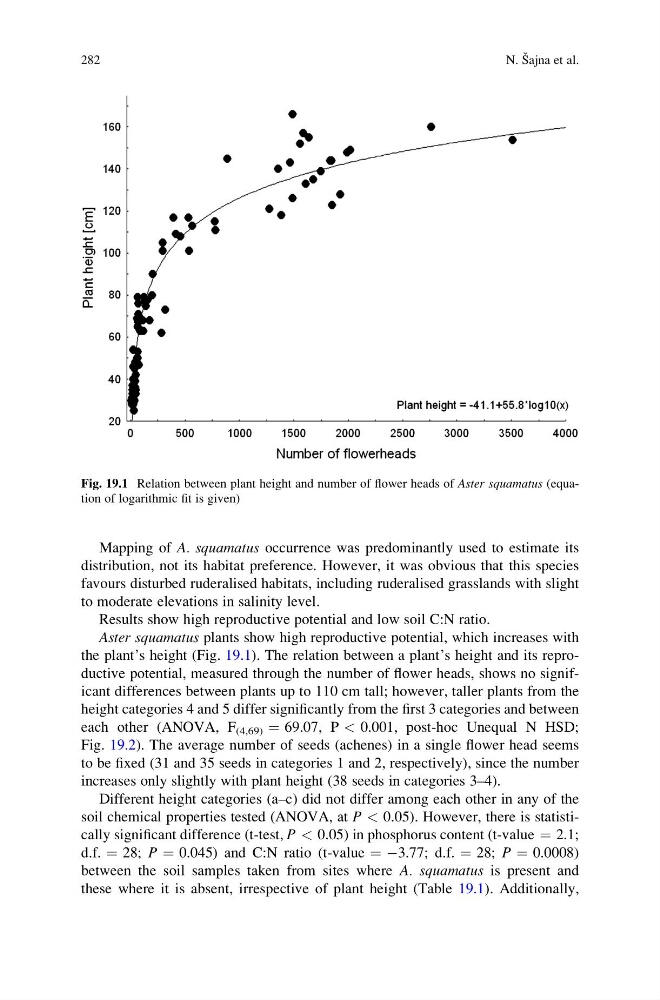
Aster squamatus plants show high reproductive potential, which increases with
the plant’s height (Fig. 19.1). The relation between a plant’s height and its reproductive potential, measured through the number of flower heads, shows no significant differences between plants up to 110 cm tall; however, taller plants from the
height categories 4 and 5 differ significantly from the first 3 categories and between
each other (ANOVA, F (4,69) ¼ 69.07, P < 0.001, post-hoc Unequal N HSD;
Fig. 19.2). The average number of seeds (achenes) in a single flower head seems
to be fixed (31 and 35 seeds in categories 1 and 2, respectively), since the number
increases only slightly with plant height (38 seeds in categories 3–4).
Different height categories (a–c) did not differ among each other in any of the
soil chemical properties tested (ANOVA, at P < 0.05). However, there is statistically significant difference (t-test, P < 0.05) in phosphorus content (t-value ¼ 2.1;
d.f. ¼ 28; P ¼ 0.045) and C:N ratio (t-value ¼ À3.77; d.f. ¼ 28; P ¼ 0.0008)
between the soil samples taken from sites where A. squamatus is present and
these where it is absent, irrespective of plant height (Table 19.1). Additionally,
Fig. 19.1 Relation between plant height and number of flower heads of Aster squamatus (equation of logarithmic fit is given)
282
N. S ˇ ajna et al.
distribution, not its habitat preference. However, it was obvious that this species
favours disturbed ruderalised habitats, including ruderalised grasslands with slight
to moderate elevations in salinity level.
Results show high reproductive potential and low soil C:N ratio.
Aster squamatus plants show high reproductive potential, which increases with
the plant’s height (Fig. 19.1). The relation between a plant’s height and its reproductive potential, measured through the number of flower heads, shows no significant differences between plants up to 110 cm tall; however, taller plants from the
height categories 4 and 5 differ significantly from the first 3 categories and between
each other (ANOVA, F (4,69) ¼ 69.07, P < 0.001, post-hoc Unequal N HSD;
Fig. 19.2). The average number of seeds (achenes) in a single flower head seems
to be fixed (31 and 35 seeds in categories 1 and 2, respectively), since the number
increases only slightly with plant height (38 seeds in categories 3–4).
Different height categories (a–c) did not differ among each other in any of the
soil chemical properties tested (ANOVA, at P < 0.05). However, there is statistically significant difference (t-test, P < 0.05) in phosphorus content (t-value ¼ 2.1;
d.f. ¼ 28; P ¼ 0.045) and C:N ratio (t-value ¼ À3.77; d.f. ¼ 28; P ¼ 0.0008)
between the soil samples taken from sites where A. squamatus is present and
these where it is absent, irrespective of plant height (Table 19.1). Additionally,
Fig. 19.1 Relation between plant height and number of flower heads of Aster squamatus (equation of logarithmic fit is given)
282
N. S ˇ ajna et al.