

But the species’ abundance and dimensions vary from area to area. Generally, the
alien species have a preference for gleisoil 68 %, alluvial soils 11 %, and shifting sand
hills 8 %; they also require a poor and moderate-drained soil (Munteanu and
Curelariu 1996), but they are able to grow on poor soils and withstand the floods in
DDBR. Although their development needs well-drained soils, they can resist in
drought conditions (Gregory and James 2003). Gleditsia triacanthos can also tolerate
strong winds but is unable to adapt to the coast area even under optimum conditions
(Ailanthus altissima, Amorpha fruticosa, Fraxinus pennsylvanica) because of the
winds from the sea. The exceptions are Elaeagnus angustifolia and Lycium barbarum
as they do not require a soil with a specific pH to develop (Doroftei et al. 2005).
They have a higher abundance and resistance in fluvial (western part) than in
fluvial-maritime (eastern part) delta areas; the difference between these sectors
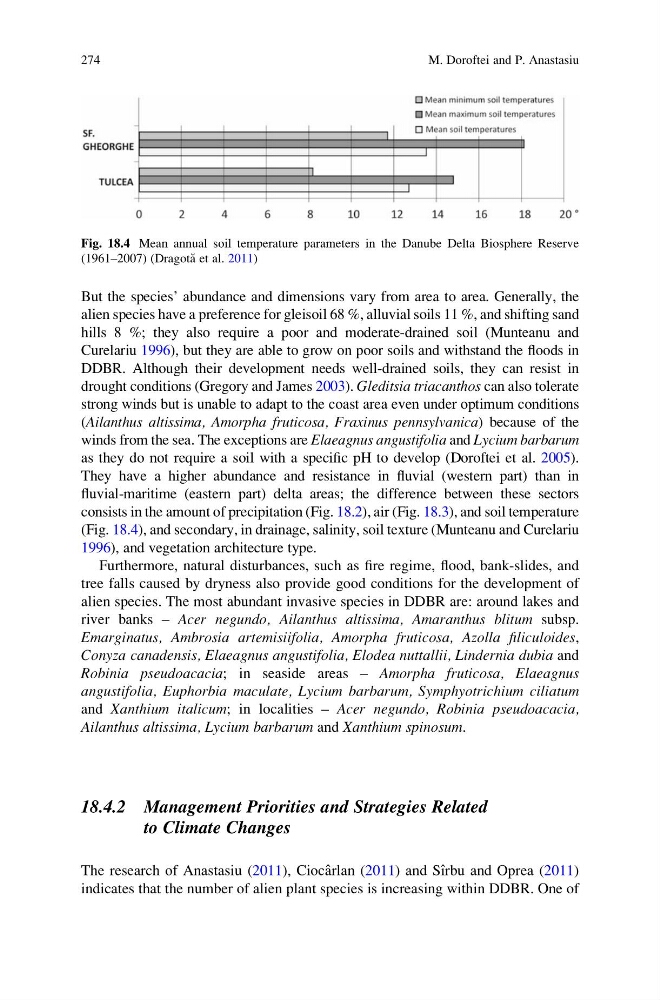
consists in the amount of precipitation (Fig. 18.2), air (Fig. 18.3), and soil temperature
(Fig. 18.4), and secondary, in drainage, salinity, soil texture (Munteanu and Curelariu
1996), and vegetation architecture type.
Furthermore, natural disturbances, such as fire regime, flood, bank-slides, and
tree falls caused by dryness also provide good conditions for the development of
alien species. The most abundant invasive species in DDBR are: around lakes and
river banks – Acer negundo, Ailanthus altissima, Amaranthus blitum subsp.
Emarginatus, Ambrosia artemisiifolia, Amorpha fruticosa, Azolla filiculoides,
Conyza canadensis, Elaeagnus angustifolia, Elodea nuttallii, Lindernia dubia and
Robinia pseudoacacia; in seaside areas – Amorpha fruticosa, Elaeagnus
angustifolia, Euphorbia maculate, Lycium barbarum, Symphyotrichium ciliatum
and Xanthium italicum; in localities – Acer negundo, Robinia pseudoacacia,
Ailanthus altissima, Lycium barbarum and Xanthium spinosum.
18.4.2 Management Priorities and Strategies Related
to Climate Changes
The research of Anastasiu (2011), Cioca ˆrlan (2011) and Sı ˆrbu and Oprea (2011)
indicates that the number of alien plant species is increasing within DDBR. One of
Fig. 18.4 Mean annual soil temperature parameters in the Danube Delta Biosphere Reserve
(1961–2007) (Dragota ˘ et al. 2011)
274
M. Doroftei and P. Anastasiu
alien species have a preference for gleisoil 68 %, alluvial soils 11 %, and shifting sand
hills 8 %; they also require a poor and moderate-drained soil (Munteanu and
Curelariu 1996), but they are able to grow on poor soils and withstand the floods in
DDBR. Although their development needs well-drained soils, they can resist in
drought conditions (Gregory and James 2003). Gleditsia triacanthos can also tolerate
strong winds but is unable to adapt to the coast area even under optimum conditions
(Ailanthus altissima, Amorpha fruticosa, Fraxinus pennsylvanica) because of the
winds from the sea. The exceptions are Elaeagnus angustifolia and Lycium barbarum
as they do not require a soil with a specific pH to develop (Doroftei et al. 2005).
They have a higher abundance and resistance in fluvial (western part) than in
fluvial-maritime (eastern part) delta areas; the difference between these sectors
consists in the amount of precipitation (Fig. 18.2), air (Fig. 18.3), and soil temperature
(Fig. 18.4), and secondary, in drainage, salinity, soil texture (Munteanu and Curelariu
1996), and vegetation architecture type.
Furthermore, natural disturbances, such as fire regime, flood, bank-slides, and
tree falls caused by dryness also provide good conditions for the development of
alien species. The most abundant invasive species in DDBR are: around lakes and
river banks – Acer negundo, Ailanthus altissima, Amaranthus blitum subsp.
Emarginatus, Ambrosia artemisiifolia, Amorpha fruticosa, Azolla filiculoides,
Conyza canadensis, Elaeagnus angustifolia, Elodea nuttallii, Lindernia dubia and
Robinia pseudoacacia; in seaside areas – Amorpha fruticosa, Elaeagnus
angustifolia, Euphorbia maculate, Lycium barbarum, Symphyotrichium ciliatum
and Xanthium italicum; in localities – Acer negundo, Robinia pseudoacacia,
Ailanthus altissima, Lycium barbarum and Xanthium spinosum.
18.4.2 Management Priorities and Strategies Related
to Climate Changes
The research of Anastasiu (2011), Cioca ˆrlan (2011) and Sı ˆrbu and Oprea (2011)
indicates that the number of alien plant species is increasing within DDBR. One of
Fig. 18.4 Mean annual soil temperature parameters in the Danube Delta Biosphere Reserve
(1961–2007) (Dragota ˘ et al. 2011)
274
M. Doroftei and P. Anastasiu