

26 % of its alpine grasslands (Pus ¸caru et al. 1956) and are the most widespread type
of habitat in the alpine area (Administrat ¸ia Parcului Natural Bucegi 2011) was used
as an example.
Bucegi Natural Park (32,497.6 ha) is located on the South-Eastern extremity of
the Romanian Carpathians, lying between 800 and 2,507 m in altitude
(Administrat ¸ia Parcului Natural Bucegi 2011), its normal climate is cold and
humid, with temperatures well below zero during winter, long periods of snow
and frost, violent winds especially on peaks, frequent fog especially in the alpine
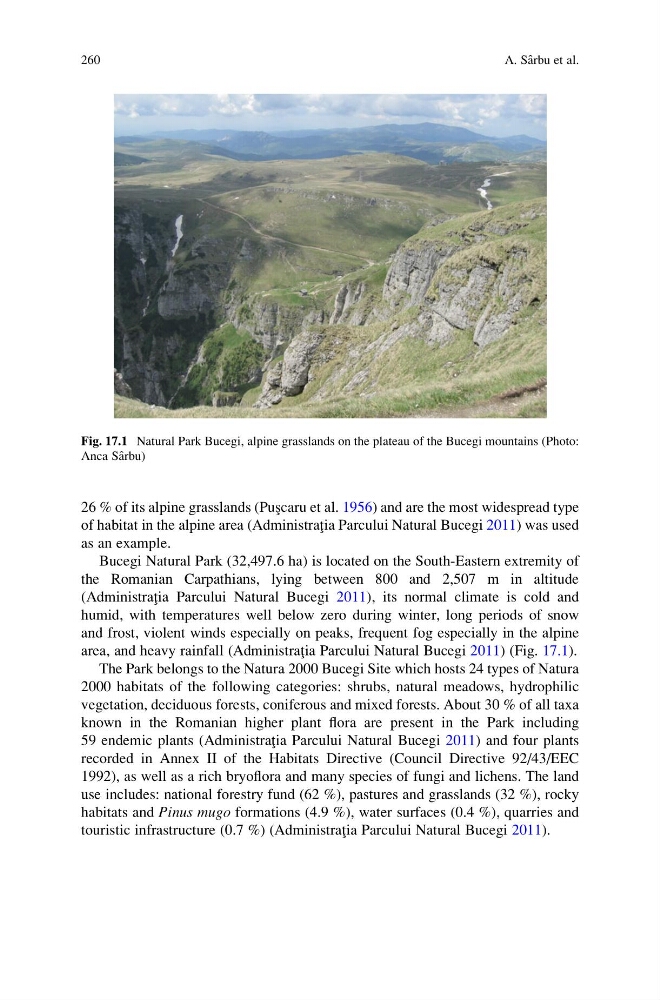
area, and heavy rainfall (Administrat ¸ia Parcului Natural Bucegi 2011) (Fig. 17.1).
The Park belongs to the Natura 2000 Bucegi Site which hosts 24 types of Natura
2000 habitats of the following categories: shrubs, natural meadows, hydrophilic
vegetation, deciduous forests, coniferous and mixed forests. About 30 % of all taxa
known in the Romanian higher plant flora are present in the Park including
59 endemic plants (Administrat ¸ia Parcului Natural Bucegi 2011) and four plants
recorded in Annex II of the Habitats Directive (Council Directive 92/43/EEC
1992), as well as a rich bryoflora and many species of fungi and lichens. The land
use includes: national forestry fund (62 %), pastures and grasslands (32 %), rocky
habitats and Pinus mugo formations (4.9 %), water surfaces (0.4 %), quarries and
touristic infrastructure (0.7 %) (Administrat ¸ia Parcului Natural Bucegi 2011).
Fig. 17.1 Natural Park Bucegi, alpine grasslands on the plateau of the Bucegi mountains (Photo:
Anca Sa ˆrbu)
260
A. Sa ˆrbu et al.
of habitat in the alpine area (Administrat ¸ia Parcului Natural Bucegi 2011) was used
as an example.
Bucegi Natural Park (32,497.6 ha) is located on the South-Eastern extremity of
the Romanian Carpathians, lying between 800 and 2,507 m in altitude
(Administrat ¸ia Parcului Natural Bucegi 2011), its normal climate is cold and
humid, with temperatures well below zero during winter, long periods of snow
and frost, violent winds especially on peaks, frequent fog especially in the alpine
area, and heavy rainfall (Administrat ¸ia Parcului Natural Bucegi 2011) (Fig. 17.1).
The Park belongs to the Natura 2000 Bucegi Site which hosts 24 types of Natura
2000 habitats of the following categories: shrubs, natural meadows, hydrophilic
vegetation, deciduous forests, coniferous and mixed forests. About 30 % of all taxa
known in the Romanian higher plant flora are present in the Park including
59 endemic plants (Administrat ¸ia Parcului Natural Bucegi 2011) and four plants
recorded in Annex II of the Habitats Directive (Council Directive 92/43/EEC
1992), as well as a rich bryoflora and many species of fungi and lichens. The land
use includes: national forestry fund (62 %), pastures and grasslands (32 %), rocky
habitats and Pinus mugo formations (4.9 %), water surfaces (0.4 %), quarries and
touristic infrastructure (0.7 %) (Administrat ¸ia Parcului Natural Bucegi 2011).
Fig. 17.1 Natural Park Bucegi, alpine grasslands on the plateau of the Bucegi mountains (Photo:
Anca Sa ˆrbu)
260
A. Sa ˆrbu et al.