

2. To investigate the population densities in TNP with standardised counting of
displaying and calling: May-June.
3. To estimate breeding success by field observations of females with chicks and
nest records and with help of radio-transmitters (Wilson and Martin 2008): July.
4. To describe habitat requirements of the species by vegetation sampling, remote
sensing techniques and environmental parameters: June-August.
5. To identify the link between climatic factors, influencing on species population
dynamics (Meteorological station).
6. To determine major impacts on the species population with help of monitoring
human impacts and environmental conditions: all year.
7. To identify ecological relationships between rock ptarmigan and other species:
all year.
8. To develop a model of potential species distribution with considering changing
in climate: combining results from long-term surveys and mathematical modelling. With population viability analysis (PVA) the different management scenarios and assessment of the potential impacts of habitat loss will be evaluated.
In the models and analysis the whole alpine rock ptarmigan population will be
included.
The method is recapped from Bossert (1977, 1995). The study area is divided
into sections that are separated by topographic structures (ridges, mountain passes).
In study plots numbers of simultaneously calling males are determined by a team of
stationary observers that will cover the whole sampling area. Observation points
within potential ptarmigan habitats were selected in the field according to good
visibility and audibility. Sampling proceeds between the end of May and the
beginning of July during early morning hours from 3:00 to 7:00 (8:00) CTE.
Individual observations of the species seeing or callings, together with observation
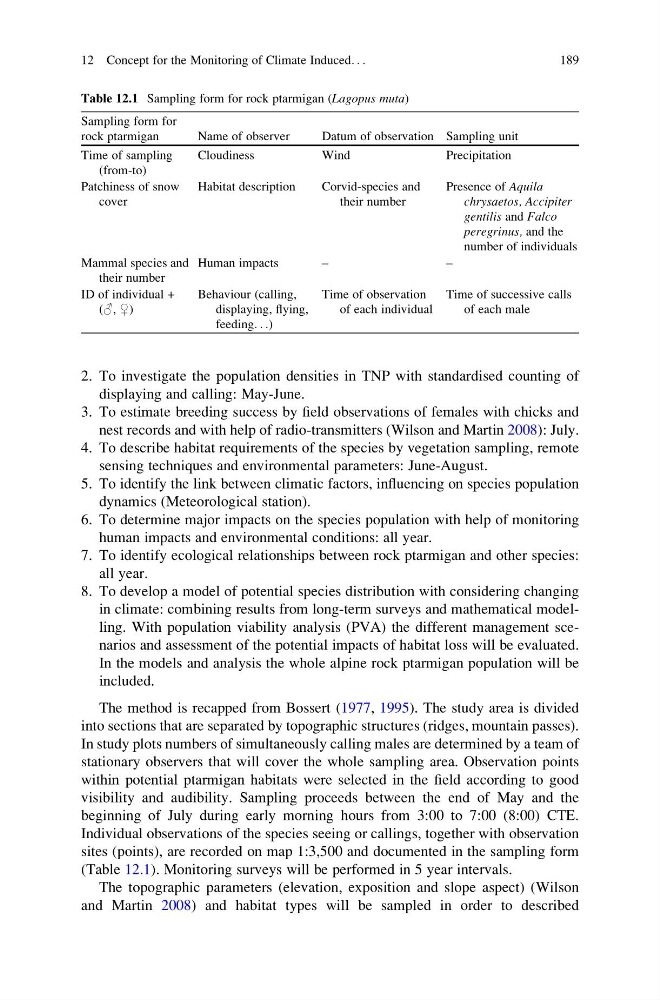
sites (points), are recorded on map 1:3,500 and documented in the sampling form
(Table 12.1). Monitoring surveys will be performed in 5 year intervals.
The topographic parameters (elevation, exposition and slope aspect) (Wilson
and Martin 2008) and habitat types will be sampled in order to described
Table 12.1 Sampling form for rock ptarmigan (Lagopus muta)
Sampling form for
rock ptarmigan
Name of observer
Datum of observation Sampling unit
Time of sampling
(from-to)
Cloudiness
Wind
Precipitation
Patchiness of snow
cover
Habitat description
Corvid-species and
their number
Presence of Aquila
chrysaetos, Accipiter
gentilis and Falco
peregrinus, and the
number of individuals
Mammal species and
their number
Human impacts
–
–
ID of individual +
(♂, ♀)
Behaviour (calling,
displaying, flying,
feeding. . .)
Time of observation
of each individual
Time of successive calls
of each male
12 Concept for the Monitoring of Climate Induced. . .
189
displaying and calling: May-June.
3. To estimate breeding success by field observations of females with chicks and
nest records and with help of radio-transmitters (Wilson and Martin 2008): July.
4. To describe habitat requirements of the species by vegetation sampling, remote
sensing techniques and environmental parameters: June-August.
5. To identify the link between climatic factors, influencing on species population
dynamics (Meteorological station).
6. To determine major impacts on the species population with help of monitoring
human impacts and environmental conditions: all year.
7. To identify ecological relationships between rock ptarmigan and other species:
all year.
8. To develop a model of potential species distribution with considering changing
in climate: combining results from long-term surveys and mathematical modelling. With population viability analysis (PVA) the different management scenarios and assessment of the potential impacts of habitat loss will be evaluated.
In the models and analysis the whole alpine rock ptarmigan population will be
included.
The method is recapped from Bossert (1977, 1995). The study area is divided
into sections that are separated by topographic structures (ridges, mountain passes).
In study plots numbers of simultaneously calling males are determined by a team of
stationary observers that will cover the whole sampling area. Observation points
within potential ptarmigan habitats were selected in the field according to good
visibility and audibility. Sampling proceeds between the end of May and the
beginning of July during early morning hours from 3:00 to 7:00 (8:00) CTE.
Individual observations of the species seeing or callings, together with observation
sites (points), are recorded on map 1:3,500 and documented in the sampling form
(Table 12.1). Monitoring surveys will be performed in 5 year intervals.
The topographic parameters (elevation, exposition and slope aspect) (Wilson
and Martin 2008) and habitat types will be sampled in order to described
Table 12.1 Sampling form for rock ptarmigan (Lagopus muta)
Sampling form for
rock ptarmigan
Name of observer
Datum of observation Sampling unit
Time of sampling
(from-to)
Cloudiness
Wind
Precipitation
Patchiness of snow
cover
Habitat description
Corvid-species and
their number
Presence of Aquila
chrysaetos, Accipiter
gentilis and Falco
peregrinus, and the
number of individuals
Mammal species and
their number
Human impacts
–
–
ID of individual +
(♂, ♀)
Behaviour (calling,
displaying, flying,
feeding. . .)
Time of observation
of each individual
Time of successive calls
of each male
12 Concept for the Monitoring of Climate Induced. . .
189