

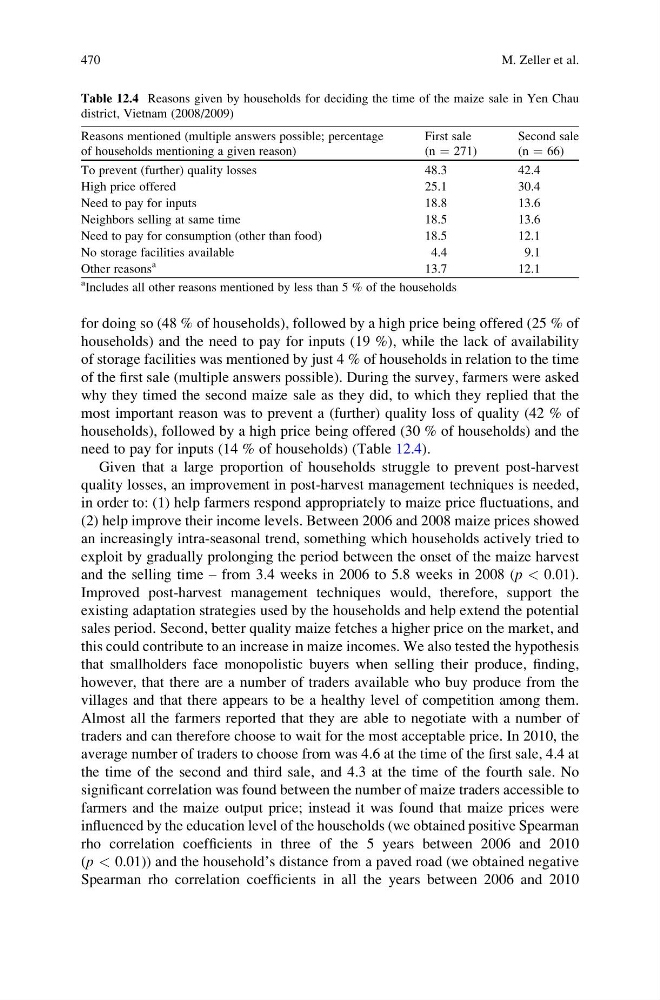
for doing so (48 % of households), followed by a high price being offered (25 % of
households) and the need to pay for inputs (19 %), while the lack of availability
of storage facilities was mentioned by just 4 % of households in relation to the time
of the first sale (multiple answers possible). During the survey, farmers were asked
why they timed the second maize sale as they did, to which they replied that the
most important reason was to prevent a (further) quality loss of quality (42 % of
households), followed by a high price being offered (30 % of households) and the
need to pay for inputs (14 % of households) (Table 12.4).
Given that a large proportion of households struggle to prevent post-harvest
quality losses, an improvement in post-harvest management techniques is needed,
in order to: (1) help farmers respond appropriately to maize price fluctuations, and
(2) help improve their income levels. Between 2006 and 2008 maize prices showed
an increasingly intra-seasonal trend, something which households actively tried to
exploit by gradually prolonging the period between the onset of the maize harvest
and the selling time – from 3.4 weeks in 2006 to 5.8 weeks in 2008 (p < 0.01).
Improved post-harvest management techniques would, therefore, support the
existing adaptation strategies used by the households and help extend the potential
sales period. Second, better quality maize fetches a higher price on the market, and
this could contribute to an increase in maize incomes. We also tested the hypothesis
that smallholders face monopolistic buyers when selling their produce, finding,
however, that there are a number of traders available who buy produce from the
villages and that there appears to be a healthy level of competition among them.
Almost all the farmers reported that they are able to negotiate with a number of
traders and can therefore choose to wait for the most acceptable price. In 2010, the
average number of traders to choose from was 4.6 at the time of the first sale, 4.4 at
the time of the second and third sale, and 4.3 at the time of the fourth sale. No
significant correlation was found between the number of maize traders accessible to
farmers and the maize output price; instead it was found that maize prices were
influenced by the education level of the households (we obtained positive Spearman
rho correlation coefficients in three of the 5 years between 2006 and 2010
(p < 0.01)) and the household’s distance from a paved road (we obtained negative
Spearman rho correlation coefficients in all the years between 2006 and 2010
Table 12.4 Reasons given by households for deciding the time of the maize sale in Yen Chau
district, Vietnam (2008/2009)
Reasons mentioned (multiple answers possible; percentage
of households mentioning a given reason)
First sale
(n ¼ 271)
Second sale
(n ¼ 66)
To prevent (further) quality losses
48.3
42.4
High price offered
25.1
30.4
Need to pay for inputs
18.8
13.6
Neighbors selling at same time
18.5
13.6
Need to pay for consumption (other than food)
18.5
12.1
No storage facilities available
4.4
9.1
Other reasons
a
13.7
12.1
a
Includes all other reasons mentioned by less than 5 % of the households
470
M. Zeller et al.
households) and the need to pay for inputs (19 %), while the lack of availability
of storage facilities was mentioned by just 4 % of households in relation to the time
of the first sale (multiple answers possible). During the survey, farmers were asked
why they timed the second maize sale as they did, to which they replied that the
most important reason was to prevent a (further) quality loss of quality (42 % of
households), followed by a high price being offered (30 % of households) and the
need to pay for inputs (14 % of households) (Table 12.4).
Given that a large proportion of households struggle to prevent post-harvest
quality losses, an improvement in post-harvest management techniques is needed,
in order to: (1) help farmers respond appropriately to maize price fluctuations, and
(2) help improve their income levels. Between 2006 and 2008 maize prices showed
an increasingly intra-seasonal trend, something which households actively tried to
exploit by gradually prolonging the period between the onset of the maize harvest
and the selling time – from 3.4 weeks in 2006 to 5.8 weeks in 2008 (p < 0.01).
Improved post-harvest management techniques would, therefore, support the
existing adaptation strategies used by the households and help extend the potential
sales period. Second, better quality maize fetches a higher price on the market, and
this could contribute to an increase in maize incomes. We also tested the hypothesis
that smallholders face monopolistic buyers when selling their produce, finding,
however, that there are a number of traders available who buy produce from the
villages and that there appears to be a healthy level of competition among them.
Almost all the farmers reported that they are able to negotiate with a number of
traders and can therefore choose to wait for the most acceptable price. In 2010, the
average number of traders to choose from was 4.6 at the time of the first sale, 4.4 at
the time of the second and third sale, and 4.3 at the time of the fourth sale. No
significant correlation was found between the number of maize traders accessible to
farmers and the maize output price; instead it was found that maize prices were
influenced by the education level of the households (we obtained positive Spearman
rho correlation coefficients in three of the 5 years between 2006 and 2010
(p < 0.01)) and the household’s distance from a paved road (we obtained negative
Spearman rho correlation coefficients in all the years between 2006 and 2010
Table 12.4 Reasons given by households for deciding the time of the maize sale in Yen Chau
district, Vietnam (2008/2009)
Reasons mentioned (multiple answers possible; percentage
of households mentioning a given reason)
First sale
(n ¼ 271)
Second sale
(n ¼ 66)
To prevent (further) quality losses
48.3
42.4
High price offered
25.1
30.4
Need to pay for inputs
18.8
13.6
Neighbors selling at same time
18.5
13.6
Need to pay for consumption (other than food)
18.5
12.1
No storage facilities available
4.4
9.1
Other reasons
a
13.7
12.1
a
Includes all other reasons mentioned by less than 5 % of the households
470
M. Zeller et al.