

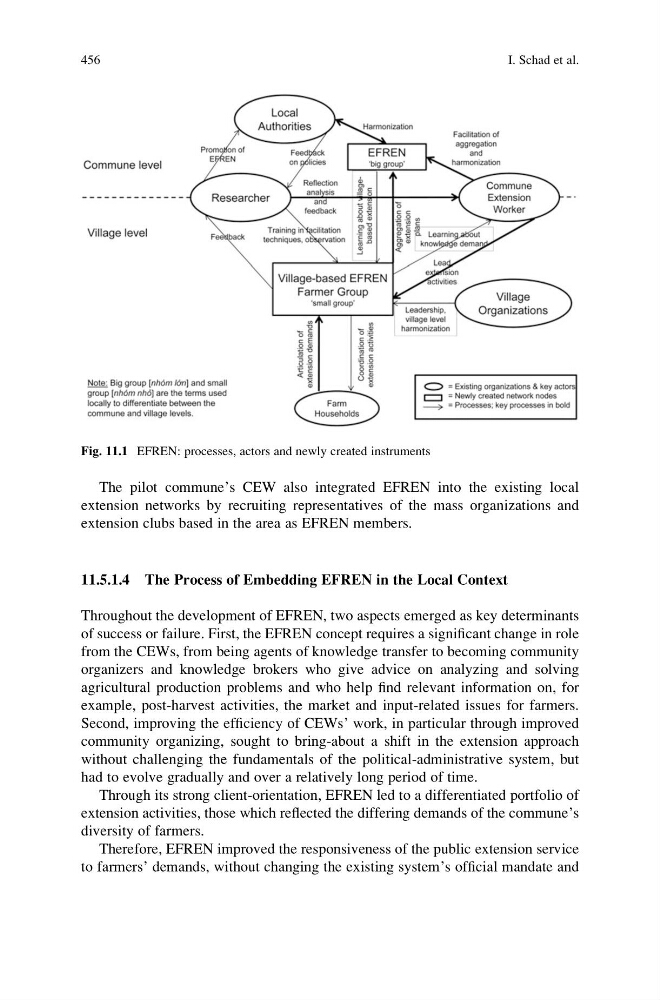
The pilot commune’s CEW also integrated EFREN into the existing local
extension networks by recruiting representatives of the mass organizations and
extension clubs based in the area as EFREN members.
11.5.1.4 The Process of Embedding EFREN in the Local Context
Throughout the development of EFREN, two aspects emerged as key determinants
of success or failure. First, the EFREN concept requires a significant change in role
from the CEWs, from being agents of knowledge transfer to becoming community
organizers and knowledge brokers who give advice on analyzing and solving
agricultural production problems and who help find relevant information on, for
example, post-harvest activities, the market and input-related issues for farmers.
Second, improving the efficiency of CEWs’ work, in particular through improved
community organizing, sought to bring-about a shift in the extension approach
without challenging the fundamentals of the political-administrative system, but
had to evolve gradually and over a relatively long period of time.
Through its strong client-orientation, EFREN led to a differentiated portfolio of
extension activities, those which reflected the differing demands of the commune’s
diversity of farmers.
Therefore, EFREN improved the responsiveness of the public extension service
to farmers’ demands, without changing the existing system’s official mandate and
Fig. 11.1 EFREN: processes, actors and newly created instruments
456
I. Schad et al.
extension networks by recruiting representatives of the mass organizations and
extension clubs based in the area as EFREN members.
11.5.1.4 The Process of Embedding EFREN in the Local Context
Throughout the development of EFREN, two aspects emerged as key determinants
of success or failure. First, the EFREN concept requires a significant change in role
from the CEWs, from being agents of knowledge transfer to becoming community
organizers and knowledge brokers who give advice on analyzing and solving
agricultural production problems and who help find relevant information on, for
example, post-harvest activities, the market and input-related issues for farmers.
Second, improving the efficiency of CEWs’ work, in particular through improved
community organizing, sought to bring-about a shift in the extension approach
without challenging the fundamentals of the political-administrative system, but
had to evolve gradually and over a relatively long period of time.
Through its strong client-orientation, EFREN led to a differentiated portfolio of
extension activities, those which reflected the differing demands of the commune’s
diversity of farmers.
Therefore, EFREN improved the responsiveness of the public extension service
to farmers’ demands, without changing the existing system’s official mandate and
Fig. 11.1 EFREN: processes, actors and newly created instruments
456
I. Schad et al.