

In contrast, U and Th occur as accessory elements in minerals like zircon,
monazite and apatite; U additionally in oxyhydrates (a term used here as a synonym
for all kind of oxides, hydrates and transitional forms) and Th in silicates. While Th
tends to residually enrich and occurs dispersed in the soil environment, U tends to
locally enrich (i.e., in concretions) over time and in the form of the uranyl cation
(UO2
2+ ) a redox sensitive component exists. Therefore, U would appear to be more
mobile in the soil environment, especially where redox processes are prominent.
This information is important to note, since it is required to understand the
gamma-ray signals produced by sedimentary rocks, which cover by far the greatest
share of the terrestrial surface and consequently serve in most cases as parent
material for soil formation. The elemental composition – also with respect to
radioactive elements – of sedimentary rocks, depends on the weathering environment of the sediment sources, fractionation during transport before deposition and
local alteration processes. Therefore, they are not predictable but need a spatial
survey to be carried out in order to distinguish parent rock from soil signals.
For carrying out field measurements, different sizes of gamma-ray spectrometers
exist which vary in their use, from undertaking spot measurements during field
walks, all the way up to airborne national surveys. Normally, they all use the same
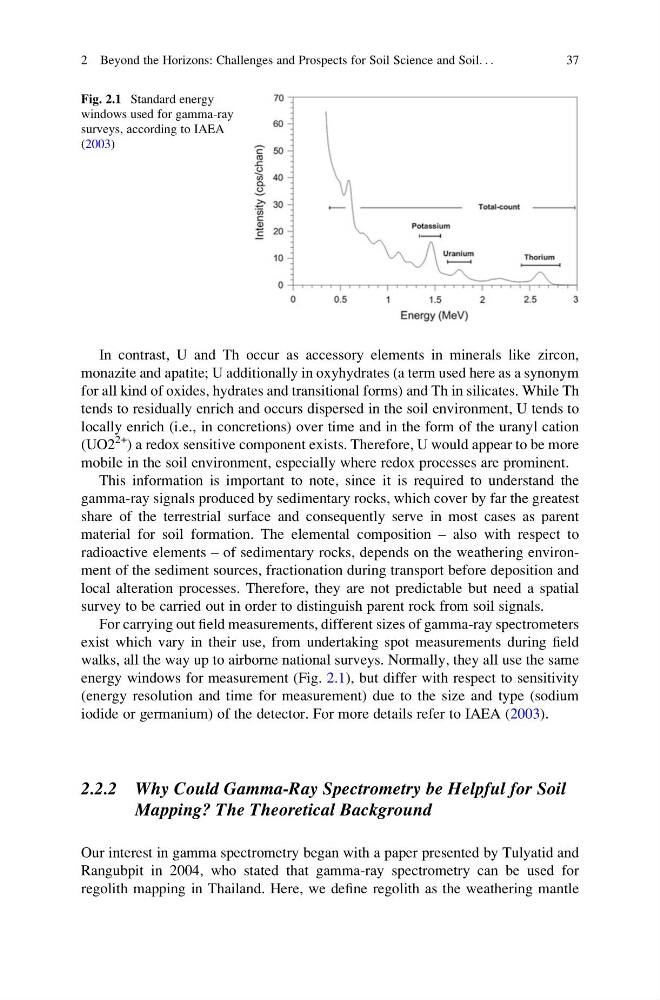
energy windows for measurement (Fig. 2.1), but differ with respect to sensitivity
(energy resolution and time for measurement) due to the size and type (sodium
iodide or germanium) of the detector. For more details refer to IAEA (2003).
2.2.2 Why Could Gamma-Ray Spectrometry be Helpful for Soil
Mapping? The Theoretical Background
Our interest in gamma spectrometry began with a paper presented by Tulyatid and
Rangubpit in 2004, who stated that gamma-ray spectrometry can be used for
regolith mapping in Thailand. Here, we define regolith as the weathering mantle
Fig. 2.1 Standard energy
windows used for gamma-ray
surveys, according to IAEA
(2003)
2 Beyond the Horizons: Challenges and Prospects for Soil Science and Soil. . .
37
monazite and apatite; U additionally in oxyhydrates (a term used here as a synonym
for all kind of oxides, hydrates and transitional forms) and Th in silicates. While Th
tends to residually enrich and occurs dispersed in the soil environment, U tends to
locally enrich (i.e., in concretions) over time and in the form of the uranyl cation
(UO2
2+ ) a redox sensitive component exists. Therefore, U would appear to be more
mobile in the soil environment, especially where redox processes are prominent.
This information is important to note, since it is required to understand the
gamma-ray signals produced by sedimentary rocks, which cover by far the greatest
share of the terrestrial surface and consequently serve in most cases as parent
material for soil formation. The elemental composition – also with respect to
radioactive elements – of sedimentary rocks, depends on the weathering environment of the sediment sources, fractionation during transport before deposition and
local alteration processes. Therefore, they are not predictable but need a spatial
survey to be carried out in order to distinguish parent rock from soil signals.
For carrying out field measurements, different sizes of gamma-ray spectrometers
exist which vary in their use, from undertaking spot measurements during field
walks, all the way up to airborne national surveys. Normally, they all use the same
energy windows for measurement (Fig. 2.1), but differ with respect to sensitivity
(energy resolution and time for measurement) due to the size and type (sodium
iodide or germanium) of the detector. For more details refer to IAEA (2003).
2.2.2 Why Could Gamma-Ray Spectrometry be Helpful for Soil
Mapping? The Theoretical Background
Our interest in gamma spectrometry began with a paper presented by Tulyatid and
Rangubpit in 2004, who stated that gamma-ray spectrometry can be used for
regolith mapping in Thailand. Here, we define regolith as the weathering mantle
Fig. 2.1 Standard energy
windows used for gamma-ray
surveys, according to IAEA
(2003)
2 Beyond the Horizons: Challenges and Prospects for Soil Science and Soil. . .
37