

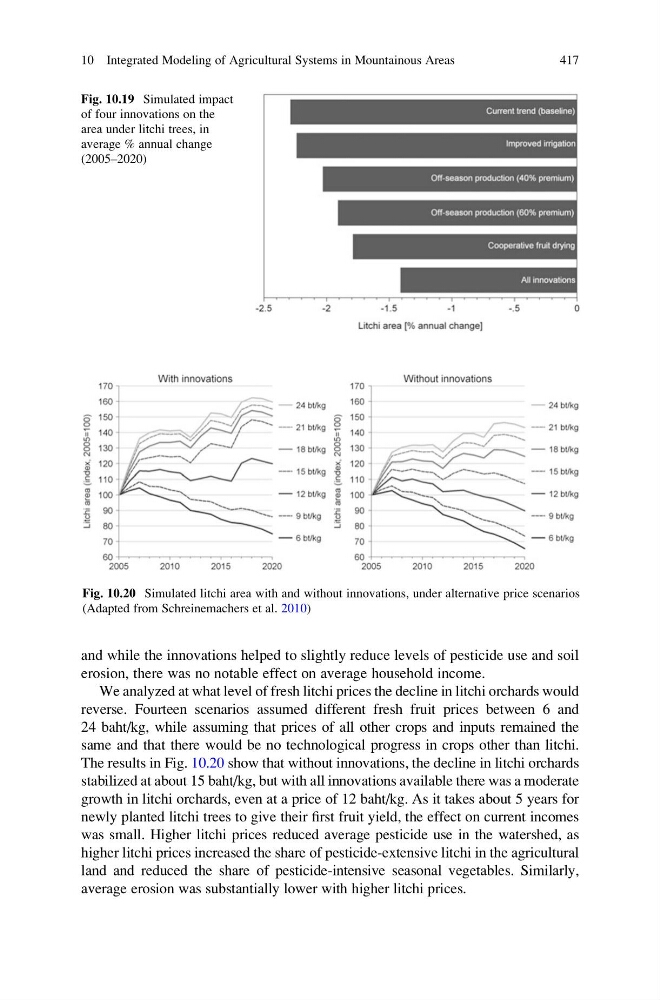
and while the innovations helped to slightly reduce levels of pesticide use and soil
erosion, there was no notable effect on average household income.
We analyzed at what level of fresh litchi prices the decline in litchi orchards would
reverse. Fourteen scenarios assumed different fresh fruit prices between 6 and
24 baht/kg, while assuming that prices of all other crops and inputs remained the
same and that there would be no technological progress in crops other than litchi.
The results in Fig. 10.20 show that without innovations, the decline in litchi orchards
stabilized at about 15 baht/kg, but with all innovations available there was a moderate
growth in litchi orchards, even at a price of 12 baht/kg. As it takes about 5 years for
newly planted litchi trees to give their first fruit yield, the effect on current incomes
was small. Higher litchi prices reduced average pesticide use in the watershed, as
higher litchi prices increased the share of pesticide-extensive litchi in the agricultural
land and reduced the share of pesticide-intensive seasonal vegetables. Similarly,
average erosion was substantially lower with higher litchi prices.
Fig. 10.20 Simulated litchi area with and without innovations, under alternative price scenarios
(Adapted from Schreinemachers et al. 2010)
Fig. 10.19 Simulated impact
of four innovations on the
area under litchi trees, in
average % annual change
(2005–2020)
10 Integrated Modeling of Agricultural Systems in Mountainous Areas
417
erosion, there was no notable effect on average household income.
We analyzed at what level of fresh litchi prices the decline in litchi orchards would
reverse. Fourteen scenarios assumed different fresh fruit prices between 6 and
24 baht/kg, while assuming that prices of all other crops and inputs remained the
same and that there would be no technological progress in crops other than litchi.
The results in Fig. 10.20 show that without innovations, the decline in litchi orchards
stabilized at about 15 baht/kg, but with all innovations available there was a moderate
growth in litchi orchards, even at a price of 12 baht/kg. As it takes about 5 years for
newly planted litchi trees to give their first fruit yield, the effect on current incomes
was small. Higher litchi prices reduced average pesticide use in the watershed, as
higher litchi prices increased the share of pesticide-extensive litchi in the agricultural
land and reduced the share of pesticide-intensive seasonal vegetables. Similarly,
average erosion was substantially lower with higher litchi prices.
Fig. 10.20 Simulated litchi area with and without innovations, under alternative price scenarios
(Adapted from Schreinemachers et al. 2010)
Fig. 10.19 Simulated impact
of four innovations on the
area under litchi trees, in
average % annual change
(2005–2020)
10 Integrated Modeling of Agricultural Systems in Mountainous Areas
417