

trees and have searched for ways to make litchi growing economically more
attractive again (Sruamsiri and Neidhart 2007); developing a range of agricultural
innovations that might contribute to this.
Against this backdrop, the objective of the present study was to assess the
potential impact of four innovations developed within the Uplands Program, as
summarized in Table 10.9, to make litchi cultivation economically more attractive
and; thereby, keeping mountain sides covered with trees. Three of these innovations
– artificial flower induction for off-season harvesting (Bangerth 2006, 2009), smallscale fruit drying (Tremblay and Neef 2009; Precoppe et al. 2011) and shelf-life
extension (Reichel et al. 2010)-are aimed at obtaining better prices for farmers,
while drip irrigation aims to reduce the level of competition for water among crops.
Artificial flower induction and drip irrigation change the management practices for
litchi trees, while the other two innovations change post-harvest management
practices.
Table 10.9 Four innovations used to improve the profitability of litchi growing (Adapted from
Schreinemachers et al. 2010)
Innovation
Innovation type
Development
stage
Main opportunities Main challenges
Artificial flower
induction
Agronomic
Research
stage
Might improve
farm gate prices
Benefits might be shortlived if the litchi
area expands
Small-scale
cooperative
fruit drying
Socioeconomic,
mechanical
Used in some
villages
Improves the profit
margins for fruit
growers
Unattractive if fresh
fruit prices are high
Shelf-life
extension
Chemical
Research
stage
Large price
premium on
high quality
fruits
Benefits may accrue to
traders rather than
farmers
Drip irrigation Mechanical
Available
Might reduce the
competition for
water
Benefits depend on the
relative scarcity of
water
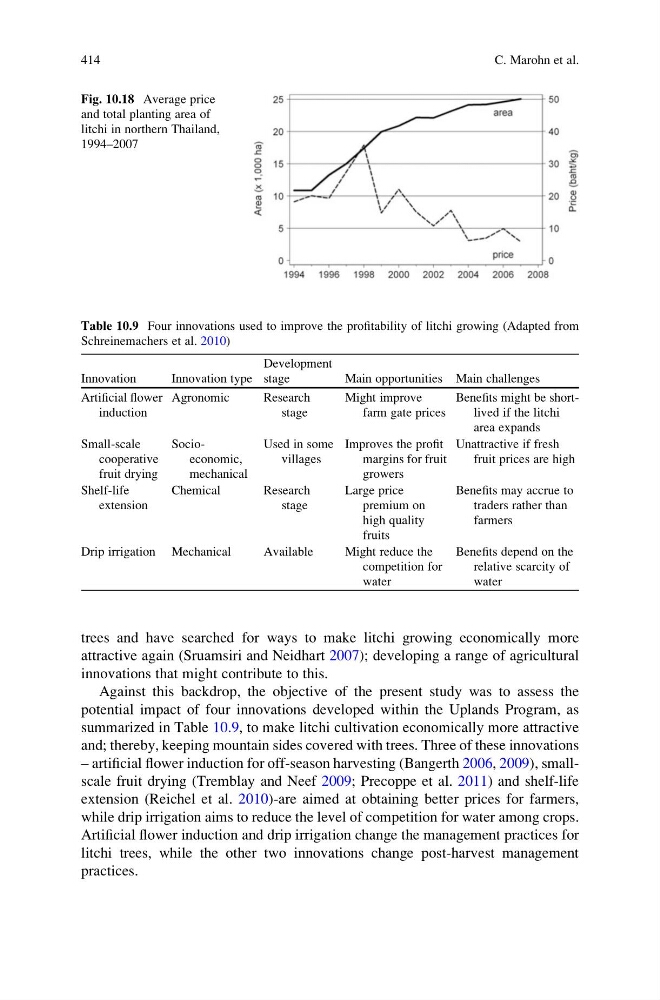
Fig. 10.18 Average price
and total planting area of
litchi in northern Thailand,
1994–2007
414
C. Marohn et al.
attractive again (Sruamsiri and Neidhart 2007); developing a range of agricultural
innovations that might contribute to this.
Against this backdrop, the objective of the present study was to assess the
potential impact of four innovations developed within the Uplands Program, as
summarized in Table 10.9, to make litchi cultivation economically more attractive
and; thereby, keeping mountain sides covered with trees. Three of these innovations
– artificial flower induction for off-season harvesting (Bangerth 2006, 2009), smallscale fruit drying (Tremblay and Neef 2009; Precoppe et al. 2011) and shelf-life
extension (Reichel et al. 2010)-are aimed at obtaining better prices for farmers,
while drip irrigation aims to reduce the level of competition for water among crops.
Artificial flower induction and drip irrigation change the management practices for
litchi trees, while the other two innovations change post-harvest management
practices.
Table 10.9 Four innovations used to improve the profitability of litchi growing (Adapted from
Schreinemachers et al. 2010)
Innovation
Innovation type
Development
stage
Main opportunities Main challenges
Artificial flower
induction
Agronomic
Research
stage
Might improve
farm gate prices
Benefits might be shortlived if the litchi
area expands
Small-scale
cooperative
fruit drying
Socioeconomic,
mechanical
Used in some
villages
Improves the profit
margins for fruit
growers
Unattractive if fresh
fruit prices are high
Shelf-life
extension
Chemical
Research
stage
Large price
premium on
high quality
fruits
Benefits may accrue to
traders rather than
farmers
Drip irrigation Mechanical
Available
Might reduce the
competition for
water
Benefits depend on the
relative scarcity of
water
Fig. 10.18 Average price
and total planting area of
litchi in northern Thailand,
1994–2007
414
C. Marohn et al.