

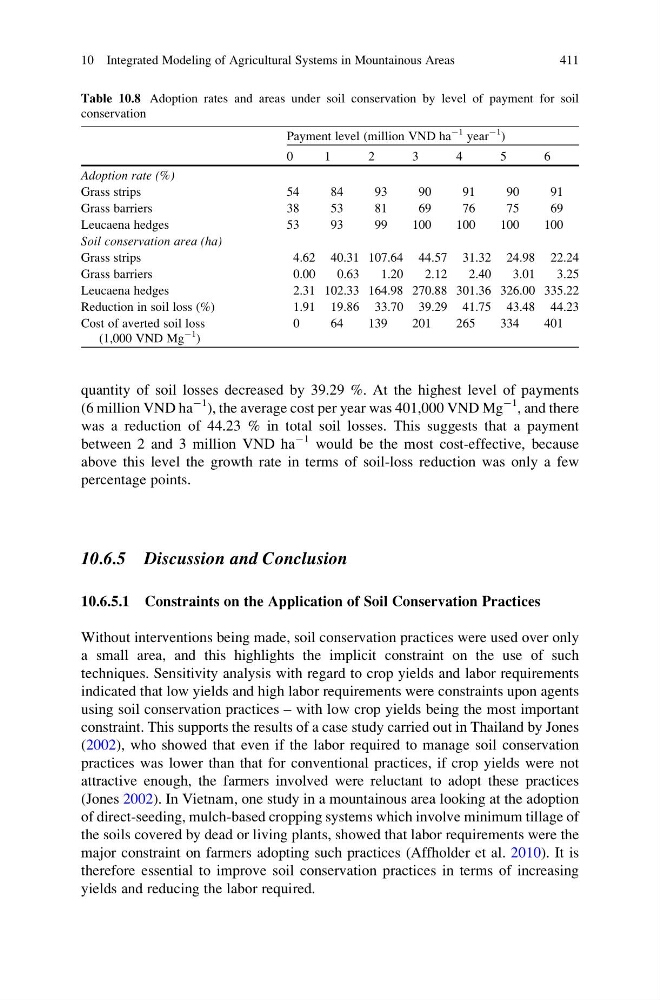
quantity of soil losses decreased by 39.29 %. At the highest level of payments
(6 million VND ha
À1 ), the average cost per year was 401,000 VND Mg
À1 , and there
was a reduction of 44.23 % in total soil losses. This suggests that a payment
between 2 and 3 million VND ha
À1 would be the most cost-effective, because
above this level the growth rate in terms of soil-loss reduction was only a few
percentage points.
10.6.5 Discussion and Conclusion
10.6.5.1 Constraints on the Application of Soil Conservation Practices
Without interventions being made, soil conservation practices were used over only
a small area, and this highlights the implicit constraint on the use of such
techniques. Sensitivity analysis with regard to crop yields and labor requirements
indicated that low yields and high labor requirements were constraints upon agents
using soil conservation practices – with low crop yields being the most important
constraint. This supports the results of a case study carried out in Thailand by Jones
(2002), who showed that even if the labor required to manage soil conservation
practices was lower than that for conventional practices, if crop yields were not
attractive enough, the farmers involved were reluctant to adopt these practices
(Jones 2002). In Vietnam, one study in a mountainous area looking at the adoption
of direct-seeding, mulch-based cropping systems which involve minimum tillage of
the soils covered by dead or living plants, showed that labor requirements were the
major constraint on farmers adopting such practices (Affholder et al. 2010). It is
therefore essential to improve soil conservation practices in terms of increasing
yields and reducing the labor required.
Table 10.8 Adoption rates and areas under soil conservation by level of payment for soil
conservation
Payment level (million VND ha
À1 year
À1
)
0
1
2
3
4
5
6
Adoption rate (%)
Grass strips
54
84
93
90
91
90
91
Grass barriers
38
53
81
69
76
75
69
Leucaena hedges
53
93
99
100
100
100
100
Soil conservation area (ha)
Grass strips
4.62 40.31 107.64 44.57 31.32 24.98 22.24
Grass barriers
0.00
0.63
1.20
2.12
2.40
3.01
3.25
Leucaena hedges
2.31 102.33 164.98 270.88 301.36 326.00 335.22
Reduction in soil loss (%)
1.91 19.86 33.70 39.29 41.75 43.48 44.23
Cost of averted soil loss
(1,000 VND Mg
À1
)
0
64
139
201
265
334
401
10 Integrated Modeling of Agricultural Systems in Mountainous Areas
411
(6 million VND ha
À1 ), the average cost per year was 401,000 VND Mg
À1 , and there
was a reduction of 44.23 % in total soil losses. This suggests that a payment
between 2 and 3 million VND ha
À1 would be the most cost-effective, because
above this level the growth rate in terms of soil-loss reduction was only a few
percentage points.
10.6.5 Discussion and Conclusion
10.6.5.1 Constraints on the Application of Soil Conservation Practices
Without interventions being made, soil conservation practices were used over only
a small area, and this highlights the implicit constraint on the use of such
techniques. Sensitivity analysis with regard to crop yields and labor requirements
indicated that low yields and high labor requirements were constraints upon agents
using soil conservation practices – with low crop yields being the most important
constraint. This supports the results of a case study carried out in Thailand by Jones
(2002), who showed that even if the labor required to manage soil conservation
practices was lower than that for conventional practices, if crop yields were not
attractive enough, the farmers involved were reluctant to adopt these practices
(Jones 2002). In Vietnam, one study in a mountainous area looking at the adoption
of direct-seeding, mulch-based cropping systems which involve minimum tillage of
the soils covered by dead or living plants, showed that labor requirements were the
major constraint on farmers adopting such practices (Affholder et al. 2010). It is
therefore essential to improve soil conservation practices in terms of increasing
yields and reducing the labor required.
Table 10.8 Adoption rates and areas under soil conservation by level of payment for soil
conservation
Payment level (million VND ha
À1 year
À1
)
0
1
2
3
4
5
6
Adoption rate (%)
Grass strips
54
84
93
90
91
90
91
Grass barriers
38
53
81
69
76
75
69
Leucaena hedges
53
93
99
100
100
100
100
Soil conservation area (ha)
Grass strips
4.62 40.31 107.64 44.57 31.32 24.98 22.24
Grass barriers
0.00
0.63
1.20
2.12
2.40
3.01
3.25
Leucaena hedges
2.31 102.33 164.98 270.88 301.36 326.00 335.22
Reduction in soil loss (%)
1.91 19.86 33.70 39.29 41.75 43.48 44.23
Cost of averted soil loss
(1,000 VND Mg
À1
)
0
64
139
201
265
334
401
10 Integrated Modeling of Agricultural Systems in Mountainous Areas
411