

expectations, and if satisfied, the selected crop would be planted. To plant the
selected crop, the agent interacted with his plot object and the plot would change its
crop attribute property from fallow to prepared plot and then to selected crop.
In addition, after the crop had been harvested, information such as the yield, price
and income level would be stored in the farm agent knowledge base, then used to
influence the agent’s decision-making in the next cropping year. All methods in this
model were verified in order to test and examine that the model would proceed in
the correct way. After parameterization and calibration, model validation was
conducted using social validation (the diagram elicitation approach) and statistical
data comparison validation.
10.5.5 Main Results
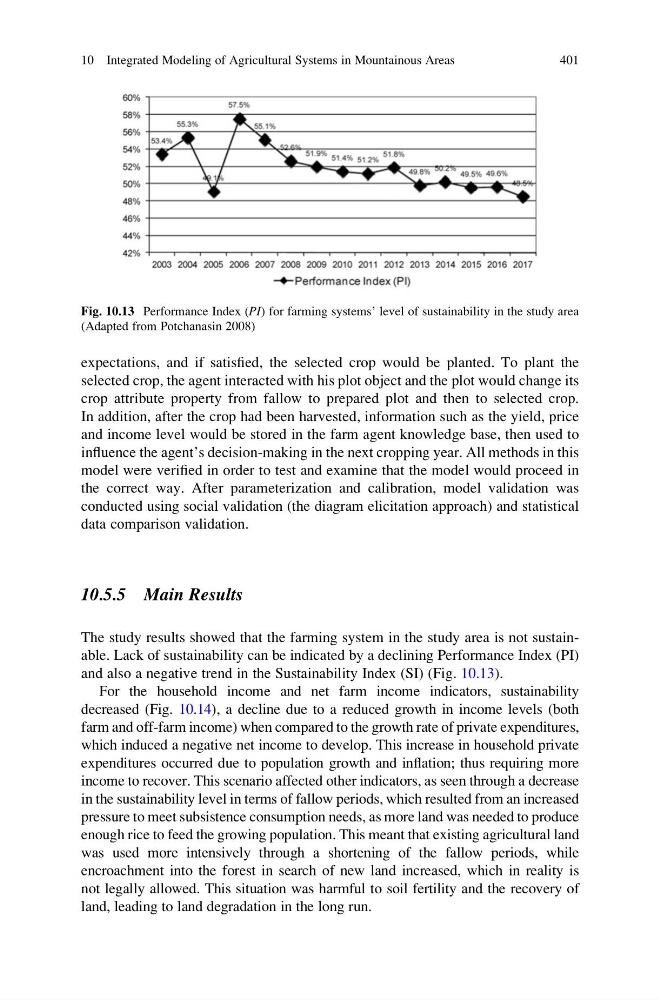
The study results showed that the farming system in the study area is not sustainable. Lack of sustainability can be indicated by a declining Performance Index (PI)
and also a negative trend in the Sustainability Index (SI) (Fig. 10.13).
For the household income and net farm income indicators, sustainability
decreased (Fig. 10.14), a decline due to a reduced growth in income levels (both
farm and off-farm income) when compared to the growth rate of private expenditures,
which induced a negative net income to develop. This increase in household private
expenditures occurred due to population growth and inflation; thus requiring more
income to recover. This scenario affected other indicators, as seen through a decrease
in the sustainability level in terms of fallow periods, which resulted from an increased
pressure to meet subsistence consumption needs, as more land was needed to produce
enough rice to feed the growing population. This meant that existing agricultural land
was used more intensively through a shortening of the fallow periods, while
encroachment into the forest in search of new land increased, which in reality is
not legally allowed. This situation was harmful to soil fertility and the recovery of
land, leading to land degradation in the long run.
Fig. 10.13 Performance Index (PI) for farming systems’ level of sustainability in the study area
(Adapted from Potchanasin 2008)
10 Integrated Modeling of Agricultural Systems in Mountainous Areas
401
selected crop, the agent interacted with his plot object and the plot would change its
crop attribute property from fallow to prepared plot and then to selected crop.
In addition, after the crop had been harvested, information such as the yield, price
and income level would be stored in the farm agent knowledge base, then used to
influence the agent’s decision-making in the next cropping year. All methods in this
model were verified in order to test and examine that the model would proceed in
the correct way. After parameterization and calibration, model validation was
conducted using social validation (the diagram elicitation approach) and statistical
data comparison validation.
10.5.5 Main Results
The study results showed that the farming system in the study area is not sustainable. Lack of sustainability can be indicated by a declining Performance Index (PI)
and also a negative trend in the Sustainability Index (SI) (Fig. 10.13).
For the household income and net farm income indicators, sustainability
decreased (Fig. 10.14), a decline due to a reduced growth in income levels (both
farm and off-farm income) when compared to the growth rate of private expenditures,
which induced a negative net income to develop. This increase in household private
expenditures occurred due to population growth and inflation; thus requiring more
income to recover. This scenario affected other indicators, as seen through a decrease
in the sustainability level in terms of fallow periods, which resulted from an increased
pressure to meet subsistence consumption needs, as more land was needed to produce
enough rice to feed the growing population. This meant that existing agricultural land
was used more intensively through a shortening of the fallow periods, while
encroachment into the forest in search of new land increased, which in reality is
not legally allowed. This situation was harmful to soil fertility and the recovery of
land, leading to land degradation in the long run.
Fig. 10.13 Performance Index (PI) for farming systems’ level of sustainability in the study area
(Adapted from Potchanasin 2008)
10 Integrated Modeling of Agricultural Systems in Mountainous Areas
401