

which is likely to stimulate further global warming. In addition, adding green
manure crop residues stimulates the release of CH 4 into the atmosphere, as a
product of microbial activity in the soil.
10.3.3 CropDSS Tool Applications in Thailand
Pannangpetch et al. (2009) used CropDSS to assess the impacts of and evaluate
options for climate change scenarios on cassava, sugarcane and maize production
in Thailand, using the ECHAM4 A2 and B2 climate scenarios. The results
reveal that increased CO 2 concentrations and temperature had a small impact on
sugarcane and maize production levels, but reduced cassava yields 43 % by the end
of the twenty-first century, as compared to the baseline period of 1980–1989.
Furthermore, yield variability over time, an important indicator of climate risk,
was relatively high, with a mean annual variation of 14 %, 18 %, 34 % and 41 %
for rice, sugarcane, cassava, and maize respectively. The authors also reported high
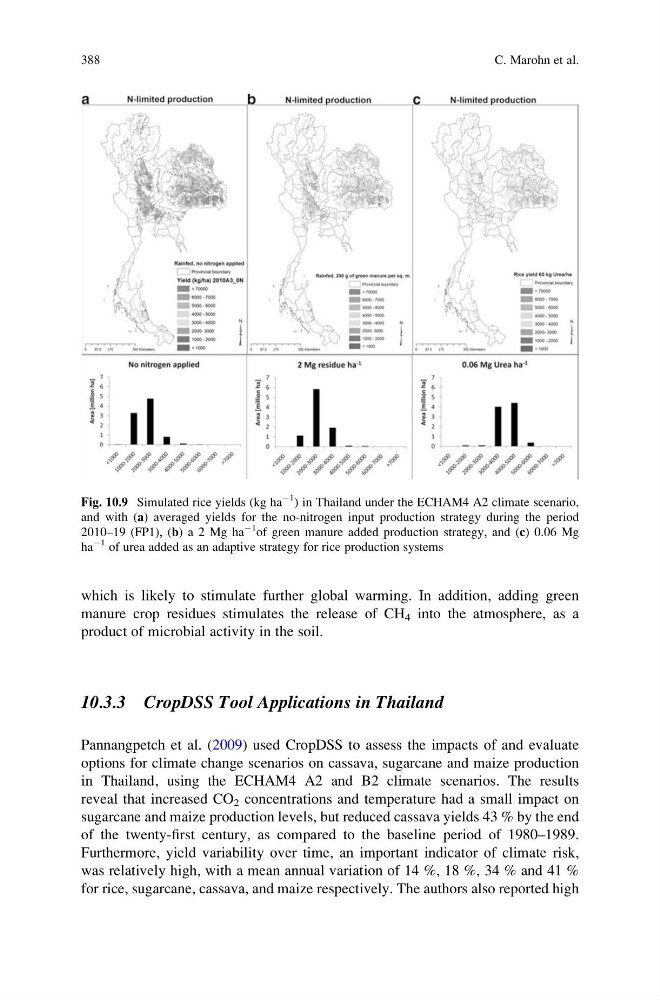
Fig. 10.9 Simulated rice yields (kg ha
À1
) in Thailand under the ECHAM4 A2 climate scenario,
and with (a) averaged yields for the no-nitrogen input production strategy during the period
2010–19 (FP1), (b) a 2 Mg ha
À1
of green manure added production strategy, and (c) 0.06 Mg
ha
À1 of urea added as an adaptive strategy for rice production systems
388
C. Marohn et al.
manure crop residues stimulates the release of CH 4 into the atmosphere, as a
product of microbial activity in the soil.
10.3.3 CropDSS Tool Applications in Thailand
Pannangpetch et al. (2009) used CropDSS to assess the impacts of and evaluate
options for climate change scenarios on cassava, sugarcane and maize production
in Thailand, using the ECHAM4 A2 and B2 climate scenarios. The results
reveal that increased CO 2 concentrations and temperature had a small impact on
sugarcane and maize production levels, but reduced cassava yields 43 % by the end
of the twenty-first century, as compared to the baseline period of 1980–1989.
Furthermore, yield variability over time, an important indicator of climate risk,
was relatively high, with a mean annual variation of 14 %, 18 %, 34 % and 41 %
for rice, sugarcane, cassava, and maize respectively. The authors also reported high
Fig. 10.9 Simulated rice yields (kg ha
À1
) in Thailand under the ECHAM4 A2 climate scenario,
and with (a) averaged yields for the no-nitrogen input production strategy during the period
2010–19 (FP1), (b) a 2 Mg ha
À1
of green manure added production strategy, and (c) 0.06 Mg
ha
À1 of urea added as an adaptive strategy for rice production systems
388
C. Marohn et al.