

energy-limited, while the N needed for microbial processes can be drawn from the
organic substrate, or from the soil mineral pool if the substrate has a wide C:N ratio.
Once the latter happens, soil mineral N is immobilized and temporally not available
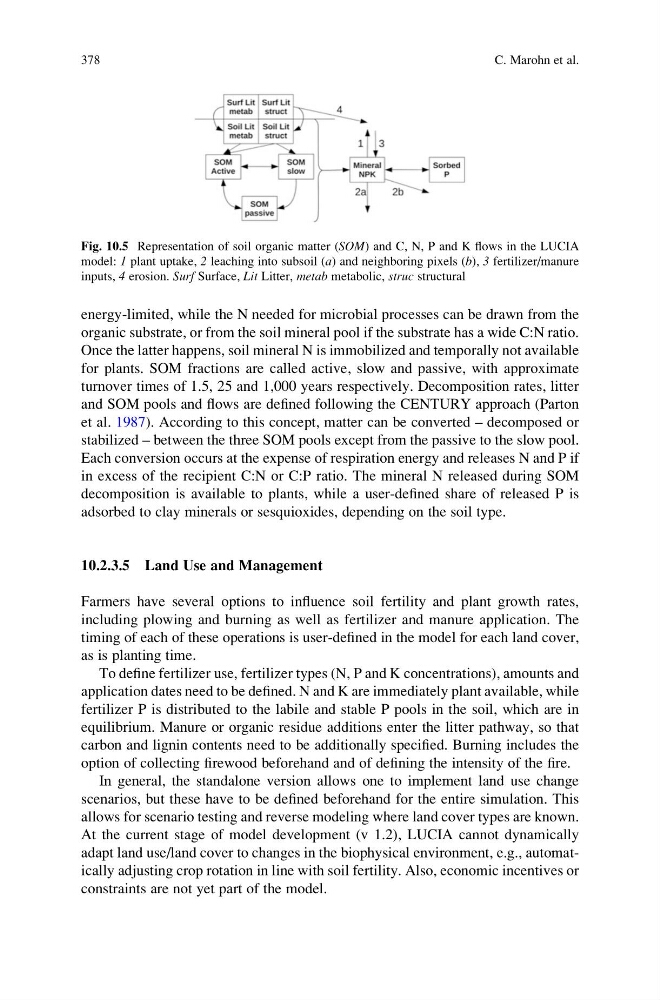
for plants. SOM fractions are called active, slow and passive, with approximate
turnover times of 1.5, 25 and 1,000 years respectively. Decomposition rates, litter
and SOM pools and flows are defined following the CENTURY approach (Parton
et al. 1987). According to this concept, matter can be converted – decomposed or
stabilized – between the three SOM pools except from the passive to the slow pool.
Each conversion occurs at the expense of respiration energy and releases N and P if
in excess of the recipient C:N or C:P ratio. The mineral N released during SOM
decomposition is available to plants, while a user-defined share of released P is
adsorbed to clay minerals or sesquioxides, depending on the soil type.
10.2.3.5 Land Use and Management
Farmers have several options to influence soil fertility and plant growth rates,
including plowing and burning as well as fertilizer and manure application. The
timing of each of these operations is user-defined in the model for each land cover,
as is planting time.
To define fertilizer use, fertilizer types (N, P and K concentrations), amounts and
application dates need to be defined. N and K are immediately plant available, while
fertilizer P is distributed to the labile and stable P pools in the soil, which are in
equilibrium. Manure or organic residue additions enter the litter pathway, so that
carbon and lignin contents need to be additionally specified. Burning includes the
option of collecting firewood beforehand and of defining the intensity of the fire.
In general, the standalone version allows one to implement land use change
scenarios, but these have to be defined beforehand for the entire simulation. This
allows for scenario testing and reverse modeling where land cover types are known.
At the current stage of model development (v 1.2), LUCIA cannot dynamically
adapt land use/land cover to changes in the biophysical environment, e.g., automatically adjusting crop rotation in line with soil fertility. Also, economic incentives or
constraints are not yet part of the model.
Fig. 10.5 Representation of soil organic matter (SOM) and C, N, P and K flows in the LUCIA
model: 1 plant uptake, 2 leaching into subsoil (a) and neighboring pixels (b), 3 fertilizer/manure
inputs, 4 erosion. Surf Surface, Lit Litter, metab metabolic, struc structural
378
C. Marohn et al.
organic substrate, or from the soil mineral pool if the substrate has a wide C:N ratio.
Once the latter happens, soil mineral N is immobilized and temporally not available
for plants. SOM fractions are called active, slow and passive, with approximate
turnover times of 1.5, 25 and 1,000 years respectively. Decomposition rates, litter
and SOM pools and flows are defined following the CENTURY approach (Parton
et al. 1987). According to this concept, matter can be converted – decomposed or
stabilized – between the three SOM pools except from the passive to the slow pool.
Each conversion occurs at the expense of respiration energy and releases N and P if
in excess of the recipient C:N or C:P ratio. The mineral N released during SOM
decomposition is available to plants, while a user-defined share of released P is
adsorbed to clay minerals or sesquioxides, depending on the soil type.
10.2.3.5 Land Use and Management
Farmers have several options to influence soil fertility and plant growth rates,
including plowing and burning as well as fertilizer and manure application. The
timing of each of these operations is user-defined in the model for each land cover,
as is planting time.
To define fertilizer use, fertilizer types (N, P and K concentrations), amounts and
application dates need to be defined. N and K are immediately plant available, while
fertilizer P is distributed to the labile and stable P pools in the soil, which are in
equilibrium. Manure or organic residue additions enter the litter pathway, so that
carbon and lignin contents need to be additionally specified. Burning includes the
option of collecting firewood beforehand and of defining the intensity of the fire.
In general, the standalone version allows one to implement land use change
scenarios, but these have to be defined beforehand for the entire simulation. This
allows for scenario testing and reverse modeling where land cover types are known.
At the current stage of model development (v 1.2), LUCIA cannot dynamically
adapt land use/land cover to changes in the biophysical environment, e.g., automatically adjusting crop rotation in line with soil fertility. Also, economic incentives or
constraints are not yet part of the model.
Fig. 10.5 Representation of soil organic matter (SOM) and C, N, P and K flows in the LUCIA
model: 1 plant uptake, 2 leaching into subsoil (a) and neighboring pixels (b), 3 fertilizer/manure
inputs, 4 erosion. Surf Surface, Lit Litter, metab metabolic, struc structural
378
C. Marohn et al.