

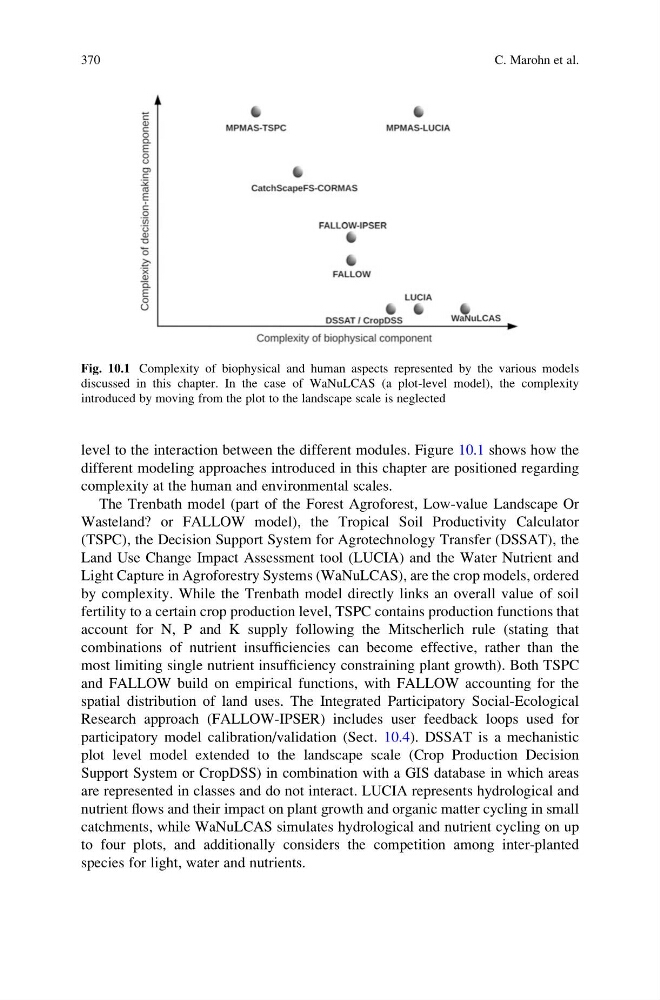
level to the interaction between the different modules. Figure 10.1 shows how the
different modeling approaches introduced in this chapter are positioned regarding
complexity at the human and environmental scales.
The Trenbath model (part of the Forest Agroforest, Low-value Landscape Or
Wasteland? or FALLOW model), the Tropical Soil Productivity Calculator
(TSPC), the Decision Support System for Agrotechnology Transfer (DSSAT), the
Land Use Change Impact Assessment tool (LUCIA) and the Water Nutrient and
Light Capture in Agroforestry Systems (WaNuLCAS), are the crop models, ordered
by complexity. While the Trenbath model directly links an overall value of soil
fertility to a certain crop production level, TSPC contains production functions that
account for N, P and K supply following the Mitscherlich rule (stating that
combinations of nutrient insufficiencies can become effective, rather than the
most limiting single nutrient insufficiency constraining plant growth). Both TSPC
and FALLOW build on empirical functions, with FALLOW accounting for the
spatial distribution of land uses. The Integrated Participatory Social-Ecological
Research approach (FALLOW-IPSER) includes user feedback loops used for
participatory model calibration/validation (Sect. 10.4). DSSAT is a mechanistic
plot level model extended to the landscape scale (Crop Production Decision
Support System or CropDSS) in combination with a GIS database in which areas
are represented in classes and do not interact. LUCIA represents hydrological and
nutrient flows and their impact on plant growth and organic matter cycling in small
catchments, while WaNuLCAS simulates hydrological and nutrient cycling on up
to four plots, and additionally considers the competition among inter-planted
species for light, water and nutrients.
Fig. 10.1 Complexity of biophysical and human aspects represented by the various models
discussed in this chapter. In the case of WaNuLCAS (a plot-level model), the complexity
introduced by moving from the plot to the landscape scale is neglected
370
C. Marohn et al.
different modeling approaches introduced in this chapter are positioned regarding
complexity at the human and environmental scales.
The Trenbath model (part of the Forest Agroforest, Low-value Landscape Or
Wasteland? or FALLOW model), the Tropical Soil Productivity Calculator
(TSPC), the Decision Support System for Agrotechnology Transfer (DSSAT), the
Land Use Change Impact Assessment tool (LUCIA) and the Water Nutrient and
Light Capture in Agroforestry Systems (WaNuLCAS), are the crop models, ordered
by complexity. While the Trenbath model directly links an overall value of soil
fertility to a certain crop production level, TSPC contains production functions that
account for N, P and K supply following the Mitscherlich rule (stating that
combinations of nutrient insufficiencies can become effective, rather than the
most limiting single nutrient insufficiency constraining plant growth). Both TSPC
and FALLOW build on empirical functions, with FALLOW accounting for the
spatial distribution of land uses. The Integrated Participatory Social-Ecological
Research approach (FALLOW-IPSER) includes user feedback loops used for
participatory model calibration/validation (Sect. 10.4). DSSAT is a mechanistic
plot level model extended to the landscape scale (Crop Production Decision
Support System or CropDSS) in combination with a GIS database in which areas
are represented in classes and do not interact. LUCIA represents hydrological and
nutrient flows and their impact on plant growth and organic matter cycling in small
catchments, while WaNuLCAS simulates hydrological and nutrient cycling on up
to four plots, and additionally considers the competition among inter-planted
species for light, water and nutrients.
Fig. 10.1 Complexity of biophysical and human aspects represented by the various models
discussed in this chapter. In the case of WaNuLCAS (a plot-level model), the complexity
introduced by moving from the plot to the landscape scale is neglected
370
C. Marohn et al.