

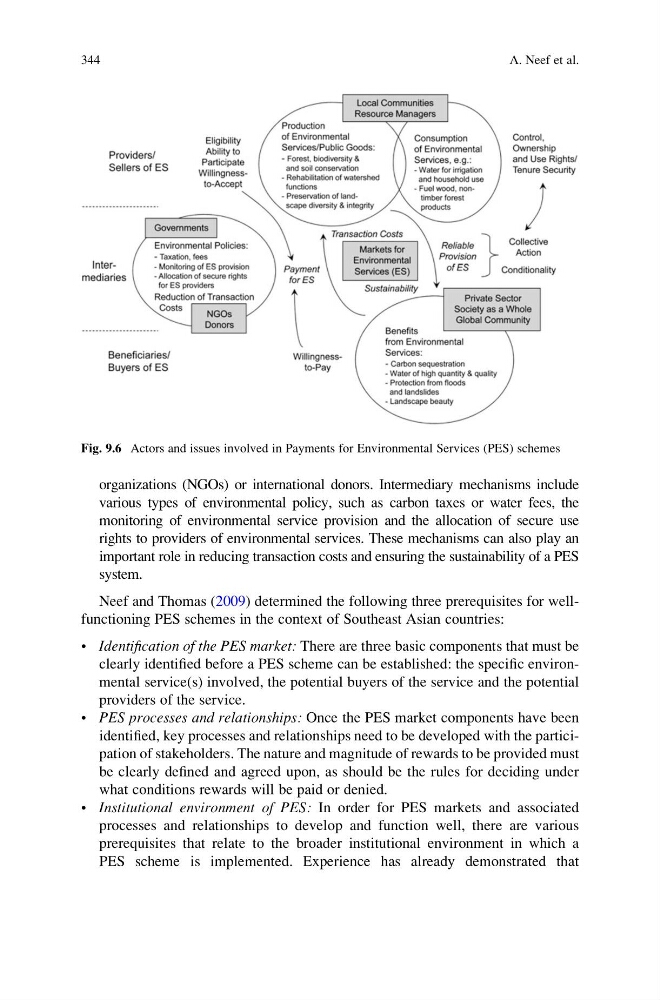
organizations (NGOs) or international donors. Intermediary mechanisms include
various types of environmental policy, such as carbon taxes or water fees, the
monitoring of environmental service provision and the allocation of secure use
rights to providers of environmental services. These mechanisms can also play an
important role in reducing transaction costs and ensuring the sustainability of a PES
system.
Neef and Thomas (2009) determined the following three prerequisites for wellfunctioning PES schemes in the context of Southeast Asian countries:
• Identification of the PES market: There are three basic components that must be
clearly identified before a PES scheme can be established: the specific environmental service(s) involved, the potential buyers of the service and the potential
providers of the service.
• PES processes and relationships: Once the PES market components have been
identified, key processes and relationships need to be developed with the participation of stakeholders. The nature and magnitude of rewards to be provided must
be clearly defined and agreed upon, as should be the rules for deciding under
what conditions rewards will be paid or denied.
• Institutional environment of PES: In order for PES markets and associated
processes and relationships to develop and function well, there are various
prerequisites that relate to the broader institutional environment in which a
PES scheme is implemented. Experience has already demonstrated that
Fig. 9.6 Actors and issues involved in Payments for Environmental Services (PES) schemes
344
A. Neef et al.
various types of environmental policy, such as carbon taxes or water fees, the
monitoring of environmental service provision and the allocation of secure use
rights to providers of environmental services. These mechanisms can also play an
important role in reducing transaction costs and ensuring the sustainability of a PES
system.
Neef and Thomas (2009) determined the following three prerequisites for wellfunctioning PES schemes in the context of Southeast Asian countries:
• Identification of the PES market: There are three basic components that must be
clearly identified before a PES scheme can be established: the specific environmental service(s) involved, the potential buyers of the service and the potential
providers of the service.
• PES processes and relationships: Once the PES market components have been
identified, key processes and relationships need to be developed with the participation of stakeholders. The nature and magnitude of rewards to be provided must
be clearly defined and agreed upon, as should be the rules for deciding under
what conditions rewards will be paid or denied.
• Institutional environment of PES: In order for PES markets and associated
processes and relationships to develop and function well, there are various
prerequisites that relate to the broader institutional environment in which a
PES scheme is implemented. Experience has already demonstrated that
Fig. 9.6 Actors and issues involved in Payments for Environmental Services (PES) schemes
344
A. Neef et al.