

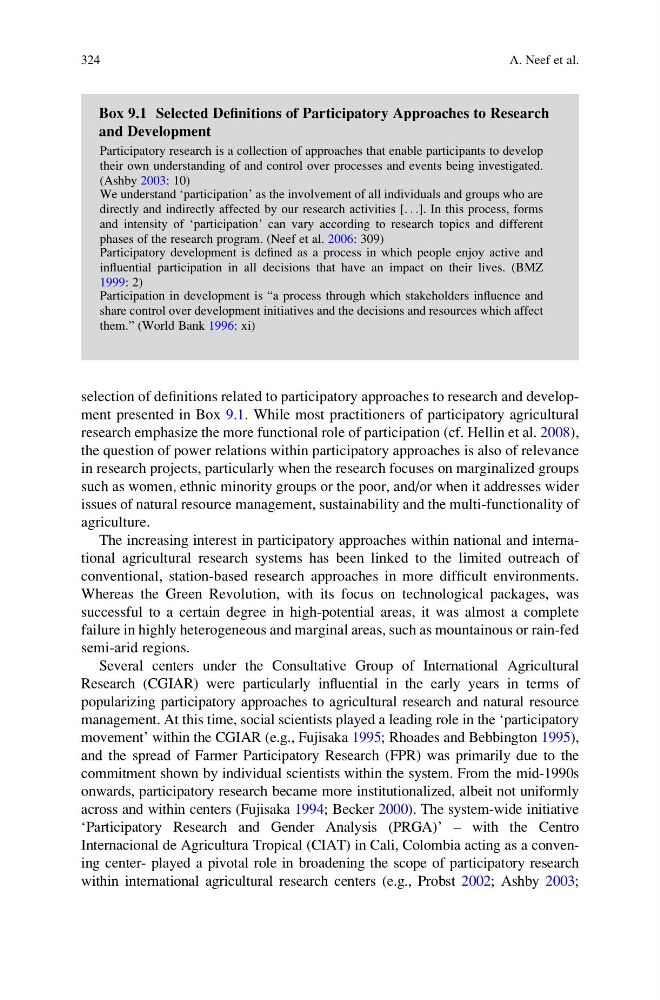
selection of definitions related to participatory approaches to research and development presented in Box 9.1. While most practitioners of participatory agricultural
research emphasize the more functional role of participation (cf. Hellin et al. 2008),
the question of power relations within participatory approaches is also of relevance
in research projects, particularly when the research focuses on marginalized groups
such as women, ethnic minority groups or the poor, and/or when it addresses wider
issues of natural resource management, sustainability and the multi-functionality of
agriculture.
The increasing interest in participatory approaches within national and international agricultural research systems has been linked to the limited outreach of
conventional, station-based research approaches in more difficult environments.
Whereas the Green Revolution, with its focus on technological packages, was
successful to a certain degree in high-potential areas, it was almost a complete
failure in highly heterogeneous and marginal areas, such as mountainous or rain-fed
semi-arid regions.
Several centers under the Consultative Group of International Agricultural
Research (CGIAR) were particularly influential in the early years in terms of
popularizing participatory approaches to agricultural research and natural resource
management. At this time, social scientists played a leading role in the ‘participatory
movement’ within the CGIAR (e.g., Fujisaka 1995; Rhoades and Bebbington 1995),
and the spread of Farmer Participatory Research (FPR) was primarily due to the
commitment shown by individual scientists within the system. From the mid-1990s
onwards, participatory research became more institutionalized, albeit not uniformly
across and within centers (Fujisaka 1994; Becker 2000). The system-wide initiative
‘Participatory Research and Gender Analysis (PRGA)’ – with the Centro
Internacional de Agricultura Tropical (CIAT) in Cali, Colombia acting as a convening center- played a pivotal role in broadening the scope of participatory research
within international agricultural research centers (e.g., Probst 2002; Ashby 2003;
Box 9.1 Selected Definitions of Participatory Approaches to Research
and Development
Participatory research is a collection of approaches that enable participants to develop
their own understanding of and control over processes and events being investigated.
(Ashby 2003: 10)
We understand ‘participation’ as the involvement of all individuals and groups who are
directly and indirectly affected by our research activities [. . .]. In this process, forms
and intensity of ‘participation’ can vary according to research topics and different
phases of the research program. (Neef et al. 2006: 309)
Participatory development is defined as a process in which people enjoy active and
influential participation in all decisions that have an impact on their lives. (BMZ
1999: 2)
Participation in development is “a process through which stakeholders influence and
share control over development initiatives and the decisions and resources which affect
them.” (World Bank 1996: xi)
324
A. Neef et al.
research emphasize the more functional role of participation (cf. Hellin et al. 2008),
the question of power relations within participatory approaches is also of relevance
in research projects, particularly when the research focuses on marginalized groups
such as women, ethnic minority groups or the poor, and/or when it addresses wider
issues of natural resource management, sustainability and the multi-functionality of
agriculture.
The increasing interest in participatory approaches within national and international agricultural research systems has been linked to the limited outreach of
conventional, station-based research approaches in more difficult environments.
Whereas the Green Revolution, with its focus on technological packages, was
successful to a certain degree in high-potential areas, it was almost a complete
failure in highly heterogeneous and marginal areas, such as mountainous or rain-fed
semi-arid regions.
Several centers under the Consultative Group of International Agricultural
Research (CGIAR) were particularly influential in the early years in terms of
popularizing participatory approaches to agricultural research and natural resource
management. At this time, social scientists played a leading role in the ‘participatory
movement’ within the CGIAR (e.g., Fujisaka 1995; Rhoades and Bebbington 1995),
and the spread of Farmer Participatory Research (FPR) was primarily due to the
commitment shown by individual scientists within the system. From the mid-1990s
onwards, participatory research became more institutionalized, albeit not uniformly
across and within centers (Fujisaka 1994; Becker 2000). The system-wide initiative
‘Participatory Research and Gender Analysis (PRGA)’ – with the Centro
Internacional de Agricultura Tropical (CIAT) in Cali, Colombia acting as a convening center- played a pivotal role in broadening the scope of participatory research
within international agricultural research centers (e.g., Probst 2002; Ashby 2003;
Box 9.1 Selected Definitions of Participatory Approaches to Research
and Development
Participatory research is a collection of approaches that enable participants to develop
their own understanding of and control over processes and events being investigated.
(Ashby 2003: 10)
We understand ‘participation’ as the involvement of all individuals and groups who are
directly and indirectly affected by our research activities [. . .]. In this process, forms
and intensity of ‘participation’ can vary according to research topics and different
phases of the research program. (Neef et al. 2006: 309)
Participatory development is defined as a process in which people enjoy active and
influential participation in all decisions that have an impact on their lives. (BMZ
1999: 2)
Participation in development is “a process through which stakeholders influence and
share control over development initiatives and the decisions and resources which affect
them.” (World Bank 1996: xi)
324
A. Neef et al.