

The local hatchery operators as well as farmers have observed a decrease in the
quality of fish fingerlings over the last several decades, reporting low growth
performance of the fish as well as a higher susceptibility of the fish to disease.
There is some evidence that inappropriate management of the local hatcheries, such
as the crossing breeding of fish without considering the degree of consanguinity,
as well as the use of a generally restricted gene pool, has led to a genetic degeneration
of fish stocks.
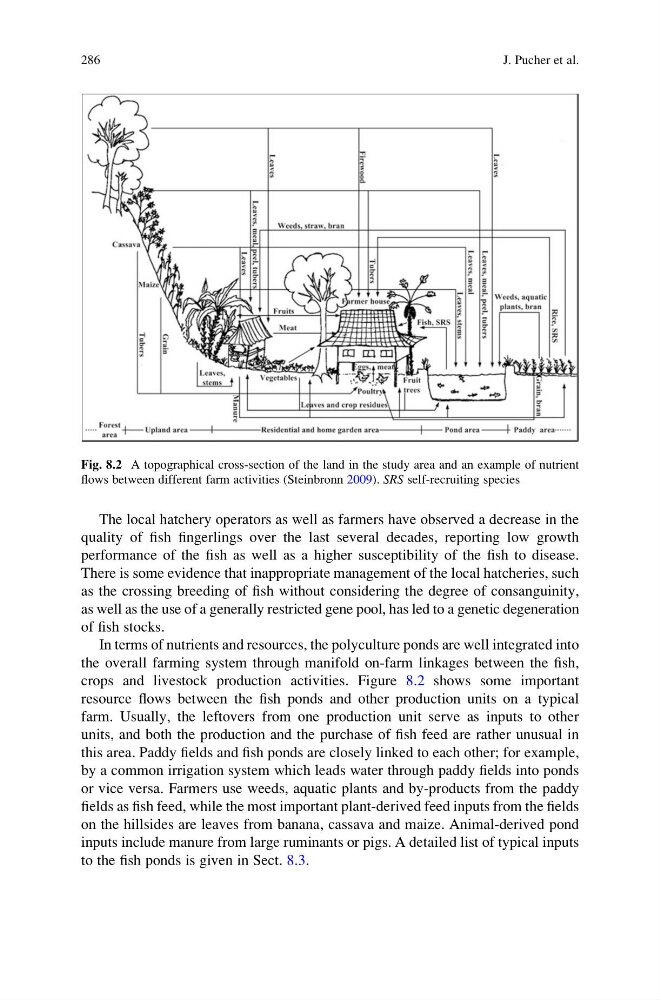
In terms of nutrients and resources, the polyculture ponds are well integrated into
the overall farming system through manifold on-farm linkages between the fish,
crops and livestock production activities. Figure 8.2 shows some important
resource flows between the fish ponds and other production units on a typical
farm. Usually, the leftovers from one production unit serve as inputs to other
units, and both the production and the purchase of fish feed are rather unusual in
this area. Paddy fields and fish ponds are closely linked to each other; for example,
by a common irrigation system which leads water through paddy fields into ponds
or vice versa. Farmers use weeds, aquatic plants and by-products from the paddy
fields as fish feed, while the most important plant-derived feed inputs from the fields
on the hillsides are leaves from banana, cassava and maize. Animal-derived pond
inputs include manure from large ruminants or pigs. A detailed list of typical inputs
to the fish ponds is given in Sect. 8.3.
Fig. 8.2 A topographical cross-section of the land in the study area and an example of nutrient
flows between different farm activities (Steinbronn 2009). SRS self-recruiting species
286
J. Pucher et al.
quality of fish fingerlings over the last several decades, reporting low growth
performance of the fish as well as a higher susceptibility of the fish to disease.
There is some evidence that inappropriate management of the local hatcheries, such
as the crossing breeding of fish without considering the degree of consanguinity,
as well as the use of a generally restricted gene pool, has led to a genetic degeneration
of fish stocks.
In terms of nutrients and resources, the polyculture ponds are well integrated into
the overall farming system through manifold on-farm linkages between the fish,
crops and livestock production activities. Figure 8.2 shows some important
resource flows between the fish ponds and other production units on a typical
farm. Usually, the leftovers from one production unit serve as inputs to other
units, and both the production and the purchase of fish feed are rather unusual in
this area. Paddy fields and fish ponds are closely linked to each other; for example,
by a common irrigation system which leads water through paddy fields into ponds
or vice versa. Farmers use weeds, aquatic plants and by-products from the paddy
fields as fish feed, while the most important plant-derived feed inputs from the fields
on the hillsides are leaves from banana, cassava and maize. Animal-derived pond
inputs include manure from large ruminants or pigs. A detailed list of typical inputs
to the fish ponds is given in Sect. 8.3.
Fig. 8.2 A topographical cross-section of the land in the study area and an example of nutrient
flows between different farm activities (Steinbronn 2009). SRS self-recruiting species
286
J. Pucher et al.