

In summary, innovative approaches to soil conservation require a change in land
use systems, not just the adoption of conventional soil conservation measures under
existing systems. A re-coupling of plant and animal production systems in the
uplands should be promoted, especially through integrated systems that allow
farmers to benefit from urban-based economic growth on the one hand, such as
through the exploitation of niche markets for high-value meat, while being environmentally sustainable on the other. Our research has revealed that farmers face
considerable knowledge, institutional and economic constraints with regard to the
adoption of soil conservation practices. Due to the public good nature of soil
conservation measures, decision-makers and development organizations in marginal areas should not only promote new, economically more attractive soil conserving land use options, but actively support their adoption by farmers in order to
address societal issues such as water safety, food security and sustainable rural
development.
Technical Notes
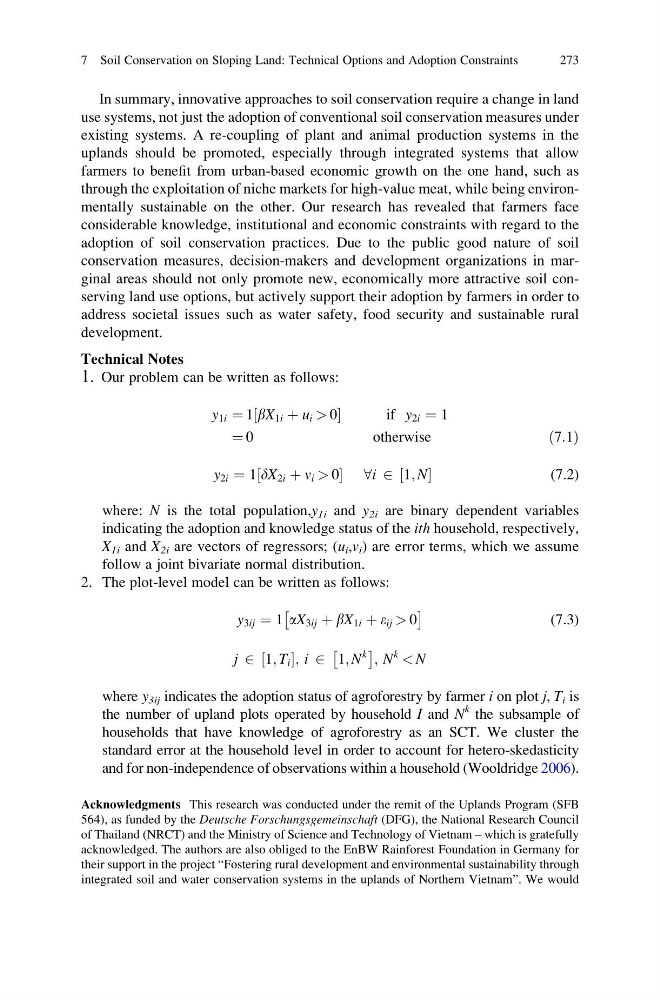
1. Our problem can be written as follows:
y 1i ¼ 1 bX 1i þ u i > 0
½
if y 2i ¼ 1
¼ 0
otherwise
ð7:1Þ
y 2i ¼ 1 dX 2i þ v i > 0
½
8 i 2 1; N
½
(7.2)
where: N is the total population,y 1i and y 2i are binary dependent variables
indicating the adoption and knowledge status of the ith household, respectively,
X 1i and X 2i are vectors of regressors; (u i ,v i ) are error terms, which we assume
follow a joint bivariate normal distribution.
2. The plot-level model can be written as follows:
y 3ij ¼ 1 aX 3ij þ bX 1i þ e ij > 0
Â
Ã
(7.3)
j 2 1; T i
½
; i 2 1; N
k
Â
Ã
; N
k
< N
where y 3ij indicates the adoption status of agroforestry by farmer i on plot j, T i is
the number of upland plots operated by household I and N
k the subsample of
households that have knowledge of agroforestry as an SCT. We cluster the
standard error at the household level in order to account for hetero-skedasticity
and for non-independence of observations within a household (Wooldridge 2006).
Acknowledgments This research was conducted under the remit of the Uplands Program (SFB
564), as funded by the Deutsche Forschungsgemeinschaft (DFG), the National Research Council
of Thailand (NRCT) and the Ministry of Science and Technology of Vietnam – which is gratefully
acknowledged. The authors are also obliged to the EnBW Rainforest Foundation in Germany for
their support in the project “Fostering rural development and environmental sustainability through
integrated soil and water conservation systems in the uplands of Northern Vietnam”. We would
7 Soil Conservation on Sloping Land: Technical Options and Adoption Constraints
273
use systems, not just the adoption of conventional soil conservation measures under
existing systems. A re-coupling of plant and animal production systems in the
uplands should be promoted, especially through integrated systems that allow
farmers to benefit from urban-based economic growth on the one hand, such as
through the exploitation of niche markets for high-value meat, while being environmentally sustainable on the other. Our research has revealed that farmers face
considerable knowledge, institutional and economic constraints with regard to the
adoption of soil conservation practices. Due to the public good nature of soil
conservation measures, decision-makers and development organizations in marginal areas should not only promote new, economically more attractive soil conserving land use options, but actively support their adoption by farmers in order to
address societal issues such as water safety, food security and sustainable rural
development.
Technical Notes
1. Our problem can be written as follows:
y 1i ¼ 1 bX 1i þ u i > 0
½
if y 2i ¼ 1
¼ 0
otherwise
ð7:1Þ
y 2i ¼ 1 dX 2i þ v i > 0
½
8 i 2 1; N
½
(7.2)
where: N is the total population,y 1i and y 2i are binary dependent variables
indicating the adoption and knowledge status of the ith household, respectively,
X 1i and X 2i are vectors of regressors; (u i ,v i ) are error terms, which we assume
follow a joint bivariate normal distribution.
2. The plot-level model can be written as follows:
y 3ij ¼ 1 aX 3ij þ bX 1i þ e ij > 0
Â
Ã
(7.3)
j 2 1; T i
½
; i 2 1; N
k
Â
Ã
; N
k
< N
where y 3ij indicates the adoption status of agroforestry by farmer i on plot j, T i is
the number of upland plots operated by household I and N
k the subsample of
households that have knowledge of agroforestry as an SCT. We cluster the
standard error at the household level in order to account for hetero-skedasticity
and for non-independence of observations within a household (Wooldridge 2006).
Acknowledgments This research was conducted under the remit of the Uplands Program (SFB
564), as funded by the Deutsche Forschungsgemeinschaft (DFG), the National Research Council
of Thailand (NRCT) and the Ministry of Science and Technology of Vietnam – which is gratefully
acknowledged. The authors are also obliged to the EnBW Rainforest Foundation in Germany for
their support in the project “Fostering rural development and environmental sustainability through
integrated soil and water conservation systems in the uplands of Northern Vietnam”. We would
7 Soil Conservation on Sloping Land: Technical Options and Adoption Constraints
273