

activities for scarce land and labor resources. To improve the economic attractiveness of soil conservation, interdisciplinary research needs to identify land use
options that are able to compete with the prevailing cropping activities and serve
a soil conservation purpose at the same time. Since livestock related products
continue to be relatively income elastic in developing economies (Zheng and
Henneberry 2011), and mixed crop-livestock systems offer a variety of advantages
for smallholder farmers, such as the provision of manure, draft power and greater
resilience in case of crop failures (Herrero et al. 2010), livestock may be particularly suitable as a means for rural households to benefit from urban-based economic
growth. Therefore, priority should be given to assessing the potential for upland
areas to expand animal husbandry activities, especially the keeping of ruminants,
and soil conserving land use options that produce feed and are easily combined with
the current production of maize, such as contour strips of fodder grasses or
leguminous cover or relay crops. There is evidence from upland areas in Lao
PDR that the introduction of forages for cattle fattening has had a positive effect
on poverty alleviation (Millar and Photakoun 2008). In Vietnam, there is evidence
of an increasing demand among affluent urban dwellers for high-value meat, such
as pork from local Ban pigs. Protein-rich feed derived from SCT may facilitate the
expansion of smallholder Ban pig rearing in upland areas and, hence, allow farmers
to benefit from such niche markets. However, institutional prerequisites, such as the
development of respective breeding and supply chain systems, must be taken care
of at the same time (Herold et al. 2010).
The Uplands Program addressed the search for economically attractive and feed
producing SCT as part of a project funded by the EnBW Rainforest Foundation in
Germany. Conventional SCT control erosion well, but often have detrimental
effects on maize grain yields. Even if similar yield levels can be achieved by
minimum tillage and relay legume cropping, the higher labor requirements
associated with the maintenance of these systems still hamper their adoption. Cut
and carry systems based on grass barriers and legumes, however, may close this gap
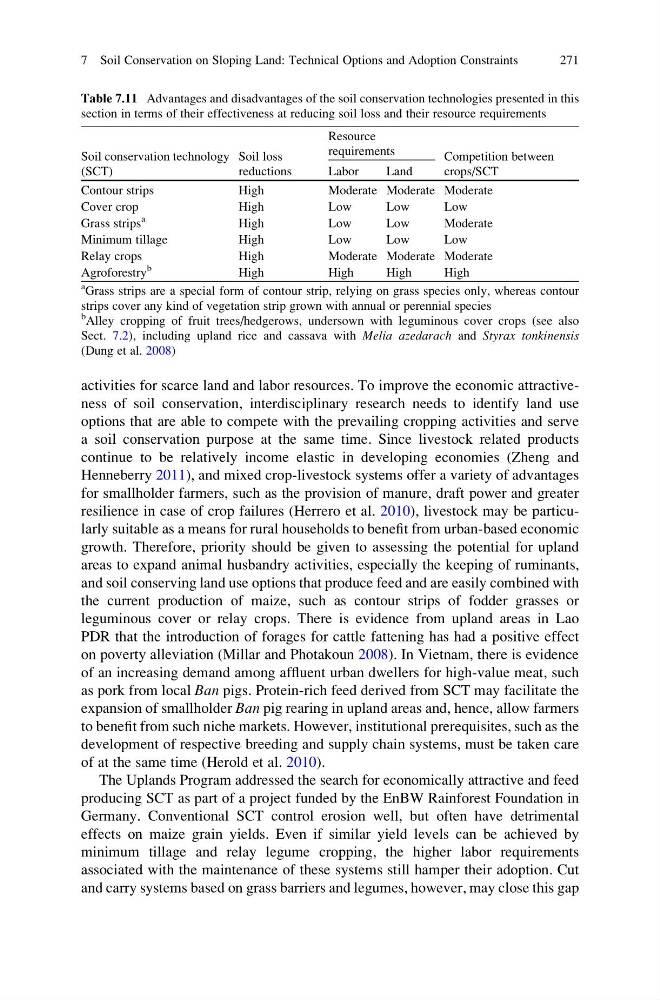
Table 7.11 Advantages and disadvantages of the soil conservation technologies presented in this
section in terms of their effectiveness at reducing soil loss and their resource requirements
Soil conservation technology
(SCT)
Soil loss
reductions
Resource
requirements
Competition between
crops/SCT
Labor
Land
Contour strips
High
Moderate Moderate Moderate
Cover crop
High
Low
Low
Low
Grass strips
a
High
Low
Low
Moderate
Minimum tillage
High
Low
Low
Low
Relay crops
High
Moderate Moderate Moderate
Agroforestry
b
High
High
High
High
a
Grass strips are a special form of contour strip, relying on grass species only, whereas contour
strips cover any kind of vegetation strip grown with annual or perennial species
b
Alley cropping of fruit trees/hedgerows, undersown with leguminous cover crops (see also
Sect. 7.2), including upland rice and cassava with Melia azedarach and Styrax tonkinensis
(Dung et al. 2008)
7 Soil Conservation on Sloping Land: Technical Options and Adoption Constraints
271
options that are able to compete with the prevailing cropping activities and serve
a soil conservation purpose at the same time. Since livestock related products
continue to be relatively income elastic in developing economies (Zheng and
Henneberry 2011), and mixed crop-livestock systems offer a variety of advantages
for smallholder farmers, such as the provision of manure, draft power and greater
resilience in case of crop failures (Herrero et al. 2010), livestock may be particularly suitable as a means for rural households to benefit from urban-based economic
growth. Therefore, priority should be given to assessing the potential for upland
areas to expand animal husbandry activities, especially the keeping of ruminants,
and soil conserving land use options that produce feed and are easily combined with
the current production of maize, such as contour strips of fodder grasses or
leguminous cover or relay crops. There is evidence from upland areas in Lao
PDR that the introduction of forages for cattle fattening has had a positive effect
on poverty alleviation (Millar and Photakoun 2008). In Vietnam, there is evidence
of an increasing demand among affluent urban dwellers for high-value meat, such
as pork from local Ban pigs. Protein-rich feed derived from SCT may facilitate the
expansion of smallholder Ban pig rearing in upland areas and, hence, allow farmers
to benefit from such niche markets. However, institutional prerequisites, such as the
development of respective breeding and supply chain systems, must be taken care
of at the same time (Herold et al. 2010).
The Uplands Program addressed the search for economically attractive and feed
producing SCT as part of a project funded by the EnBW Rainforest Foundation in
Germany. Conventional SCT control erosion well, but often have detrimental
effects on maize grain yields. Even if similar yield levels can be achieved by
minimum tillage and relay legume cropping, the higher labor requirements
associated with the maintenance of these systems still hamper their adoption. Cut
and carry systems based on grass barriers and legumes, however, may close this gap
Table 7.11 Advantages and disadvantages of the soil conservation technologies presented in this
section in terms of their effectiveness at reducing soil loss and their resource requirements
Soil conservation technology
(SCT)
Soil loss
reductions
Resource
requirements
Competition between
crops/SCT
Labor
Land
Contour strips
High
Moderate Moderate Moderate
Cover crop
High
Low
Low
Low
Grass strips
a
High
Low
Low
Moderate
Minimum tillage
High
Low
Low
Low
Relay crops
High
Moderate Moderate Moderate
Agroforestry
b
High
High
High
High
a
Grass strips are a special form of contour strip, relying on grass species only, whereas contour
strips cover any kind of vegetation strip grown with annual or perennial species
b
Alley cropping of fruit trees/hedgerows, undersown with leguminous cover crops (see also
Sect. 7.2), including upland rice and cassava with Melia azedarach and Styrax tonkinensis
(Dung et al. 2008)
7 Soil Conservation on Sloping Land: Technical Options and Adoption Constraints
271