

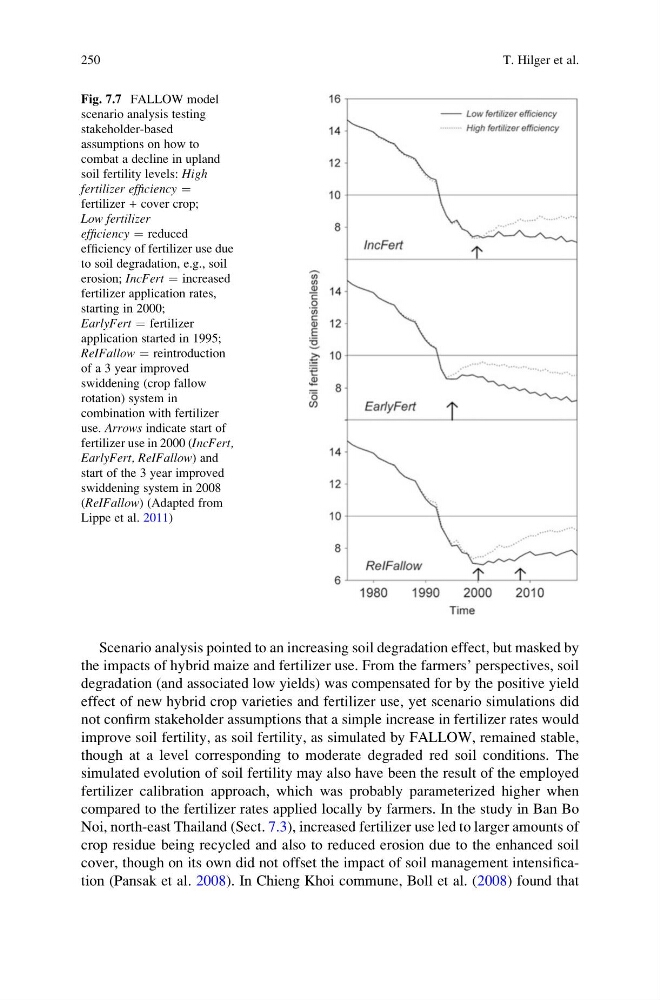
Scenario analysis pointed to an increasing soil degradation effect, but masked by
the impacts of hybrid maize and fertilizer use. From the farmers’ perspectives, soil
degradation (and associated low yields) was compensated for by the positive yield
effect of new hybrid crop varieties and fertilizer use, yet scenario simulations did
not confirm stakeholder assumptions that a simple increase in fertilizer rates would
improve soil fertility, as soil fertility, as simulated by FALLOW, remained stable,
though at a level corresponding to moderate degraded red soil conditions. The
simulated evolution of soil fertility may also have been the result of the employed
fertilizer calibration approach, which was probably parameterized higher when
compared to the fertilizer rates applied locally by farmers. In the study in Ban Bo
Noi, north-east Thailand (Sect. 7.3), increased fertilizer use led to larger amounts of
crop residue being recycled and also to reduced erosion due to the enhanced soil
cover, though on its own did not offset the impact of soil management intensification (Pansak et al. 2008). In Chieng Khoi commune, Boll et al. (2008) found that
Fig. 7.7 FALLOW model
scenario analysis testing
stakeholder-based
assumptions on how to
combat a decline in upland
soil fertility levels: High
fertilizer efficiency ¼
fertilizer + cover crop;
Low fertilizer
efficiency ¼ reduced
efficiency of fertilizer use due
to soil degradation, e.g., soil
erosion; IncFert ¼ increased
fertilizer application rates,
starting in 2000;
EarlyFert ¼ fertilizer
application started in 1995;
ReIFallow ¼ reintroduction
of a 3 year improved
swiddening (crop fallow
rotation) system in
combination with fertilizer
use. Arrows indicate start of
fertilizer use in 2000 (IncFert,
EarlyFert, ReIFallow) and
start of the 3 year improved
swiddening system in 2008
(ReIFallow) (Adapted from
Lippe et al. 2011)
250
T. Hilger et al.
the impacts of hybrid maize and fertilizer use. From the farmers’ perspectives, soil
degradation (and associated low yields) was compensated for by the positive yield
effect of new hybrid crop varieties and fertilizer use, yet scenario simulations did
not confirm stakeholder assumptions that a simple increase in fertilizer rates would
improve soil fertility, as soil fertility, as simulated by FALLOW, remained stable,
though at a level corresponding to moderate degraded red soil conditions. The
simulated evolution of soil fertility may also have been the result of the employed
fertilizer calibration approach, which was probably parameterized higher when
compared to the fertilizer rates applied locally by farmers. In the study in Ban Bo
Noi, north-east Thailand (Sect. 7.3), increased fertilizer use led to larger amounts of
crop residue being recycled and also to reduced erosion due to the enhanced soil
cover, though on its own did not offset the impact of soil management intensification (Pansak et al. 2008). In Chieng Khoi commune, Boll et al. (2008) found that
Fig. 7.7 FALLOW model
scenario analysis testing
stakeholder-based
assumptions on how to
combat a decline in upland
soil fertility levels: High
fertilizer efficiency ¼
fertilizer + cover crop;
Low fertilizer
efficiency ¼ reduced
efficiency of fertilizer use due
to soil degradation, e.g., soil
erosion; IncFert ¼ increased
fertilizer application rates,
starting in 2000;
EarlyFert ¼ fertilizer
application started in 1995;
ReIFallow ¼ reintroduction
of a 3 year improved
swiddening (crop fallow
rotation) system in
combination with fertilizer
use. Arrows indicate start of
fertilizer use in 2000 (IncFert,
EarlyFert, ReIFallow) and
start of the 3 year improved
swiddening system in 2008
(ReIFallow) (Adapted from
Lippe et al. 2011)
250
T. Hilger et al.