

At Ban Bo Muang Noi after 3 years, run-off from the fertilized control plot was
still significantly (p > 0.05) higher as compared to that from the hedgerow
treatments without fertilizer application. With regards to soil loss, a similar observation was made for the control plot without fertilizer (data not presented), but not
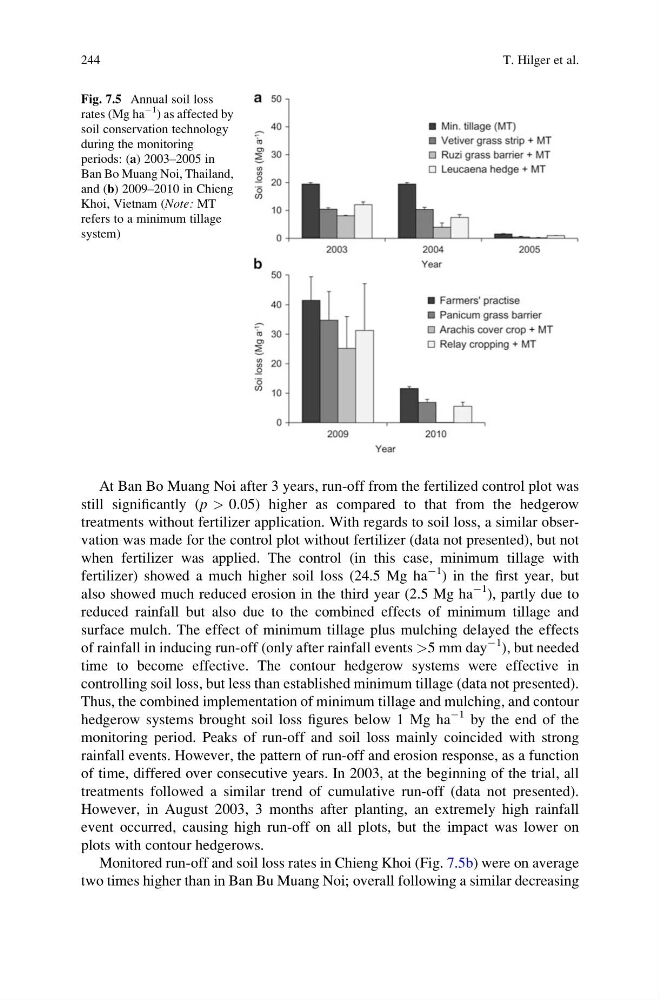
when fertilizer was applied. The control (in this case, minimum tillage with
fertilizer) showed a much higher soil loss (24.5 Mg ha
À1 ) in the first year, but
also showed much reduced erosion in the third year (2.5 Mg ha
À1 ), partly due to
reduced rainfall but also due to the combined effects of minimum tillage and
surface mulch. The effect of minimum tillage plus mulching delayed the effects
of rainfall in inducing run-off (only after rainfall events >5 mm day
À1 ), but needed
time to become effective. The contour hedgerow systems were effective in
controlling soil loss, but less than established minimum tillage (data not presented).
Thus, the combined implementation of minimum tillage and mulching, and contour
hedgerow systems brought soil loss figures below 1 Mg ha
À1 by the end of the
monitoring period. Peaks of run-off and soil loss mainly coincided with strong
rainfall events. However, the pattern of run-off and erosion response, as a function
of time, differed over consecutive years. In 2003, at the beginning of the trial, all
treatments followed a similar trend of cumulative run-off (data not presented).
However, in August 2003, 3 months after planting, an extremely high rainfall
event occurred, causing high run-off on all plots, but the impact was lower on
plots with contour hedgerows.
Monitored run-off and soil loss rates in Chieng Khoi (Fig. 7.5b) were on average
two times higher than in Ban Bu Muang Noi; overall following a similar decreasing
Fig. 7.5 Annual soil loss
rates (Mg ha
À1
) as affected by
soil conservation technology
during the monitoring
periods: (a) 2003–2005 in
Ban Bo Muang Noi, Thailand,
and (b) 2009–2010 in Chieng
Khoi, Vietnam (Note: MT
refers to a minimum tillage
system)
244
T. Hilger et al.
still significantly (p > 0.05) higher as compared to that from the hedgerow
treatments without fertilizer application. With regards to soil loss, a similar observation was made for the control plot without fertilizer (data not presented), but not
when fertilizer was applied. The control (in this case, minimum tillage with
fertilizer) showed a much higher soil loss (24.5 Mg ha
À1 ) in the first year, but
also showed much reduced erosion in the third year (2.5 Mg ha
À1 ), partly due to
reduced rainfall but also due to the combined effects of minimum tillage and
surface mulch. The effect of minimum tillage plus mulching delayed the effects
of rainfall in inducing run-off (only after rainfall events >5 mm day
À1 ), but needed
time to become effective. The contour hedgerow systems were effective in
controlling soil loss, but less than established minimum tillage (data not presented).
Thus, the combined implementation of minimum tillage and mulching, and contour
hedgerow systems brought soil loss figures below 1 Mg ha
À1 by the end of the
monitoring period. Peaks of run-off and soil loss mainly coincided with strong
rainfall events. However, the pattern of run-off and erosion response, as a function
of time, differed over consecutive years. In 2003, at the beginning of the trial, all
treatments followed a similar trend of cumulative run-off (data not presented).
However, in August 2003, 3 months after planting, an extremely high rainfall
event occurred, causing high run-off on all plots, but the impact was lower on
plots with contour hedgerows.
Monitored run-off and soil loss rates in Chieng Khoi (Fig. 7.5b) were on average
two times higher than in Ban Bu Muang Noi; overall following a similar decreasing
Fig. 7.5 Annual soil loss
rates (Mg ha
À1
) as affected by
soil conservation technology
during the monitoring
periods: (a) 2003–2005 in
Ban Bo Muang Noi, Thailand,
and (b) 2009–2010 in Chieng
Khoi, Vietnam (Note: MT
refers to a minimum tillage
system)
244
T. Hilger et al.