

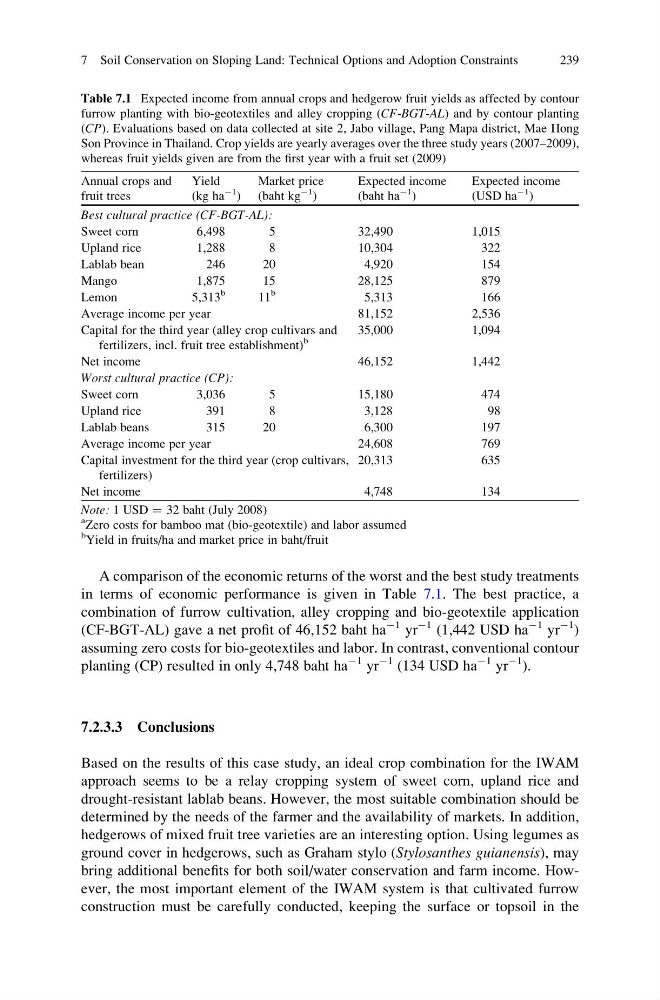
A comparison of the economic returns of the worst and the best study treatments
in terms of economic performance is given in Table 7.1. The best practice, a
combination of furrow cultivation, alley cropping and bio-geotextile application
(CF-BGT-AL) gave a net profit of 46,152 baht ha
À1 yr
À1 (1,442 USD ha
À1 yr
À1 )
assuming zero costs for bio-geotextiles and labor. In contrast, conventional contour
planting (CP) resulted in only 4,748 baht ha
À1 yr
À1 (134 USD ha
À1 yr
À1 ).
7.2.3.3 Conclusions
Based on the results of this case study, an ideal crop combination for the IWAM
approach seems to be a relay cropping system of sweet corn, upland rice and
drought-resistant lablab beans. However, the most suitable combination should be
determined by the needs of the farmer and the availability of markets. In addition,
hedgerows of mixed fruit tree varieties are an interesting option. Using legumes as
ground cover in hedgerows, such as Graham stylo (Stylosanthes guianensis), may
bring additional benefits for both soil/water conservation and farm income. However, the most important element of the IWAM system is that cultivated furrow
construction must be carefully conducted, keeping the surface or topsoil in the
Table 7.1 Expected income from annual crops and hedgerow fruit yields as affected by contour
furrow planting with bio-geotextiles and alley cropping (CF-BGT-AL) and by contour planting
(CP). Evaluations based on data collected at site 2, Jabo village, Pang Mapa district, Mae Hong
Son Province in Thailand. Crop yields are yearly averages over the three study years (2007–2009),
whereas fruit yields given are from the first year with a fruit set (2009)
Annual crops and
fruit trees
Yield
(kg ha
À1
)
Market price
(baht kg
À1
)
Expected income
(baht ha
À1
)
Expected income
(USD ha
À1
)
Best cultural practice (CF-BGT-AL):
Sweet corn
6,498
5
32,490
1,015
Upland rice
1,288
8
10,304
322
Lablab bean
246
20
4,920
154
Mango
1,875
15
28,125
879
Lemon
5,313
b
11
b
5,313
166
Average income per year
81,152
2,536
Capital for the third year (alley crop cultivars and
fertilizers, incl. fruit tree establishment)
b
35,000
1,094
Net income
46,152
1,442
Worst cultural practice (CP):
Sweet corn
3,036
5
15,180
474
Upland rice
391
8
3,128
98
Lablab beans
315
20
6,300
197
Average income per year
24,608
769
Capital investment for the third year (crop cultivars,
fertilizers)
20,313
635
Net income
4,748
134
Note: 1 USD ¼ 32 baht (July 2008)
a
Zero costs for bamboo mat (bio-geotextile) and labor assumed
b
Yield in fruits/ha and market price in baht/fruit
7 Soil Conservation on Sloping Land: Technical Options and Adoption Constraints
239
in terms of economic performance is given in Table 7.1. The best practice, a
combination of furrow cultivation, alley cropping and bio-geotextile application
(CF-BGT-AL) gave a net profit of 46,152 baht ha
À1 yr
À1 (1,442 USD ha
À1 yr
À1 )
assuming zero costs for bio-geotextiles and labor. In contrast, conventional contour
planting (CP) resulted in only 4,748 baht ha
À1 yr
À1 (134 USD ha
À1 yr
À1 ).
7.2.3.3 Conclusions
Based on the results of this case study, an ideal crop combination for the IWAM
approach seems to be a relay cropping system of sweet corn, upland rice and
drought-resistant lablab beans. However, the most suitable combination should be
determined by the needs of the farmer and the availability of markets. In addition,
hedgerows of mixed fruit tree varieties are an interesting option. Using legumes as
ground cover in hedgerows, such as Graham stylo (Stylosanthes guianensis), may
bring additional benefits for both soil/water conservation and farm income. However, the most important element of the IWAM system is that cultivated furrow
construction must be carefully conducted, keeping the surface or topsoil in the
Table 7.1 Expected income from annual crops and hedgerow fruit yields as affected by contour
furrow planting with bio-geotextiles and alley cropping (CF-BGT-AL) and by contour planting
(CP). Evaluations based on data collected at site 2, Jabo village, Pang Mapa district, Mae Hong
Son Province in Thailand. Crop yields are yearly averages over the three study years (2007–2009),
whereas fruit yields given are from the first year with a fruit set (2009)
Annual crops and
fruit trees
Yield
(kg ha
À1
)
Market price
(baht kg
À1
)
Expected income
(baht ha
À1
)
Expected income
(USD ha
À1
)
Best cultural practice (CF-BGT-AL):
Sweet corn
6,498
5
32,490
1,015
Upland rice
1,288
8
10,304
322
Lablab bean
246
20
4,920
154
Mango
1,875
15
28,125
879
Lemon
5,313
b
11
b
5,313
166
Average income per year
81,152
2,536
Capital for the third year (alley crop cultivars and
fertilizers, incl. fruit tree establishment)
b
35,000
1,094
Net income
46,152
1,442
Worst cultural practice (CP):
Sweet corn
3,036
5
15,180
474
Upland rice
391
8
3,128
98
Lablab beans
315
20
6,300
197
Average income per year
24,608
769
Capital investment for the third year (crop cultivars,
fertilizers)
20,313
635
Net income
4,748
134
Note: 1 USD ¼ 32 baht (July 2008)
a
Zero costs for bamboo mat (bio-geotextile) and labor assumed
b
Yield in fruits/ha and market price in baht/fruit
7 Soil Conservation on Sloping Land: Technical Options and Adoption Constraints
239