

An RQ value higher than unity indicates that it is likely that the compound poses a
significant risk to the aquatic environment. If the RQ value is lower than unity it is
likely that an unacceptable effect will not occur. Typically, the PEC is derived from
simulation studies; for instance, based on exposure or transport models. Measured
data are however more reliable than simulated data and these are to be preferred if
available. The PNEC value of a pesticide is derived from one of the above mentioned
critical concentrations (C crit ). If available, the NOEC is used as a risk indicator, yet if
NOEC data are missing then the lowest acute toxicity of the LC 50 and EC 50 can be
used. To take into account the uncertainty inherent in extrapolating from laboratory
toxicity tests and a limited number of species to the “real” environment, C crit is
divided by the so-called assessment factor (AF) to derive the final PNEC.
PNEC ¼
C crit
AF
(4.2)
The AF depends on the number and type of available toxicity data and has values
of 10, 100 or 1,000. For further details on the derivation of AF, see Commission of
European Communities (2003).
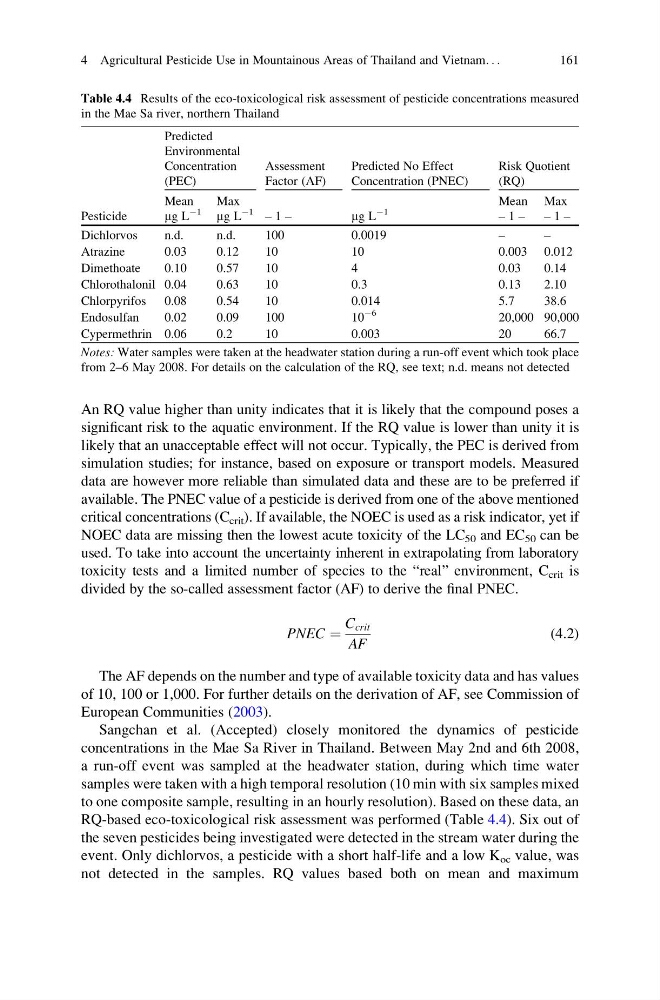
Sangchan et al. (Accepted) closely monitored the dynamics of pesticide
concentrations in the Mae Sa River in Thailand. Between May 2nd and 6th 2008,
a run-off event was sampled at the headwater station, during which time water
samples were taken with a high temporal resolution (10 min with six samples mixed
to one composite sample, resulting in an hourly resolution). Based on these data, an
RQ-based eco-toxicological risk assessment was performed (Table 4.4). Six out of
the seven pesticides being investigated were detected in the stream water during the
event. Only dichlorvos, a pesticide with a short half-life and a low K oc value, was
not detected in the samples. RQ values based both on mean and maximum
Table 4.4 Results of the eco-toxicological risk assessment of pesticide concentrations measured
in the Mae Sa river, northern Thailand
Pesticide
Predicted
Environmental
Concentration
(PEC)
Assessment
Factor (AF)
Predicted No Effect
Concentration (PNEC)
Risk Quotient
(RQ)
Mean
mg L
À1
Max
mg L
À1 – 1 –
mg L
À1
Mean
– 1 –
Max
– 1 –
Dichlorvos
n.d.
n.d.
100
0.0019
–
–
Atrazine
0.03
0.12
10
10
0.003 0.012
Dimethoate
0.10
0.57
10
4
0.03
0.14
Chlorothalonil 0.04
0.63
10
0.3
0.13
2.10
Chlorpyrifos 0.08
0.54
10
0.014
5.7
38.6
Endosulfan
0.02
0.09
100
10
À6
20,000 90,000
Cypermethrin 0.06
0.2
10
0.003
20
66.7
Notes: Water samples were taken at the headwater station during a run-off event which took place
from 2–6 May 2008. For details on the calculation of the RQ, see text; n.d. means not detected
4 Agricultural Pesticide Use in Mountainous Areas of Thailand and Vietnam. . .
161
significant risk to the aquatic environment. If the RQ value is lower than unity it is
likely that an unacceptable effect will not occur. Typically, the PEC is derived from
simulation studies; for instance, based on exposure or transport models. Measured
data are however more reliable than simulated data and these are to be preferred if
available. The PNEC value of a pesticide is derived from one of the above mentioned
critical concentrations (C crit ). If available, the NOEC is used as a risk indicator, yet if
NOEC data are missing then the lowest acute toxicity of the LC 50 and EC 50 can be
used. To take into account the uncertainty inherent in extrapolating from laboratory
toxicity tests and a limited number of species to the “real” environment, C crit is
divided by the so-called assessment factor (AF) to derive the final PNEC.
PNEC ¼
C crit
AF
(4.2)
The AF depends on the number and type of available toxicity data and has values
of 10, 100 or 1,000. For further details on the derivation of AF, see Commission of
European Communities (2003).
Sangchan et al. (Accepted) closely monitored the dynamics of pesticide
concentrations in the Mae Sa River in Thailand. Between May 2nd and 6th 2008,
a run-off event was sampled at the headwater station, during which time water
samples were taken with a high temporal resolution (10 min with six samples mixed
to one composite sample, resulting in an hourly resolution). Based on these data, an
RQ-based eco-toxicological risk assessment was performed (Table 4.4). Six out of
the seven pesticides being investigated were detected in the stream water during the
event. Only dichlorvos, a pesticide with a short half-life and a low K oc value, was
not detected in the samples. RQ values based both on mean and maximum
Table 4.4 Results of the eco-toxicological risk assessment of pesticide concentrations measured
in the Mae Sa river, northern Thailand
Pesticide
Predicted
Environmental
Concentration
(PEC)
Assessment
Factor (AF)
Predicted No Effect
Concentration (PNEC)
Risk Quotient
(RQ)
Mean
mg L
À1
Max
mg L
À1 – 1 –
mg L
À1
Mean
– 1 –
Max
– 1 –
Dichlorvos
n.d.
n.d.
100
0.0019
–
–
Atrazine
0.03
0.12
10
10
0.003 0.012
Dimethoate
0.10
0.57
10
4
0.03
0.14
Chlorothalonil 0.04
0.63
10
0.3
0.13
2.10
Chlorpyrifos 0.08
0.54
10
0.014
5.7
38.6
Endosulfan
0.02
0.09
100
10
À6
20,000 90,000
Cypermethrin 0.06
0.2
10
0.003
20
66.7
Notes: Water samples were taken at the headwater station during a run-off event which took place
from 2–6 May 2008. For details on the calculation of the RQ, see text; n.d. means not detected
4 Agricultural Pesticide Use in Mountainous Areas of Thailand and Vietnam. . .
161