

management, especially for irrigation purposes, influences the fraction and timing
of sediment associated nutrients released to lowland cropping areas. The following
case study describes sediment redistribution within the landscape and its effects on
downstream rice production areas, as influenced by irrigation networks (Schmitter
et al. 2010, 2011, 2012).
3.4.1 The Influence of a Reservoir on Irrigated Nutrient Loads
An assessment of C and N reallocation was performed within a sub-catchment of
the Chieng Khoi watershed, which has an irrigation reservoir with a capacity of
1 Â 10
6 m
3 . As mentioned earlier, irrigation management is performed through the
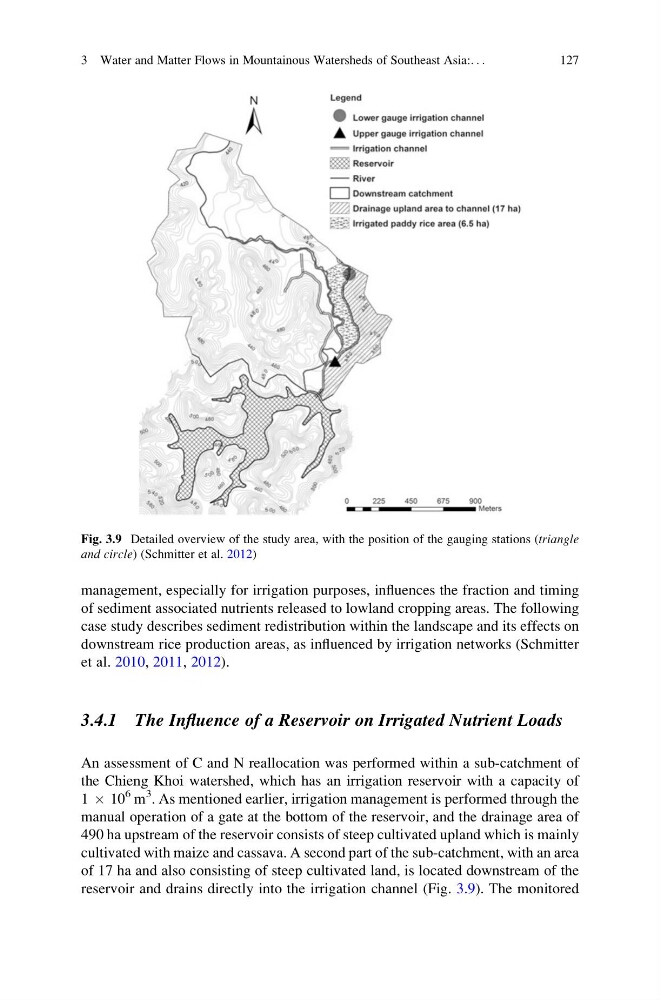
manual operation of a gate at the bottom of the reservoir, and the drainage area of
490 ha upstream of the reservoir consists of steep cultivated upland which is mainly
cultivated with maize and cassava. A second part of the sub-catchment, with an area
of 17 ha and also consisting of steep cultivated land, is located downstream of the
reservoir and drains directly into the irrigation channel (Fig. 3.9). The monitored
Fig. 3.9 Detailed overview of the study area, with the position of the gauging stations (triangle
and circle) (Schmitter et al. 2012)
3 Water and Matter Flows in Mountainous Watersheds of Southeast Asia:. . .
127
of sediment associated nutrients released to lowland cropping areas. The following
case study describes sediment redistribution within the landscape and its effects on
downstream rice production areas, as influenced by irrigation networks (Schmitter
et al. 2010, 2011, 2012).
3.4.1 The Influence of a Reservoir on Irrigated Nutrient Loads
An assessment of C and N reallocation was performed within a sub-catchment of
the Chieng Khoi watershed, which has an irrigation reservoir with a capacity of
1 Â 10
6 m
3 . As mentioned earlier, irrigation management is performed through the
manual operation of a gate at the bottom of the reservoir, and the drainage area of
490 ha upstream of the reservoir consists of steep cultivated upland which is mainly
cultivated with maize and cassava. A second part of the sub-catchment, with an area
of 17 ha and also consisting of steep cultivated land, is located downstream of the
reservoir and drains directly into the irrigation channel (Fig. 3.9). The monitored
Fig. 3.9 Detailed overview of the study area, with the position of the gauging stations (triangle
and circle) (Schmitter et al. 2012)
3 Water and Matter Flows in Mountainous Watersheds of Southeast Asia:. . .
127