

The abrupt onset of the flood prevented local people from taking action aimed at
reducing the spread and penetration of the floodwaters through the use of flood
prevention measures. In the end, emergency interventions were limited to
protecting public infrastructure such as bridges or community houses. Shortly
after the flood had passed, the communal people’s committee initiated reconstruction work on the public infrastructure, and as a result, each household in Chieng
Khoi had to contribute one person for this task (Schad et al. 2012).
The direct agro-environmental impacts of the flood were diverse. Both the
breaking of fishpond dykes by the flood and the washing over of neighboring
ponds resulted in the significant loss of farmed fish. Rice plants in the paddy fields
close to the river were severely damaged, and the flood also demolished irrigation
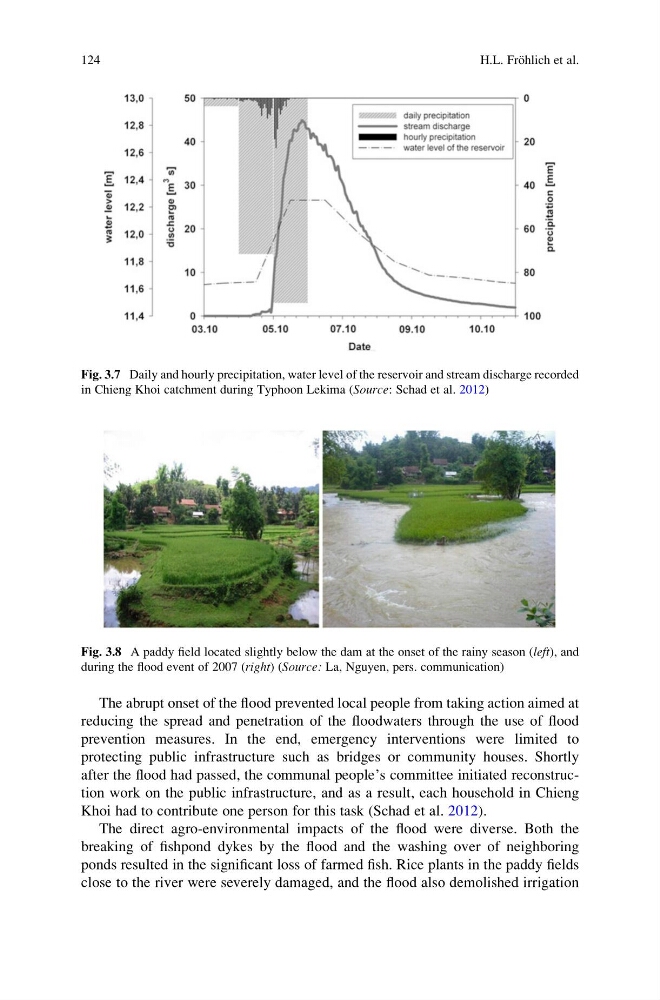
Fig. 3.7 Daily and hourly precipitation, water level of the reservoir and stream discharge recorded
in Chieng Khoi catchment during Typhoon Lekima (Source: Schad et al. 2012)
Fig. 3.8 A paddy field located slightly below the dam at the onset of the rainy season (left), and
during the flood event of 2007 (right) (Source: La, Nguyen, pers. communication)
124
H.L. Fro ¨hlich et al.
reducing the spread and penetration of the floodwaters through the use of flood
prevention measures. In the end, emergency interventions were limited to
protecting public infrastructure such as bridges or community houses. Shortly
after the flood had passed, the communal people’s committee initiated reconstruction work on the public infrastructure, and as a result, each household in Chieng
Khoi had to contribute one person for this task (Schad et al. 2012).
The direct agro-environmental impacts of the flood were diverse. Both the
breaking of fishpond dykes by the flood and the washing over of neighboring
ponds resulted in the significant loss of farmed fish. Rice plants in the paddy fields
close to the river were severely damaged, and the flood also demolished irrigation
Fig. 3.7 Daily and hourly precipitation, water level of the reservoir and stream discharge recorded
in Chieng Khoi catchment during Typhoon Lekima (Source: Schad et al. 2012)
Fig. 3.8 A paddy field located slightly below the dam at the onset of the rainy season (left), and
during the flood event of 2007 (right) (Source: La, Nguyen, pers. communication)
124
H.L. Fro ¨hlich et al.