

components of understanding to be in place: (1) the complex interplay of biophysical processes on hill slopes, which often involve non-linear mechanisms such as
thresholds and storage effects, (2) knowledge on how these processes are scaled and
connected throughout the catchment (e.g., Collins and Walling 2004), and
(3) through which process combinations – defined hereafter as process domains –
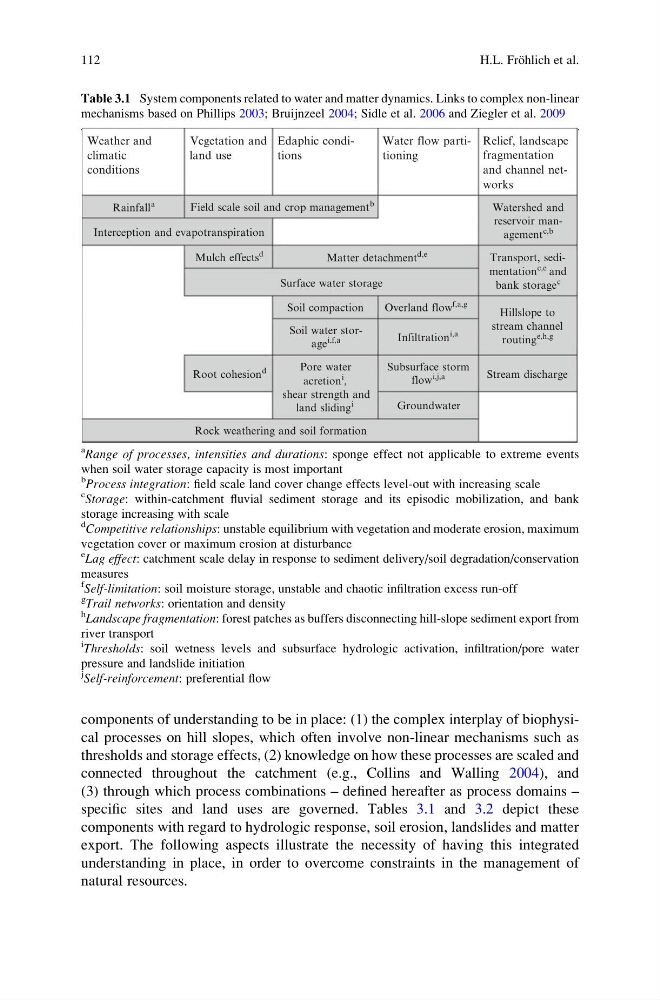
specific sites and land uses are governed. Tables 3.1 and 3.2 depict these
components with regard to hydrologic response, soil erosion, landslides and matter
export. The following aspects illustrate the necessity of having this integrated
understanding in place, in order to overcome constraints in the management of
natural resources.
Table 3.1 System components related to water and matter dynamics. Links to complex non-linear
mechanisms based on Phillips 2003; Bruijnzeel 2004; Sidle et al. 2006 and Ziegler et al. 2009
Weather and
Vegetation and Edaphic condiWater flow parti- Relief, landscape
fragmentation
and channel networks
tioning
tions
land use
climatic
conditions
Rainfall
a
Interception and evapotranspiration
Mulch effects
d
Surface water storage
Soil compaction
Root cohesion
d
Pore water
shear strength and
land sliding
i
Rock weathering and soil formation
acretion
i
,
Soil water storage
i,f,a
Overland flow
f,a,g
Infiltration
i,a
Subsurface storm
flow
i,j,a
Matter detachment
d,e
Watershed and
reservoir management
c,b
Transport, sedimentation
c,e and
bank storage
c
Hillslope to
stream channel
routing
e,h,g
Stream discharge
Field scale soil and crop management
b
Groundwater
a
Range of processes, intensities and durations: sponge effect not applicable to extreme events
when soil water storage capacity is most important
b
Process integration: field scale land cover change effects level-out with increasing scale
c
Storage: within-catchment fluvial sediment storage and its episodic mobilization, and bank
storage increasing with scale
d
Competitive relationships: unstable equilibrium with vegetation and moderate erosion, maximum
vegetation cover or maximum erosion at disturbance
e
Lag effect: catchment scale delay in response to sediment delivery/soil degradation/conservation
measures
f
Self-limitation: soil moisture storage, unstable and chaotic infiltration excess run-off
g
Trail networks: orientation and density
h
Landscape fragmentation: forest patches as buffers disconnecting hill-slope sediment export from
river transport
i Thresholds: soil wetness levels and subsurface hydrologic activation, infiltration/pore water
pressure and landslide initiation
j Self-reinforcement: preferential flow
112
H.L. Fro ¨hlich et al.
thresholds and storage effects, (2) knowledge on how these processes are scaled and
connected throughout the catchment (e.g., Collins and Walling 2004), and
(3) through which process combinations – defined hereafter as process domains –
specific sites and land uses are governed. Tables 3.1 and 3.2 depict these
components with regard to hydrologic response, soil erosion, landslides and matter
export. The following aspects illustrate the necessity of having this integrated
understanding in place, in order to overcome constraints in the management of
natural resources.
Table 3.1 System components related to water and matter dynamics. Links to complex non-linear
mechanisms based on Phillips 2003; Bruijnzeel 2004; Sidle et al. 2006 and Ziegler et al. 2009
Weather and
Vegetation and Edaphic condiWater flow parti- Relief, landscape
fragmentation
and channel networks
tioning
tions
land use
climatic
conditions
Rainfall
a
Interception and evapotranspiration
Mulch effects
d
Surface water storage
Soil compaction
Root cohesion
d
Pore water
shear strength and
land sliding
i
Rock weathering and soil formation
acretion
i
,
Soil water storage
i,f,a
Overland flow
f,a,g
Infiltration
i,a
Subsurface storm
flow
i,j,a
Matter detachment
d,e
Watershed and
reservoir management
c,b
Transport, sedimentation
c,e and
bank storage
c
Hillslope to
stream channel
routing
e,h,g
Stream discharge
Field scale soil and crop management
b
Groundwater
a
Range of processes, intensities and durations: sponge effect not applicable to extreme events
when soil water storage capacity is most important
b
Process integration: field scale land cover change effects level-out with increasing scale
c
Storage: within-catchment fluvial sediment storage and its episodic mobilization, and bank
storage increasing with scale
d
Competitive relationships: unstable equilibrium with vegetation and moderate erosion, maximum
vegetation cover or maximum erosion at disturbance
e
Lag effect: catchment scale delay in response to sediment delivery/soil degradation/conservation
measures
f
Self-limitation: soil moisture storage, unstable and chaotic infiltration excess run-off
g
Trail networks: orientation and density
h
Landscape fragmentation: forest patches as buffers disconnecting hill-slope sediment export from
river transport
i Thresholds: soil wetness levels and subsurface hydrologic activation, infiltration/pore water
pressure and landslide initiation
j Self-reinforcement: preferential flow
112
H.L. Fro ¨hlich et al.