

to a depth of >80 cm for the home garden profile suggests that sedimentation is not
an exception, but a frequently occurring process.
Changed soil organic matter content or stocks are a good indicator of chemical
soil fertility dynamics; however, their use in evaluating the effects of erosion are
limited because they are largely driven by litter addition and decomposition. Other
chemical soil fertility parameters like the stock of available nutrients can explain
erosion impacts only in part, because fertilization and crop uptake might superimpose these effects. Despite these limitations, an analysis of soils in the Chieng Khoi
catchment was able to highlight some of the effects of soil erosion on soil fertility.
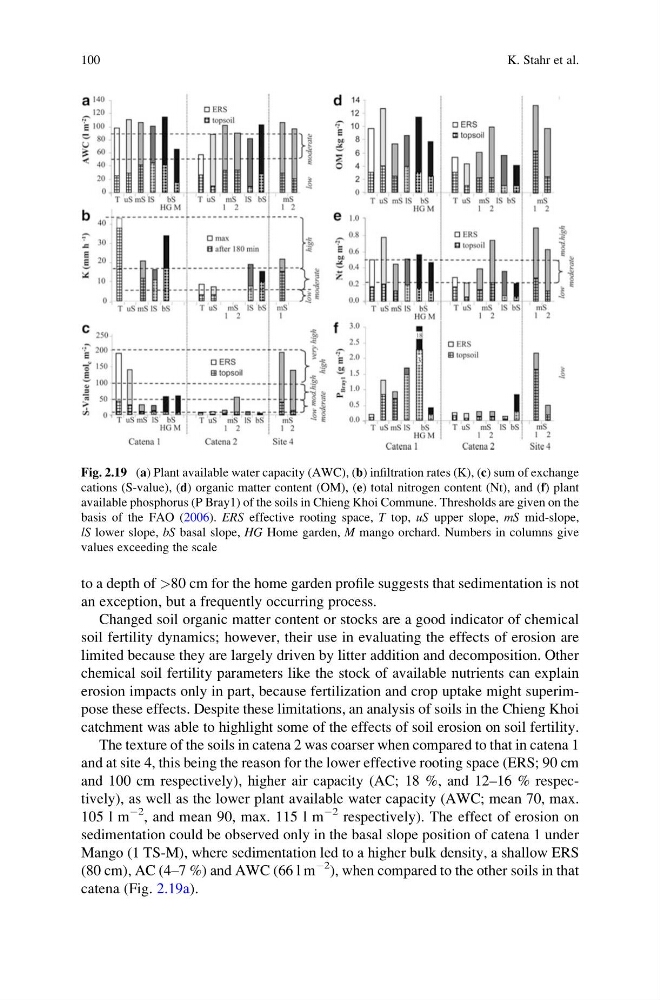
The texture of the soils in catena 2 was coarser when compared to that in catena 1
and at site 4, this being the reason for the lower effective rooting space (ERS; 90 cm
and 100 cm respectively), higher air capacity (AC; 18 %, and 12–16 % respectively), as well as the lower plant available water capacity (AWC; mean 70, max.
105 l m
À2 , and mean 90, max. 115 l m
À2 respectively). The effect of erosion on
sedimentation could be observed only in the basal slope position of catena 1 under
Mango (1 TS-M), where sedimentation led to a higher bulk density, a shallow ERS
(80 cm), AC (4–7 %) and AWC (66 l m
À2 ), when compared to the other soils in that
catena (Fig. 2.19a).
Fig. 2.19 (a) Plant available water capacity (AWC), (b) infiltration rates (K), (c) sum of exchange
cations (S-value), (d) organic matter content (OM), (e) total nitrogen content (Nt), and (f) plant
available phosphorus (P Bray1) of the soils in Chieng Khoi Commune. Thresholds are given on the
basis of the FAO (2006). ERS effective rooting space, T top, uS upper slope, mS mid-slope,
lS lower slope, bS basal slope, HG Home garden, M mango orchard. Numbers in columns give
values exceeding the scale
100
K. Stahr et al.
an exception, but a frequently occurring process.
Changed soil organic matter content or stocks are a good indicator of chemical
soil fertility dynamics; however, their use in evaluating the effects of erosion are
limited because they are largely driven by litter addition and decomposition. Other
chemical soil fertility parameters like the stock of available nutrients can explain
erosion impacts only in part, because fertilization and crop uptake might superimpose these effects. Despite these limitations, an analysis of soils in the Chieng Khoi
catchment was able to highlight some of the effects of soil erosion on soil fertility.
The texture of the soils in catena 2 was coarser when compared to that in catena 1
and at site 4, this being the reason for the lower effective rooting space (ERS; 90 cm
and 100 cm respectively), higher air capacity (AC; 18 %, and 12–16 % respectively), as well as the lower plant available water capacity (AWC; mean 70, max.
105 l m
À2 , and mean 90, max. 115 l m
À2 respectively). The effect of erosion on
sedimentation could be observed only in the basal slope position of catena 1 under
Mango (1 TS-M), where sedimentation led to a higher bulk density, a shallow ERS
(80 cm), AC (4–7 %) and AWC (66 l m
À2 ), when compared to the other soils in that
catena (Fig. 2.19a).
Fig. 2.19 (a) Plant available water capacity (AWC), (b) infiltration rates (K), (c) sum of exchange
cations (S-value), (d) organic matter content (OM), (e) total nitrogen content (Nt), and (f) plant
available phosphorus (P Bray1) of the soils in Chieng Khoi Commune. Thresholds are given on the
basis of the FAO (2006). ERS effective rooting space, T top, uS upper slope, mS mid-slope,
lS lower slope, bS basal slope, HG Home garden, M mango orchard. Numbers in columns give
values exceeding the scale
100
K. Stahr et al.