

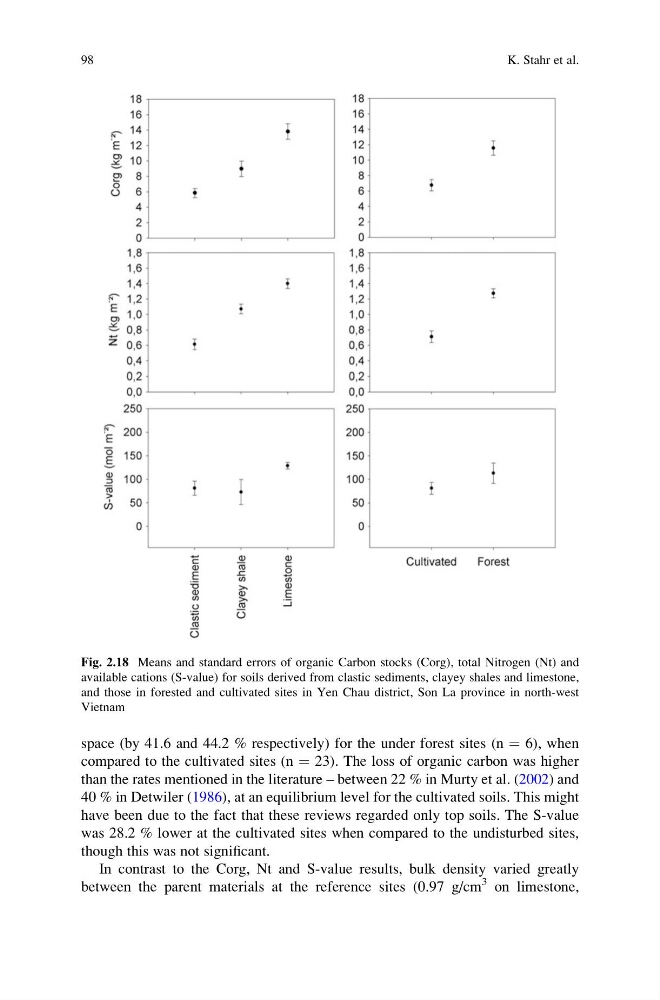
space (by 41.6 and 44.2 % respectively) for the under forest sites (n ¼ 6), when
compared to the cultivated sites (n ¼ 23). The loss of organic carbon was higher
than the rates mentioned in the literature – between 22 % in Murty et al. (2002) and
40 % in Detwiler (1986), at an equilibrium level for the cultivated soils. This might
have been due to the fact that these reviews regarded only top soils. The S-value
was 28.2 % lower at the cultivated sites when compared to the undisturbed sites,
though this was not significant.
In contrast to the Corg, Nt and S-value results, bulk density varied greatly
between the parent materials at the reference sites (0.97 g/cm
3 on limestone,
Fig. 2.18 Means and standard errors of organic Carbon stocks (Corg), total Nitrogen (Nt) and
available cations (S-value) for soils derived from clastic sediments, clayey shales and limestone,
and those in forested and cultivated sites in Yen Chau district, Son La province in north-west
Vietnam
98
K. Stahr et al.
compared to the cultivated sites (n ¼ 23). The loss of organic carbon was higher
than the rates mentioned in the literature – between 22 % in Murty et al. (2002) and
40 % in Detwiler (1986), at an equilibrium level for the cultivated soils. This might
have been due to the fact that these reviews regarded only top soils. The S-value
was 28.2 % lower at the cultivated sites when compared to the undisturbed sites,
though this was not significant.
In contrast to the Corg, Nt and S-value results, bulk density varied greatly
between the parent materials at the reference sites (0.97 g/cm
3 on limestone,
Fig. 2.18 Means and standard errors of organic Carbon stocks (Corg), total Nitrogen (Nt) and
available cations (S-value) for soils derived from clastic sediments, clayey shales and limestone,
and those in forested and cultivated sites in Yen Chau district, Son La province in north-west
Vietnam
98
K. Stahr et al.