

Soils were described and classified according to FAO guidelines (FAO 2006)
and the IUSS Working Group WRB (2006). The characterization of the physical
soil properties was estimated or measured, with the effective rooting space (ERS)
and plant available water capacity (AWC) estimated according to the FAO
guidelines (FAO 2006). Bulk density (BD) and infiltration rates were measured,
and for the latter double rings were used with a constant pressure and a measuring
time of 3 h (for details see Dung 2010). The characterization of soil nutrient statuses
was determined (Schlichting et al. 1995) using the following methods. Organic
carbon (C org), total carbon (Ct) and total nitrogen (Nt) contents were analyzed
through dry combustion, as measured by Leco Instruments GmbH, Krefeld,
Germany, while the organic matter (OM) content was estimated by multiplying C
org by 1.7. Cation exchange capacity (CEC), the exchangeable cations Ca
2+ , Mg
2+ ,
K
+
, Na
+ (ammonium acetate pH 7 method), S-values (portion of CEC occupied by
Ca
2+ , Mg
2+ , K
+ , Na
+
) and the plant available phosphorus (P-Bray1) (extraction by
0.03 M NH 4 F and 0.025 M HCl, quantification spectro-photometrically using the
molybdenum blue method). For calculating the nutrient stocks per total soil volume
(g, kg or mol c m
À2 ), any value of a soil layer below 30 cm in depth was halved. This
was done to account for the higher root densities and the resulting higher nutrient
uptake in top soils when compared to deeper soil horizons. Soils were determined,
among other things, by the parent materials, with almost all the sloped soils
showing clay-cutans. Luvisols and Alisols were the most common soil types,
while on hill crests Leptosols and Cambisols were found (Clemens et al. 2010).
A typical catena on limestone comprised of Rendzic or Haplic Leptosols, and
Haplic Phaeozems on very steep upper slopes (>70 %), Luvic Phaeozems and
Cutanic Luvisols at mid-slope and foot slope positions, and Cutanic Alisols on flat
land. On clayey shale, Cutanic Alisols and Alic Stagnosols were widespread
(Haering et al. 2008), whilst on marl (NK-M), clay rich soil with a prismatic
structure showing deep vertical cracks in the dry season was revealed (Vertisols).
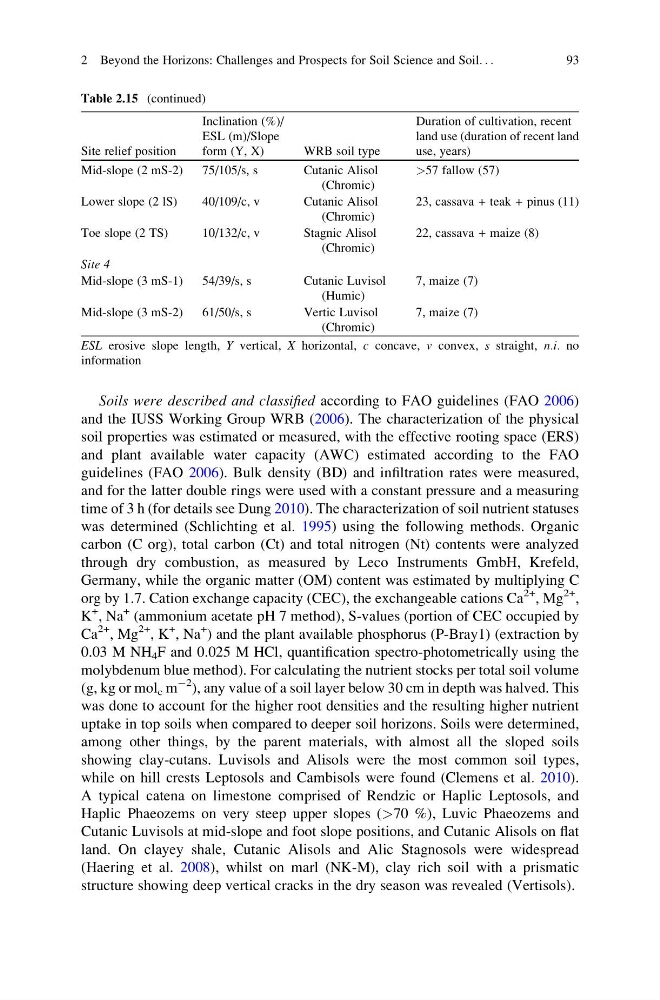
Table 2.15 (continued)
Site relief position
Inclination (%)/
ESL (m)/Slope
form (Y, X)
WRB soil type
Duration of cultivation, recent
land use (duration of recent land
use, years)
Mid-slope (2 mS-2)
75/105/s, s
Cutanic Alisol
(Chromic)
>57 fallow (57)
Lower slope (2 lS)
40/109/c, v
Cutanic Alisol
(Chromic)
23, cassava + teak + pinus (11)
Toe slope (2 TS)
10/132/c, v
Stagnic Alisol
(Chromic)
22, cassava + maize (8)
Site 4
Mid-slope (3 mS-1)
54/39/s, s
Cutanic Luvisol
(Humic)
7, maize (7)
Mid-slope (3 mS-2)
61/50/s, s
Vertic Luvisol
(Chromic)
7, maize (7)
ESL erosive slope length, Y vertical, X horizontal, c concave, v convex, s straight, n.i. no
information
2 Beyond the Horizons: Challenges and Prospects for Soil Science and Soil. . .
93
and the IUSS Working Group WRB (2006). The characterization of the physical
soil properties was estimated or measured, with the effective rooting space (ERS)
and plant available water capacity (AWC) estimated according to the FAO
guidelines (FAO 2006). Bulk density (BD) and infiltration rates were measured,
and for the latter double rings were used with a constant pressure and a measuring
time of 3 h (for details see Dung 2010). The characterization of soil nutrient statuses
was determined (Schlichting et al. 1995) using the following methods. Organic
carbon (C org), total carbon (Ct) and total nitrogen (Nt) contents were analyzed
through dry combustion, as measured by Leco Instruments GmbH, Krefeld,
Germany, while the organic matter (OM) content was estimated by multiplying C
org by 1.7. Cation exchange capacity (CEC), the exchangeable cations Ca
2+ , Mg
2+ ,
K
+
, Na
+ (ammonium acetate pH 7 method), S-values (portion of CEC occupied by
Ca
2+ , Mg
2+ , K
+ , Na
+
) and the plant available phosphorus (P-Bray1) (extraction by
0.03 M NH 4 F and 0.025 M HCl, quantification spectro-photometrically using the
molybdenum blue method). For calculating the nutrient stocks per total soil volume
(g, kg or mol c m
À2 ), any value of a soil layer below 30 cm in depth was halved. This
was done to account for the higher root densities and the resulting higher nutrient
uptake in top soils when compared to deeper soil horizons. Soils were determined,
among other things, by the parent materials, with almost all the sloped soils
showing clay-cutans. Luvisols and Alisols were the most common soil types,
while on hill crests Leptosols and Cambisols were found (Clemens et al. 2010).
A typical catena on limestone comprised of Rendzic or Haplic Leptosols, and
Haplic Phaeozems on very steep upper slopes (>70 %), Luvic Phaeozems and
Cutanic Luvisols at mid-slope and foot slope positions, and Cutanic Alisols on flat
land. On clayey shale, Cutanic Alisols and Alic Stagnosols were widespread
(Haering et al. 2008), whilst on marl (NK-M), clay rich soil with a prismatic
structure showing deep vertical cracks in the dry season was revealed (Vertisols).
Table 2.15 (continued)
Site relief position
Inclination (%)/
ESL (m)/Slope
form (Y, X)
WRB soil type
Duration of cultivation, recent
land use (duration of recent land
use, years)
Mid-slope (2 mS-2)
75/105/s, s
Cutanic Alisol
(Chromic)
>57 fallow (57)
Lower slope (2 lS)
40/109/c, v
Cutanic Alisol
(Chromic)
23, cassava + teak + pinus (11)
Toe slope (2 TS)
10/132/c, v
Stagnic Alisol
(Chromic)
22, cassava + maize (8)
Site 4
Mid-slope (3 mS-1)
54/39/s, s
Cutanic Luvisol
(Humic)
7, maize (7)
Mid-slope (3 mS-2)
61/50/s, s
Vertic Luvisol
(Chromic)
7, maize (7)
ESL erosive slope length, Y vertical, X horizontal, c concave, v convex, s straight, n.i. no
information
2 Beyond the Horizons: Challenges and Prospects for Soil Science and Soil. . .
93