

82
2 Experiments in Pebble Flows
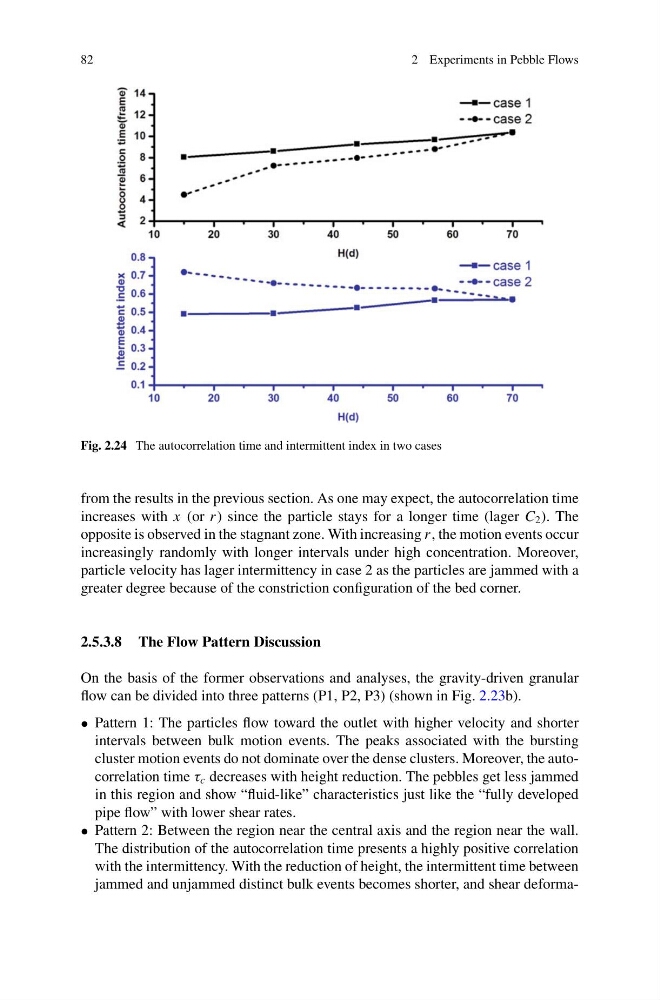
Fig. 2.24 The autocorrelation time and intermittent index in two cases
from the results in the previous section. As one may expect, the autocorrelation time
increases with x (or r ) since the particle stays for a longer time (lager C 2 ). The
opposite is observed in the stagnant zone. With increasing r , the motion events occur
increasingly randomly with longer intervals under high concentration. Moreover,
particle velocity has lager intermittency in case 2 as the particles are jammed with a
greater degree because of the constriction configuration of the bed corner.
2.5.3.8 The Flow Pattern Discussion
On the basis of the former observations and analyses, the gravity-driven granular
flow can be divided into three patterns (P1, P2, P3) (shown in Fig. 2.23b).
• Pattern 1: The particles flow toward the outlet with higher velocity and shorter
intervals between bulk motion events. The peaks associated with the bursting
cluster motion events do not dominate over the dense clusters. Moreover, the autocorrelation time τ c decreases with height reduction. The pebbles get less jammed
in this region and show “fluid-like” characteristics just like the “fully developed
pipe flow” with lower shear rates.
• Pattern 2: Between the region near the central axis and the region near the wall.
The distribution of the autocorrelation time presents a highly positive correlation
with the intermittency. With the reduction of height, the intermittent time between
jammed and unjammed distinct bulk events becomes shorter, and shear deforma-
2 Experiments in Pebble Flows
Fig. 2.24 The autocorrelation time and intermittent index in two cases
from the results in the previous section. As one may expect, the autocorrelation time
increases with x (or r ) since the particle stays for a longer time (lager C 2 ). The
opposite is observed in the stagnant zone. With increasing r , the motion events occur
increasingly randomly with longer intervals under high concentration. Moreover,
particle velocity has lager intermittency in case 2 as the particles are jammed with a
greater degree because of the constriction configuration of the bed corner.
2.5.3.8 The Flow Pattern Discussion
On the basis of the former observations and analyses, the gravity-driven granular
flow can be divided into three patterns (P1, P2, P3) (shown in Fig. 2.23b).
• Pattern 1: The particles flow toward the outlet with higher velocity and shorter
intervals between bulk motion events. The peaks associated with the bursting
cluster motion events do not dominate over the dense clusters. Moreover, the autocorrelation time τ c decreases with height reduction. The pebbles get less jammed
in this region and show “fluid-like” characteristics just like the “fully developed
pipe flow” with lower shear rates.
• Pattern 2: Between the region near the central axis and the region near the wall.
The distribution of the autocorrelation time presents a highly positive correlation
with the intermittency. With the reduction of height, the intermittent time between
jammed and unjammed distinct bulk events becomes shorter, and shear deforma-