

2.3 Pebble Flow in Two-Region Beds
61
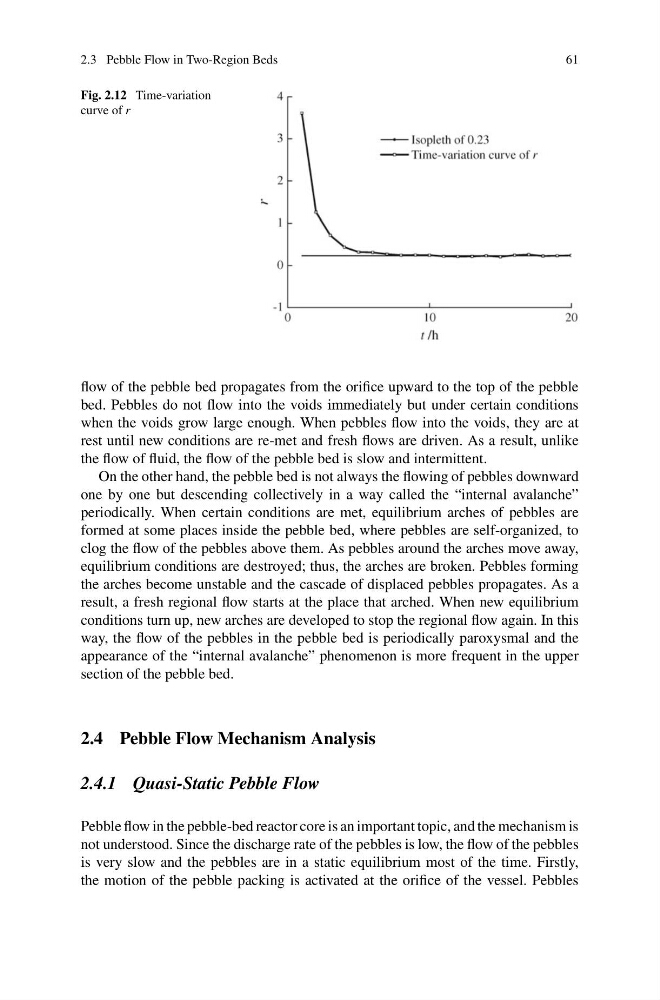
Fig. 2.12 Time-variation
curve of r
flow of the pebble bed propagates from the orifice upward to the top of the pebble
bed. Pebbles do not flow into the voids immediately but under certain conditions
when the voids grow large enough. When pebbles flow into the voids, they are at
rest until new conditions are re-met and fresh flows are driven. As a result, unlike
the flow of fluid, the flow of the pebble bed is slow and intermittent.
On the other hand, the pebble bed is not always the flowing of pebbles downward
one by one but descending collectively in a way called the “internal avalanche”
periodically. When certain conditions are met, equilibrium arches of pebbles are
formed at some places inside the pebble bed, where pebbles are self-organized, to
clog the flow of the pebbles above them. As pebbles around the arches move away,
equilibrium conditions are destroyed; thus, the arches are broken. Pebbles forming
the arches become unstable and the cascade of displaced pebbles propagates. As a
result, a fresh regional flow starts at the place that arched. When new equilibrium
conditions turn up, new arches are developed to stop the regional flow again. In this
way, the flow of the pebbles in the pebble bed is periodically paroxysmal and the
appearance of the “internal avalanche” phenomenon is more frequent in the upper
section of the pebble bed.
2.4 Pebble Flow Mechanism Analysis
2.4.1 Quasi-Static Pebble Flow
Pebble flow in the pebble-bed reactor core is an important topic, and the mechanism is
not understood. Since the discharge rate of the pebbles is low, the flow of the pebbles
is very slow and the pebbles are in a static equilibrium most of the time. Firstly,
the motion of the pebble packing is activated at the orifice of the vessel. Pebbles
61
Fig. 2.12 Time-variation
curve of r
flow of the pebble bed propagates from the orifice upward to the top of the pebble
bed. Pebbles do not flow into the voids immediately but under certain conditions
when the voids grow large enough. When pebbles flow into the voids, they are at
rest until new conditions are re-met and fresh flows are driven. As a result, unlike
the flow of fluid, the flow of the pebble bed is slow and intermittent.
On the other hand, the pebble bed is not always the flowing of pebbles downward
one by one but descending collectively in a way called the “internal avalanche”
periodically. When certain conditions are met, equilibrium arches of pebbles are
formed at some places inside the pebble bed, where pebbles are self-organized, to
clog the flow of the pebbles above them. As pebbles around the arches move away,
equilibrium conditions are destroyed; thus, the arches are broken. Pebbles forming
the arches become unstable and the cascade of displaced pebbles propagates. As a
result, a fresh regional flow starts at the place that arched. When new equilibrium
conditions turn up, new arches are developed to stop the regional flow again. In this
way, the flow of the pebbles in the pebble bed is periodically paroxysmal and the
appearance of the “internal avalanche” phenomenon is more frequent in the upper
section of the pebble bed.
2.4 Pebble Flow Mechanism Analysis
2.4.1 Quasi-Static Pebble Flow
Pebble flow in the pebble-bed reactor core is an important topic, and the mechanism is
not understood. Since the discharge rate of the pebbles is low, the flow of the pebbles
is very slow and the pebbles are in a static equilibrium most of the time. Firstly,
the motion of the pebble packing is activated at the orifice of the vessel. Pebbles