

2.3 Pebble Flow in Two-Region Beds
59
bed so much so that even a uniform mixing of the graphite and fuel pebbles will result.
The experiments show that stagnant zones appear in the cornet of the vessel, so the
motions of pebbles clinging to the radial wall of the vessel determine the size of the
stagnant zones. Statistical investigations are undertaken to study the characteristics
of the pebble motions.
The initial pebble bed is formed with all the pebbles colorless for easy visualization, and the experimental procedure is the same as described in Sect. 2.1. While
in recirculation, new pebbles loaded into the vessel are all colorless. Nine pebbles
tagged with different colors are seeded at the top of the pebble bed clinging to the
wall of the vessel. Tagged pebbles are distributed uniformly along the radial length
and pairwise symmetrized against the central axis of the vessel. As they descend
with the pebble bed, their positions are detected visually and recorded at intervals
manually. In this way, tracks of pebbles seeded in the packing are determined, and
are found to be generally of the “streamline” form. Each tagged pebble is placed at
the same position repeatedly, and a series of related streamlines are obtained. The
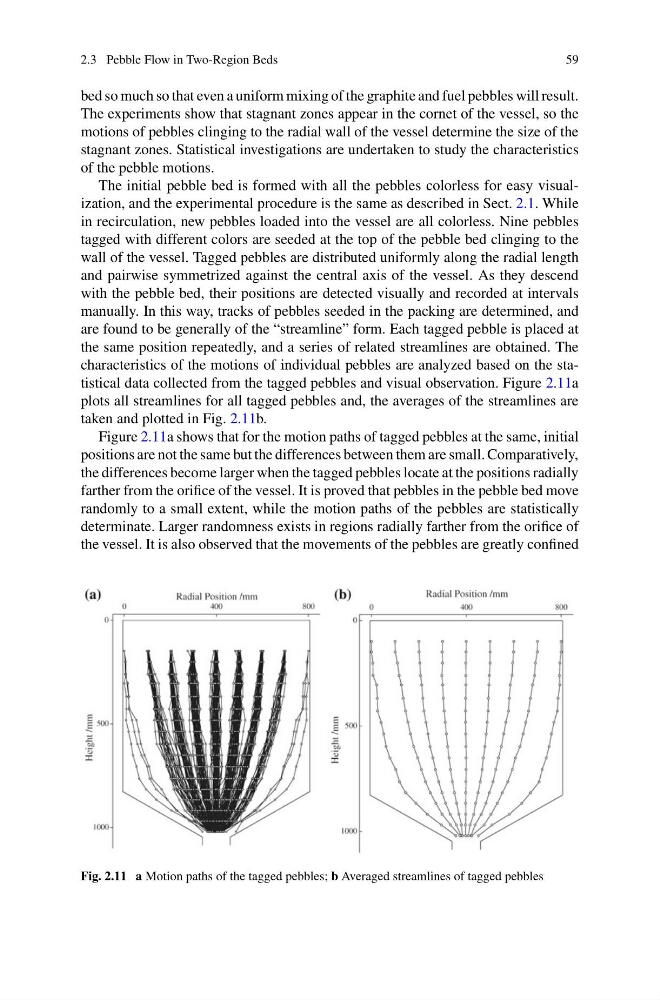
characteristics of the motions of individual pebbles are analyzed based on the statistical data collected from the tagged pebbles and visual observation. Figure 2.11a
plots all streamlines for all tagged pebbles and, the averages of the streamlines are
taken and plotted in Fig. 2.11b.
Figure 2.11a shows that for the motion paths of tagged pebbles at the same, initial
positions are not the same but the differences between them are small. Comparatively,
the differences become larger when the tagged pebbles locate at the positions radially
farther from the orifice of the vessel. It is proved that pebbles in the pebble bed move
randomly to a small extent, while the motion paths of the pebbles are statistically
determinate. Larger randomness exists in regions radially farther from the orifice of
the vessel. It is also observed that the movements of the pebbles are greatly confined
Fig. 2.11 a Motion paths of the tagged pebbles; b Averaged streamlines of tagged pebbles
59
bed so much so that even a uniform mixing of the graphite and fuel pebbles will result.
The experiments show that stagnant zones appear in the cornet of the vessel, so the
motions of pebbles clinging to the radial wall of the vessel determine the size of the
stagnant zones. Statistical investigations are undertaken to study the characteristics
of the pebble motions.
The initial pebble bed is formed with all the pebbles colorless for easy visualization, and the experimental procedure is the same as described in Sect. 2.1. While
in recirculation, new pebbles loaded into the vessel are all colorless. Nine pebbles
tagged with different colors are seeded at the top of the pebble bed clinging to the
wall of the vessel. Tagged pebbles are distributed uniformly along the radial length
and pairwise symmetrized against the central axis of the vessel. As they descend
with the pebble bed, their positions are detected visually and recorded at intervals
manually. In this way, tracks of pebbles seeded in the packing are determined, and
are found to be generally of the “streamline” form. Each tagged pebble is placed at
the same position repeatedly, and a series of related streamlines are obtained. The
characteristics of the motions of individual pebbles are analyzed based on the statistical data collected from the tagged pebbles and visual observation. Figure 2.11a
plots all streamlines for all tagged pebbles and, the averages of the streamlines are
taken and plotted in Fig. 2.11b.
Figure 2.11a shows that for the motion paths of tagged pebbles at the same, initial
positions are not the same but the differences between them are small. Comparatively,
the differences become larger when the tagged pebbles locate at the positions radially
farther from the orifice of the vessel. It is proved that pebbles in the pebble bed move
randomly to a small extent, while the motion paths of the pebbles are statistically
determinate. Larger randomness exists in regions radially farther from the orifice of
the vessel. It is also observed that the movements of the pebbles are greatly confined
Fig. 2.11 a Motion paths of the tagged pebbles; b Averaged streamlines of tagged pebbles