

2.1 Experimental Test Facility
45
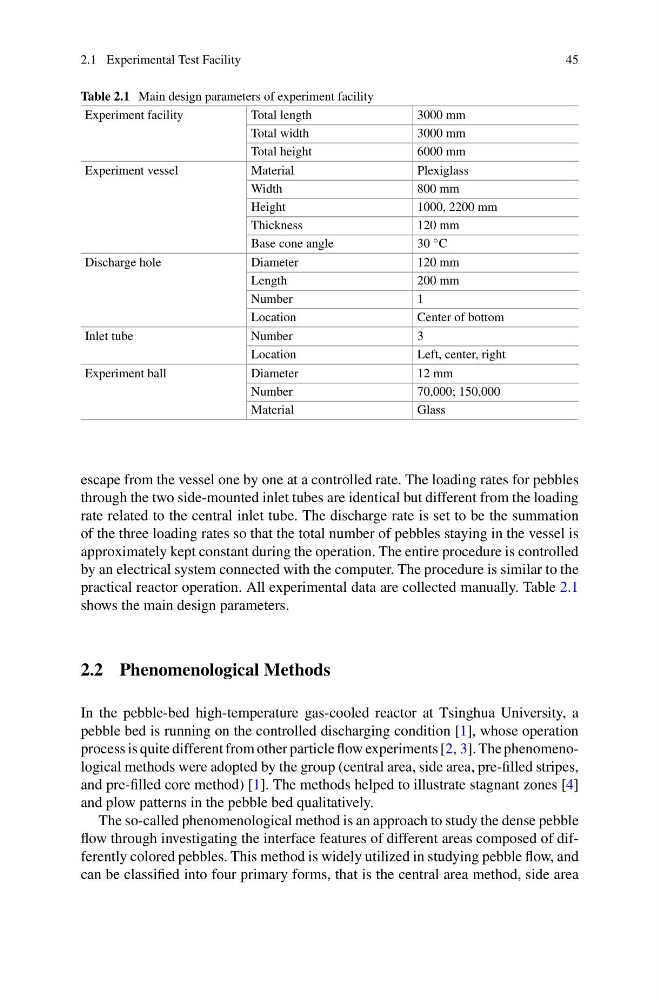
Table 2.1 Main design parameters of experiment facility
Experiment facility
Total length
3000 mm
Total width
3000 mm
Total height
6000 mm
Experiment vessel
Material
Plexiglass
Width
800 mm
Height
1000, 2200 mm
Thickness
120 mm
Base cone angle
30 ◦ C
Discharge hole
Diameter
120 mm
Length
200 mm
Number
1
Location
Center of bottom
Inlet tube
Number
3
Location
Left, center, right
Experiment ball
Diameter
12 mm
Number
70,000; 150,000
Material
Glass
escape from the vessel one by one at a controlled rate. The loading rates for pebbles
through the two side-mounted inlet tubes are identical but different from the loading
rate related to the central inlet tube. The discharge rate is set to be the summation
of the three loading rates so that the total number of pebbles staying in the vessel is
approximately kept constant during the operation. The entire procedure is controlled
by an electrical system connected with the computer. The procedure is similar to the
practical reactor operation. All experimental data are collected manually. Table 2.1
shows the main design parameters.
2.2 Phenomenological Methods
In the pebble-bed high-temperature gas-cooled reactor at Tsinghua University, a
pebble bed is running on the controlled discharging condition [1], whose operation
process is quite different from other particle flow experiments [2, 3]. The phenomenological methods were adopted by the group (central area, side area, pre-filled stripes,
and pre-filled core method) [1]. The methods helped to illustrate stagnant zones [4]
and plow patterns in the pebble bed qualitatively.
The so-called phenomenological method is an approach to study the dense pebble
flow through investigating the interface features of different areas composed of differently colored pebbles. This method is widely utilized in studying pebble flow, and
can be classified into four primary forms, that is the central area method, side area
45
Table 2.1 Main design parameters of experiment facility
Experiment facility
Total length
3000 mm
Total width
3000 mm
Total height
6000 mm
Experiment vessel
Material
Plexiglass
Width
800 mm
Height
1000, 2200 mm
Thickness
120 mm
Base cone angle
30 ◦ C
Discharge hole
Diameter
120 mm
Length
200 mm
Number
1
Location
Center of bottom
Inlet tube
Number
3
Location
Left, center, right
Experiment ball
Diameter
12 mm
Number
70,000; 150,000
Material
Glass
escape from the vessel one by one at a controlled rate. The loading rates for pebbles
through the two side-mounted inlet tubes are identical but different from the loading
rate related to the central inlet tube. The discharge rate is set to be the summation
of the three loading rates so that the total number of pebbles staying in the vessel is
approximately kept constant during the operation. The entire procedure is controlled
by an electrical system connected with the computer. The procedure is similar to the
practical reactor operation. All experimental data are collected manually. Table 2.1
shows the main design parameters.
2.2 Phenomenological Methods
In the pebble-bed high-temperature gas-cooled reactor at Tsinghua University, a
pebble bed is running on the controlled discharging condition [1], whose operation
process is quite different from other particle flow experiments [2, 3]. The phenomenological methods were adopted by the group (central area, side area, pre-filled stripes,
and pre-filled core method) [1]. The methods helped to illustrate stagnant zones [4]
and plow patterns in the pebble bed qualitatively.
The so-called phenomenological method is an approach to study the dense pebble
flow through investigating the interface features of different areas composed of differently colored pebbles. This method is widely utilized in studying pebble flow, and
can be classified into four primary forms, that is the central area method, side area