

7.5 Friction Optimization
497
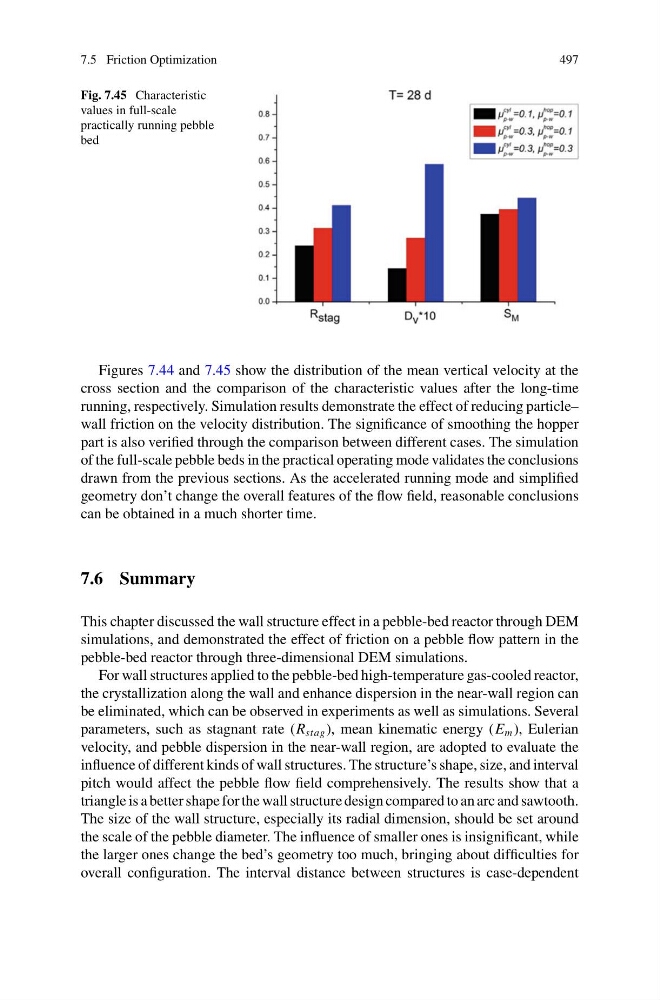
Fig. 7.45 Characteristic
values in full-scale
practically running pebble
bed
Figures 7.44 and 7.45 show the distribution of the mean vertical velocity at the
cross section and the comparison of the characteristic values after the long-time
running, respectively. Simulation results demonstrate the effect of reducing particle–
wall friction on the velocity distribution. The significance of smoothing the hopper
part is also verified through the comparison between different cases. The simulation
of the full-scale pebble beds in the practical operating mode validates the conclusions
drawn from the previous sections. As the accelerated running mode and simplified
geometry don’t change the overall features of the flow field, reasonable conclusions
can be obtained in a much shorter time.
7.6 Summary
This chapter discussed the wall structure effect in a pebble-bed reactor through DEM
simulations, and demonstrated the effect of friction on a pebble flow pattern in the
pebble-bed reactor through three-dimensional DEM simulations.
For wall structures applied to the pebble-bed high-temperature gas-cooled reactor,
the crystallization along the wall and enhance dispersion in the near-wall region can
be eliminated, which can be observed in experiments as well as simulations. Several
parameters, such as stagnant rate (R stag ), mean kinematic energy (E m ), Eulerian
velocity, and pebble dispersion in the near-wall region, are adopted to evaluate the
influence of different kinds of wall structures. The structure’s shape, size, and interval
pitch would affect the pebble flow field comprehensively. The results show that a
triangle is a better shape for the wall structure design compared to an arc and sawtooth.
The size of the wall structure, especially its radial dimension, should be set around
the scale of the pebble diameter. The influence of smaller ones is insignificant, while
the larger ones change the bed’s geometry too much, bringing about difficulties for
overall configuration. The interval distance between structures is case-dependent
497
Fig. 7.45 Characteristic
values in full-scale
practically running pebble
bed
Figures 7.44 and 7.45 show the distribution of the mean vertical velocity at the
cross section and the comparison of the characteristic values after the long-time
running, respectively. Simulation results demonstrate the effect of reducing particle–
wall friction on the velocity distribution. The significance of smoothing the hopper
part is also verified through the comparison between different cases. The simulation
of the full-scale pebble beds in the practical operating mode validates the conclusions
drawn from the previous sections. As the accelerated running mode and simplified
geometry don’t change the overall features of the flow field, reasonable conclusions
can be obtained in a much shorter time.
7.6 Summary
This chapter discussed the wall structure effect in a pebble-bed reactor through DEM
simulations, and demonstrated the effect of friction on a pebble flow pattern in the
pebble-bed reactor through three-dimensional DEM simulations.
For wall structures applied to the pebble-bed high-temperature gas-cooled reactor,
the crystallization along the wall and enhance dispersion in the near-wall region can
be eliminated, which can be observed in experiments as well as simulations. Several
parameters, such as stagnant rate (R stag ), mean kinematic energy (E m ), Eulerian
velocity, and pebble dispersion in the near-wall region, are adopted to evaluate the
influence of different kinds of wall structures. The structure’s shape, size, and interval
pitch would affect the pebble flow field comprehensively. The results show that a
triangle is a better shape for the wall structure design compared to an arc and sawtooth.
The size of the wall structure, especially its radial dimension, should be set around
the scale of the pebble diameter. The influence of smaller ones is insignificant, while
the larger ones change the bed’s geometry too much, bringing about difficulties for
overall configuration. The interval distance between structures is case-dependent