

7.2 Wall Structure Optimization
453
high velocity in the bottom bed where crystallization usually happens. It should be
mentioned that wall-sticking velocity is determined by the friction coefficient of the
wall as well, which is not taken into consideration in this analysis.
7.2.5 Extra Dispersion Effect
The dispersion phenomenon which arises from pebbles’ random motion is another
essential feature of a pebble flow. However, opposite conventional fluids, dispersion of the pebble flow is quite finite and is usually restricted within several pebble
diameters. This is because each pebble’s motion is blocked by a wall or surrounding neighbors [4]. In real reactor engineering, enhancing pebble dispersion in the
near-wall region is beneficial to the pebble-bed reactor’s safety and operation.
Wall structures strengthen near-wall disturbance and bring about extra dispersion
effect to near-wall pebbles. The extra dispersion effect can be observed from the
pebbles’ radial positions. Colored pebbles that are located in the near-wall region at
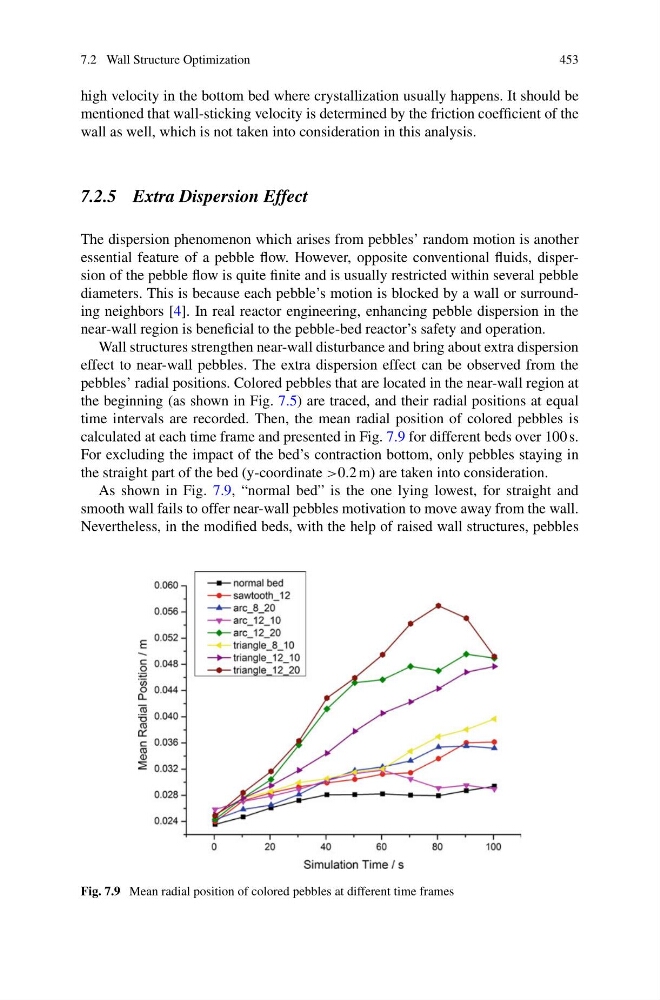
the beginning (as shown in Fig. 7.5) are traced, and their radial positions at equal
time intervals are recorded. Then, the mean radial position of colored pebbles is
calculated at each time frame and presented in Fig. 7.9 for different beds over 100 s.
For excluding the impact of the bed’s contraction bottom, only pebbles staying in
the straight part of the bed (y-coordinate >0.2 m) are taken into consideration.
As shown in Fig. 7.9, “normal bed” is the one lying lowest, for straight and
smooth wall fails to offer near-wall pebbles motivation to move away from the wall.
Nevertheless, in the modified beds, with the help of raised wall structures, pebbles
Fig. 7.9 Mean radial position of colored pebbles at different time frames
453
high velocity in the bottom bed where crystallization usually happens. It should be
mentioned that wall-sticking velocity is determined by the friction coefficient of the
wall as well, which is not taken into consideration in this analysis.
7.2.5 Extra Dispersion Effect
The dispersion phenomenon which arises from pebbles’ random motion is another
essential feature of a pebble flow. However, opposite conventional fluids, dispersion of the pebble flow is quite finite and is usually restricted within several pebble
diameters. This is because each pebble’s motion is blocked by a wall or surrounding neighbors [4]. In real reactor engineering, enhancing pebble dispersion in the
near-wall region is beneficial to the pebble-bed reactor’s safety and operation.
Wall structures strengthen near-wall disturbance and bring about extra dispersion
effect to near-wall pebbles. The extra dispersion effect can be observed from the
pebbles’ radial positions. Colored pebbles that are located in the near-wall region at
the beginning (as shown in Fig. 7.5) are traced, and their radial positions at equal
time intervals are recorded. Then, the mean radial position of colored pebbles is
calculated at each time frame and presented in Fig. 7.9 for different beds over 100 s.
For excluding the impact of the bed’s contraction bottom, only pebbles staying in
the straight part of the bed (y-coordinate >0.2 m) are taken into consideration.
As shown in Fig. 7.9, “normal bed” is the one lying lowest, for straight and
smooth wall fails to offer near-wall pebbles motivation to move away from the wall.
Nevertheless, in the modified beds, with the help of raised wall structures, pebbles
Fig. 7.9 Mean radial position of colored pebbles at different time frames