

410
6 Applications: Two-Region Pebble Beds
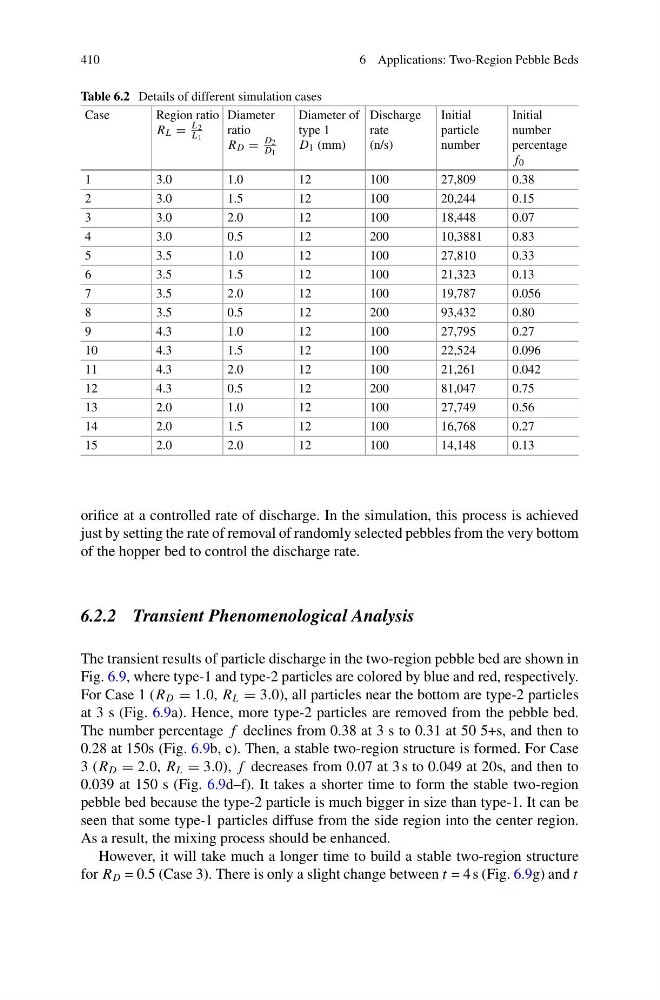
Table 6.2 Details of different simulation cases
Case
Region ratio
R L =
L2
L1
Diameter
ratio
R D =
D2
D1
Diameter of
type 1
D 1 (mm)
Discharge
rate
(n/s)
Initial
particle
number
Initial
number
percentage
f 0
1
3.0
1.0
12
100
27,809
0.38
2
3.0
1.5
12
100
20,244
0.15
3
3.0
2.0
12
100
18,448
0.07
4
3.0
0.5
12
200
10,3881
0.83
5
3.5
1.0
12
100
27,810
0.33
6
3.5
1.5
12
100
21,323
0.13
7
3.5
2.0
12
100
19,787
0.056
8
3.5
0.5
12
200
93,432
0.80
9
4.3
1.0
12
100
27,795
0.27
10
4.3
1.5
12
100
22,524
0.096
11
4.3
2.0
12
100
21,261
0.042
12
4.3
0.5
12
200
81,047
0.75
13
2.0
1.0
12
100
27,749
0.56
14
2.0
1.5
12
100
16,768
0.27
15
2.0
2.0
12
100
14,148
0.13
orifice at a controlled rate of discharge. In the simulation, this process is achieved
just by setting the rate of removal of randomly selected pebbles from the very bottom
of the hopper bed to control the discharge rate.
6.2.2 Transient Phenomenological Analysis
The transient results of particle discharge in the two-region pebble bed are shown in
Fig. 6.9, where type-1 and type-2 particles are colored by blue and red, respectively.
For Case 1 (R D = 1.0, R L = 3.0), all particles near the bottom are type-2 particles
at 3 s (Fig. 6.9a). Hence, more type-2 particles are removed from the pebble bed.
The number percentage f declines from 0.38 at 3 s to 0.31 at 50 5+s, and then to
0.28 at 150s (Fig. 6.9b, c). Then, a stable two-region structure is formed. For Case
3 (R D = 2.0, R L = 3.0), f decreases from 0.07 at 3 s to 0.049 at 20s, and then to
0.039 at 150 s (Fig. 6.9d–f). It takes a shorter time to form the stable two-region
pebble bed because the type-2 particle is much bigger in size than type-1. It can be
seen that some type-1 particles diffuse from the side region into the center region.
As a result, the mixing process should be enhanced.
However, it will take much a longer time to build a stable two-region structure
for R D = 0.5 (Case 3). There is only a slight change between t = 4 s (Fig. 6.9g) and t
6 Applications: Two-Region Pebble Beds
Table 6.2 Details of different simulation cases
Case
Region ratio
R L =
L2
L1
Diameter
ratio
R D =
D2
D1
Diameter of
type 1
D 1 (mm)
Discharge
rate
(n/s)
Initial
particle
number
Initial
number
percentage
f 0
1
3.0
1.0
12
100
27,809
0.38
2
3.0
1.5
12
100
20,244
0.15
3
3.0
2.0
12
100
18,448
0.07
4
3.0
0.5
12
200
10,3881
0.83
5
3.5
1.0
12
100
27,810
0.33
6
3.5
1.5
12
100
21,323
0.13
7
3.5
2.0
12
100
19,787
0.056
8
3.5
0.5
12
200
93,432
0.80
9
4.3
1.0
12
100
27,795
0.27
10
4.3
1.5
12
100
22,524
0.096
11
4.3
2.0
12
100
21,261
0.042
12
4.3
0.5
12
200
81,047
0.75
13
2.0
1.0
12
100
27,749
0.56
14
2.0
1.5
12
100
16,768
0.27
15
2.0
2.0
12
100
14,148
0.13
orifice at a controlled rate of discharge. In the simulation, this process is achieved
just by setting the rate of removal of randomly selected pebbles from the very bottom
of the hopper bed to control the discharge rate.
6.2.2 Transient Phenomenological Analysis
The transient results of particle discharge in the two-region pebble bed are shown in
Fig. 6.9, where type-1 and type-2 particles are colored by blue and red, respectively.
For Case 1 (R D = 1.0, R L = 3.0), all particles near the bottom are type-2 particles
at 3 s (Fig. 6.9a). Hence, more type-2 particles are removed from the pebble bed.
The number percentage f declines from 0.38 at 3 s to 0.31 at 50 5+s, and then to
0.28 at 150s (Fig. 6.9b, c). Then, a stable two-region structure is formed. For Case
3 (R D = 2.0, R L = 3.0), f decreases from 0.07 at 3 s to 0.049 at 20s, and then to
0.039 at 150 s (Fig. 6.9d–f). It takes a shorter time to form the stable two-region
pebble bed because the type-2 particle is much bigger in size than type-1. It can be
seen that some type-1 particles diffuse from the side region into the center region.
As a result, the mixing process should be enhanced.
However, it will take much a longer time to build a stable two-region structure
for R D = 0.5 (Case 3). There is only a slight change between t = 4 s (Fig. 6.9g) and t