

382
5 Numerical Models for Pebble-Bed Heat Transfer
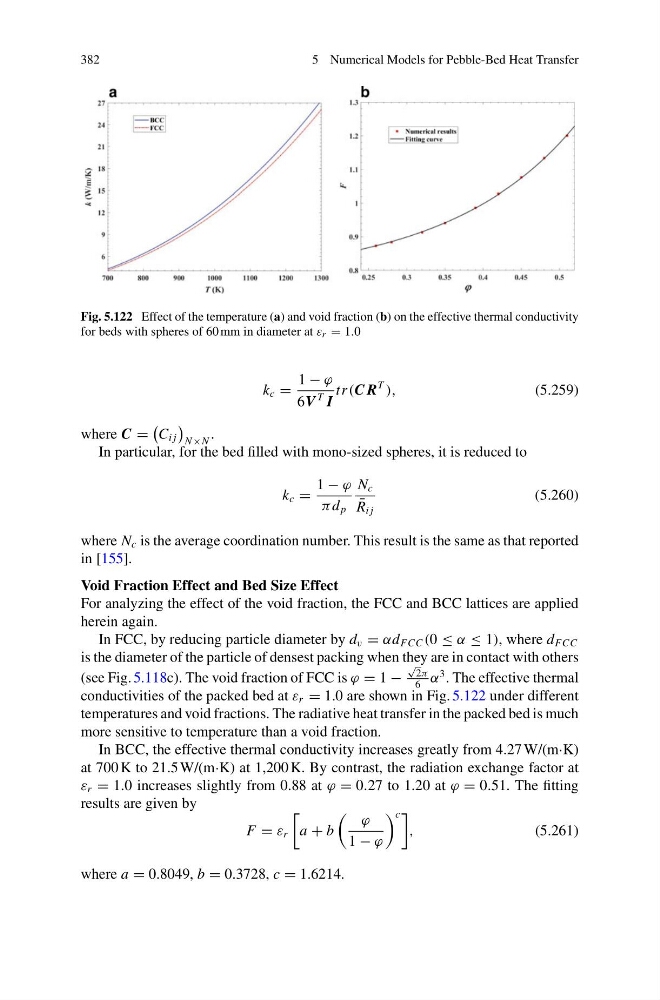
Fig. 5.122 Effect of the temperature (a) and void fraction (b) on the effective thermal conductivity
for beds with spheres of 60 mm in diameter at ε r = 1.0
k c =
1 − ϕ
6V
T I
tr(C R
T
),
(5.259)
where C =
C i j
N ×N
.
In particular, for the bed filled with mono-sized spheres, it is reduced to
k c =
1 − ϕ
π d p
N c
¯
R i j
(5.260)
where N c is the average coordination number. This result is the same as that reported
in [155].
Void Fraction Effect and Bed Size Effect
For analyzing the effect of the void fraction, the FCC and BCC lattices are applied
herein again.
In FCC, by reducing particle diameter by d v = αd FCC (0 ≤ α ≤ 1), where d FCC
is the diameter of the particle of densest packing when they are in contact with others
(see Fig. 5.118c). The void fraction of FCC is ϕ = 1 −
√
2π
6
α
3 . The effective thermal
conductivities of the packed bed at ε r = 1.0 are shown in Fig. 5.122 under different
temperatures and void fractions. The radiative heat transfer in the packed bed is much
more sensitive to temperature than a void fraction.
In BCC, the effective thermal conductivity increases greatly from 4.27 W/(m·K)
at 700 K to 21.5 W/(m·K) at 1,200 K. By contrast, the radiation exchange factor at
ε r = 1.0 increases slightly from 0.88 at ϕ = 0.27 to 1.20 at ϕ = 0.51. The fitting
results are given by
F = ε r
a + b
ϕ
1 − ϕ
c
,
(5.261)
where a = 0.8049, b = 0.3728, c = 1.6214.
5 Numerical Models for Pebble-Bed Heat Transfer
Fig. 5.122 Effect of the temperature (a) and void fraction (b) on the effective thermal conductivity
for beds with spheres of 60 mm in diameter at ε r = 1.0
k c =
1 − ϕ
6V
T I
tr(C R
T
),
(5.259)
where C =
C i j
N ×N
.
In particular, for the bed filled with mono-sized spheres, it is reduced to
k c =
1 − ϕ
π d p
N c
¯
R i j
(5.260)
where N c is the average coordination number. This result is the same as that reported
in [155].
Void Fraction Effect and Bed Size Effect
For analyzing the effect of the void fraction, the FCC and BCC lattices are applied
herein again.
In FCC, by reducing particle diameter by d v = αd FCC (0 ≤ α ≤ 1), where d FCC
is the diameter of the particle of densest packing when they are in contact with others
(see Fig. 5.118c). The void fraction of FCC is ϕ = 1 −
√
2π
6
α
3 . The effective thermal
conductivities of the packed bed at ε r = 1.0 are shown in Fig. 5.122 under different
temperatures and void fractions. The radiative heat transfer in the packed bed is much
more sensitive to temperature than a void fraction.
In BCC, the effective thermal conductivity increases greatly from 4.27 W/(m·K)
at 700 K to 21.5 W/(m·K) at 1,200 K. By contrast, the radiation exchange factor at
ε r = 1.0 increases slightly from 0.88 at ϕ = 0.27 to 1.20 at ϕ = 0.51. The fitting
results are given by
F = ε r
a + b
ϕ
1 − ϕ
c
,
(5.261)
where a = 0.8049, b = 0.3728, c = 1.6214.