

376
5 Numerical Models for Pebble-Bed Heat Transfer
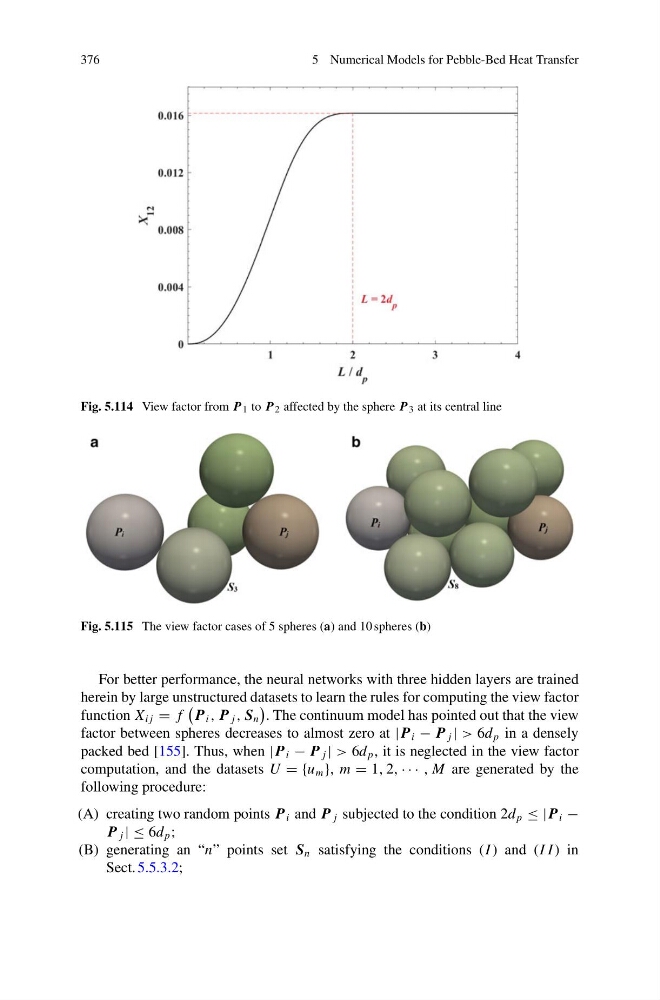
Fig. 5.114 View factor from P 1 to P 2 affected by the sphere P 3 at its central line
Fig. 5.115 The view factor cases of 5 spheres (a) and 10 spheres (b)
For better performance, the neural networks with three hidden layers are trained
herein by large unstructured datasets to learn the rules for computing the view factor
function X i j = f
P i , P j , S n
. The continuum model has pointed out that the view
factor between spheres decreases to almost zero at | P i − P j | > 6d p in a densely
packed bed [155]. Thus, when | P i − P j | > 6d p , it is neglected in the view factor
computation, and the datasets U = {u m }, m = 1, 2, · · · , M are generated by the
following procedure:
(A) creating two random points P i and P j subjected to the condition 2d p ≤ |P i −
P j | ≤ 6d p ;
(B) generating an “n” points set S n satisfying the conditions (I ) and (I I ) in
Sect. 5.5.3.2;
5 Numerical Models for Pebble-Bed Heat Transfer
Fig. 5.114 View factor from P 1 to P 2 affected by the sphere P 3 at its central line
Fig. 5.115 The view factor cases of 5 spheres (a) and 10 spheres (b)
For better performance, the neural networks with three hidden layers are trained
herein by large unstructured datasets to learn the rules for computing the view factor
function X i j = f
P i , P j , S n
. The continuum model has pointed out that the view
factor between spheres decreases to almost zero at | P i − P j | > 6d p in a densely
packed bed [155]. Thus, when | P i − P j | > 6d p , it is neglected in the view factor
computation, and the datasets U = {u m }, m = 1, 2, · · · , M are generated by the
following procedure:
(A) creating two random points P i and P j subjected to the condition 2d p ≤ |P i −
P j | ≤ 6d p ;
(B) generating an “n” points set S n satisfying the conditions (I ) and (I I ) in
Sect. 5.5.3.2;