

328
5 Numerical Models for Pebble-Bed Heat Transfer
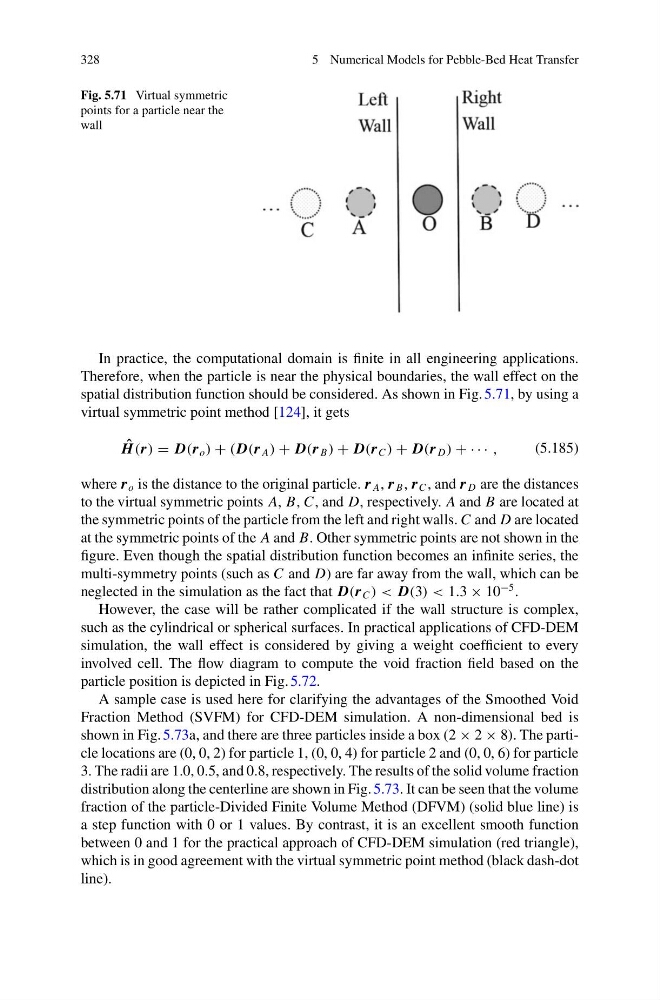
Fig. 5.71 Virtual symmetric
points for a particle near the
wall
In practice, the computational domain is finite in all engineering applications.
Therefore, when the particle is near the physical boundaries, the wall effect on the
spatial distribution function should be considered. As shown in Fig. 5.71, by using a
virtual symmetric point method [124], it gets
ˆ
H(r) = D(r o ) + ( D(r A ) + D(r B ) + D(r C ) + D(r D ) + · · · ,
(5.185)
where r o is the distance to the original particle. r A , r B , r C , and r D are the distances
to the virtual symmetric points A, B, C, and D, respectively. A and B are located at
the symmetric points of the particle from the left and right walls. C and D are located
at the symmetric points of the A and B. Other symmetric points are not shown in the
figure. Even though the spatial distribution function becomes an infinite series, the
multi-symmetry points (such as C and D) are far away from the wall, which can be
neglected in the simulation as the fact that D(r C ) < D(3) < 1.3 × 10
−5 .
However, the case will be rather complicated if the wall structure is complex,
such as the cylindrical or spherical surfaces. In practical applications of CFD-DEM
simulation, the wall effect is considered by giving a weight coefficient to every
involved cell. The flow diagram to compute the void fraction field based on the
particle position is depicted in Fig. 5.72.
A sample case is used here for clarifying the advantages of the Smoothed Void
Fraction Method (SVFM) for CFD-DEM simulation. A non-dimensional bed is
shown in Fig. 5.73a, and there are three particles inside a box (2 × 2 × 8). The particle locations are (0, 0, 2) for particle 1, (0, 0, 4) for particle 2 and (0, 0, 6) for particle
3. The radii are 1.0, 0.5, and 0.8, respectively. The results of the solid volume fraction
distribution along the centerline are shown in Fig. 5.73. It can be seen that the volume
fraction of the particle-Divided Finite Volume Method (DFVM) (solid blue line) is
a step function with 0 or 1 values. By contrast, it is an excellent smooth function
between 0 and 1 for the practical approach of CFD-DEM simulation (red triangle),
which is in good agreement with the virtual symmetric point method (black dash-dot
line).
5 Numerical Models for Pebble-Bed Heat Transfer
Fig. 5.71 Virtual symmetric
points for a particle near the
wall
In practice, the computational domain is finite in all engineering applications.
Therefore, when the particle is near the physical boundaries, the wall effect on the
spatial distribution function should be considered. As shown in Fig. 5.71, by using a
virtual symmetric point method [124], it gets
ˆ
H(r) = D(r o ) + ( D(r A ) + D(r B ) + D(r C ) + D(r D ) + · · · ,
(5.185)
where r o is the distance to the original particle. r A , r B , r C , and r D are the distances
to the virtual symmetric points A, B, C, and D, respectively. A and B are located at
the symmetric points of the particle from the left and right walls. C and D are located
at the symmetric points of the A and B. Other symmetric points are not shown in the
figure. Even though the spatial distribution function becomes an infinite series, the
multi-symmetry points (such as C and D) are far away from the wall, which can be
neglected in the simulation as the fact that D(r C ) < D(3) < 1.3 × 10
−5 .
However, the case will be rather complicated if the wall structure is complex,
such as the cylindrical or spherical surfaces. In practical applications of CFD-DEM
simulation, the wall effect is considered by giving a weight coefficient to every
involved cell. The flow diagram to compute the void fraction field based on the
particle position is depicted in Fig. 5.72.
A sample case is used here for clarifying the advantages of the Smoothed Void
Fraction Method (SVFM) for CFD-DEM simulation. A non-dimensional bed is
shown in Fig. 5.73a, and there are three particles inside a box (2 × 2 × 8). The particle locations are (0, 0, 2) for particle 1, (0, 0, 4) for particle 2 and (0, 0, 6) for particle
3. The radii are 1.0, 0.5, and 0.8, respectively. The results of the solid volume fraction
distribution along the centerline are shown in Fig. 5.73. It can be seen that the volume
fraction of the particle-Divided Finite Volume Method (DFVM) (solid blue line) is
a step function with 0 or 1 values. By contrast, it is an excellent smooth function
between 0 and 1 for the practical approach of CFD-DEM simulation (red triangle),
which is in good agreement with the virtual symmetric point method (black dash-dot
line).