

322
5 Numerical Models for Pebble-Bed Heat Transfer
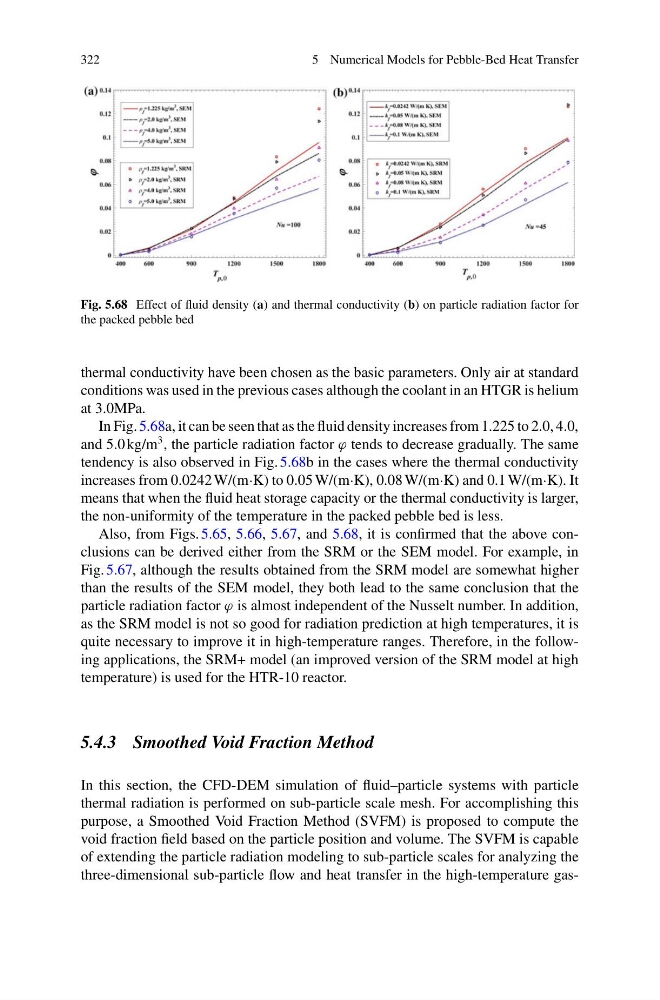
Fig. 5.68 Effect of fluid density (a) and thermal conductivity (b) on particle radiation factor for
the packed pebble bed
thermal conductivity have been chosen as the basic parameters. Only air at standard
conditions was used in the previous cases although the coolant in an HTGR is helium
at 3.0MPa.
In Fig. 5.68a, it can be seen that as the fluid density increases from 1.225 to 2.0, 4.0,
and 5.0 kg/m
3 , the particle radiation factor ϕ tends to decrease gradually. The same
tendency is also observed in Fig. 5.68b in the cases where the thermal conductivity
increases from 0.0242 W/(m·K) to 0.05 W/(m·K), 0.08 W/(m·K) and 0.1 W/(m·K). It
means that when the fluid heat storage capacity or the thermal conductivity is larger,
the non-uniformity of the temperature in the packed pebble bed is less.
Also, from Figs. 5.65, 5.66, 5.67, and 5.68, it is confirmed that the above conclusions can be derived either from the SRM or the SEM model. For example, in
Fig. 5.67, although the results obtained from the SRM model are somewhat higher
than the results of the SEM model, they both lead to the same conclusion that the
particle radiation factor ϕ is almost independent of the Nusselt number. In addition,
as the SRM model is not so good for radiation prediction at high temperatures, it is
quite necessary to improve it in high-temperature ranges. Therefore, in the following applications, the SRM+ model (an improved version of the SRM model at high
temperature) is used for the HTR-10 reactor.
5.4.3 Smoothed Void Fraction Method
In this section, the CFD-DEM simulation of fluid–particle systems with particle
thermal radiation is performed on sub-particle scale mesh. For accomplishing this
purpose, a Smoothed Void Fraction Method (SVFM) is proposed to compute the
void fraction field based on the particle position and volume. The SVFM is capable
of extending the particle radiation modeling to sub-particle scales for analyzing the
three-dimensional sub-particle flow and heat transfer in the high-temperature gas-
5 Numerical Models for Pebble-Bed Heat Transfer
Fig. 5.68 Effect of fluid density (a) and thermal conductivity (b) on particle radiation factor for
the packed pebble bed
thermal conductivity have been chosen as the basic parameters. Only air at standard
conditions was used in the previous cases although the coolant in an HTGR is helium
at 3.0MPa.
In Fig. 5.68a, it can be seen that as the fluid density increases from 1.225 to 2.0, 4.0,
and 5.0 kg/m
3 , the particle radiation factor ϕ tends to decrease gradually. The same
tendency is also observed in Fig. 5.68b in the cases where the thermal conductivity
increases from 0.0242 W/(m·K) to 0.05 W/(m·K), 0.08 W/(m·K) and 0.1 W/(m·K). It
means that when the fluid heat storage capacity or the thermal conductivity is larger,
the non-uniformity of the temperature in the packed pebble bed is less.
Also, from Figs. 5.65, 5.66, 5.67, and 5.68, it is confirmed that the above conclusions can be derived either from the SRM or the SEM model. For example, in
Fig. 5.67, although the results obtained from the SRM model are somewhat higher
than the results of the SEM model, they both lead to the same conclusion that the
particle radiation factor ϕ is almost independent of the Nusselt number. In addition,
as the SRM model is not so good for radiation prediction at high temperatures, it is
quite necessary to improve it in high-temperature ranges. Therefore, in the following applications, the SRM+ model (an improved version of the SRM model at high
temperature) is used for the HTR-10 reactor.
5.4.3 Smoothed Void Fraction Method
In this section, the CFD-DEM simulation of fluid–particle systems with particle
thermal radiation is performed on sub-particle scale mesh. For accomplishing this
purpose, a Smoothed Void Fraction Method (SVFM) is proposed to compute the
void fraction field based on the particle position and volume. The SVFM is capable
of extending the particle radiation modeling to sub-particle scales for analyzing the
three-dimensional sub-particle flow and heat transfer in the high-temperature gas-