

298
5 Numerical Models for Pebble-Bed Heat Transfer
5.3.10.4 Extension of Particle-Scale Heat Transfer Model to
Clumped-Pebbles
In Sect. 5.3.9, for the nuclear-packed pebble beds of mono-sized and poly-dispersed
spherical particles, the heat transfer behavior in particle scale at steady state was
investigated by coupling the Sub-Cell radiation Model (SCM) and the elastic Hertz–
Mindlin model of Discrete Element Method (DEM). Moreover, the SCM can be
extended to simple cases of non-spherical particles, such as the shape given in [93,
94]. The non-overlapping clumped-sphere method is applied to the present simulations. Every particle is modeled as a clump of several spheres rigidly bonded together.
Combining the Discrete Element Method (DEM) with the Sub-Cell radiation Model
(SCM), the governing equations of motion and heat transfer for the bonded-sphere
particles are given as
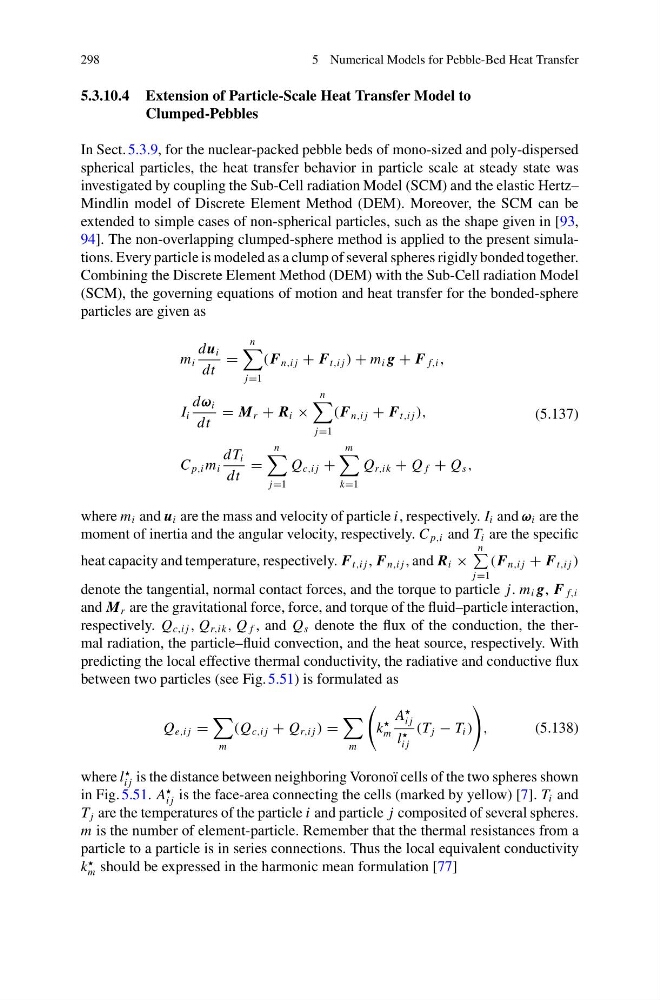
m i
du i
dt
=
n
j=1
(F n,i j + F t,i j ) + m i g + F f,i ,
I i
dω i
dt
= M r + R i ×
n
j=1
(F n,i j + F t,i j ),
C p,i m i
dT i
dt
=
n
j=1
Q c,i j +
m
k=1
Q r,ik + Q f + Q s ,
(5.137)
where m i and u i are the mass and velocity of particle i, respectively. I i and ω i are the
moment of inertia and the angular velocity, respectively. C p,i and T i are the specific
heat capacity and temperature, respectively. F t,i j , F n,i j , and R i ×
n
j=1
(F n,i j + F t,i j )
denote the tangential, normal contact forces, and the torque to particle j. m i g, F f,i
and M r are the gravitational force, force, and torque of the fluid–particle interaction,
respectively. Q c,i j , Q r,ik , Q f , and Q s denote the flux of the conduction, the thermal radiation, the particle–fluid convection, and the heat source, respectively. With
predicting the local effective thermal conductivity, the radiative and conductive flux
between two particles (see Fig. 5.51) is formulated as
Q e,i j =
m
(Q c,i j + Q r,i j ) =
m
k
m
A
i j
l
i j
(T j − T i )
,
(5.138)
where l
i j is the distance between neighboring Voronoï cells of the two spheres shown
in Fig. 5.51. A
i j is the face-area connecting the cells (marked by yellow) [7]. T i and
T j are the temperatures of the particle i and particle j composited of several spheres.
m is the number of element-particle. Remember that the thermal resistances from a
particle to a particle is in series connections. Thus the local equivalent conductivity
k
m should be expressed in the harmonic mean formulation [77]
5 Numerical Models for Pebble-Bed Heat Transfer
5.3.10.4 Extension of Particle-Scale Heat Transfer Model to
Clumped-Pebbles
In Sect. 5.3.9, for the nuclear-packed pebble beds of mono-sized and poly-dispersed
spherical particles, the heat transfer behavior in particle scale at steady state was
investigated by coupling the Sub-Cell radiation Model (SCM) and the elastic Hertz–
Mindlin model of Discrete Element Method (DEM). Moreover, the SCM can be
extended to simple cases of non-spherical particles, such as the shape given in [93,
94]. The non-overlapping clumped-sphere method is applied to the present simulations. Every particle is modeled as a clump of several spheres rigidly bonded together.
Combining the Discrete Element Method (DEM) with the Sub-Cell radiation Model
(SCM), the governing equations of motion and heat transfer for the bonded-sphere
particles are given as
m i
du i
dt
=
n
j=1
(F n,i j + F t,i j ) + m i g + F f,i ,
I i
dω i
dt
= M r + R i ×
n
j=1
(F n,i j + F t,i j ),
C p,i m i
dT i
dt
=
n
j=1
Q c,i j +
m
k=1
Q r,ik + Q f + Q s ,
(5.137)
where m i and u i are the mass and velocity of particle i, respectively. I i and ω i are the
moment of inertia and the angular velocity, respectively. C p,i and T i are the specific
heat capacity and temperature, respectively. F t,i j , F n,i j , and R i ×
n
j=1
(F n,i j + F t,i j )
denote the tangential, normal contact forces, and the torque to particle j. m i g, F f,i
and M r are the gravitational force, force, and torque of the fluid–particle interaction,
respectively. Q c,i j , Q r,ik , Q f , and Q s denote the flux of the conduction, the thermal radiation, the particle–fluid convection, and the heat source, respectively. With
predicting the local effective thermal conductivity, the radiative and conductive flux
between two particles (see Fig. 5.51) is formulated as
Q e,i j =
m
(Q c,i j + Q r,i j ) =
m
k
m
A
i j
l
i j
(T j − T i )
,
(5.138)
where l
i j is the distance between neighboring Voronoï cells of the two spheres shown
in Fig. 5.51. A
i j is the face-area connecting the cells (marked by yellow) [7]. T i and
T j are the temperatures of the particle i and particle j composited of several spheres.
m is the number of element-particle. Remember that the thermal resistances from a
particle to a particle is in series connections. Thus the local equivalent conductivity
k
m should be expressed in the harmonic mean formulation [77]