

5.3 Discrete Modeling of Pebble Radiation
295
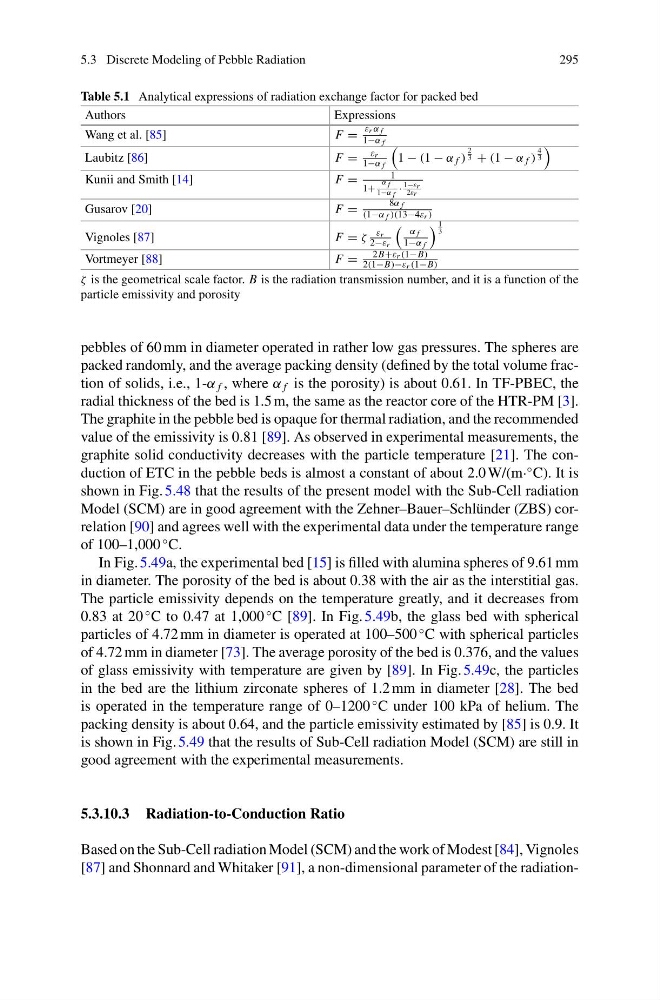
Table 5.1 Analytical expressions of radiation exchange factor for packed bed
Authors
Expressions
Wang et al. [85]
F =
εr α f
1−α f
Laubitz [86]
F =
εr
1−α f
1 − (1 − α f )
2
3 + (1 − α f )
4
3
Kunii and Smith [14]
F =
1
1+
α f
1−α f
·
1−εr
2εr
Gusarov [20]
F =
8α f
(1−α f )(13−4εr )
Vignoles [87]
F = ζ
εr
2−εr
α f
1−α f
1
3
Vortmeyer [88]
F =
2B+εr (1−B)
2(1−B)−εr (1−B)
ζ is the geometrical scale factor. B is the radiation transmission number, and it is a function of the
particle emissivity and porosity
pebbles of 60 mm in diameter operated in rather low gas pressures. The spheres are
packed randomly, and the average packing density (defined by the total volume fraction of solids, i.e., 1-α f , where α f is the porosity) is about 0.61. In TF-PBEC, the
radial thickness of the bed is 1.5 m, the same as the reactor core of the HTR-PM [3].
The graphite in the pebble bed is opaque for thermal radiation, and the recommended
value of the emissivity is 0.81 [89]. As observed in experimental measurements, the
graphite solid conductivity decreases with the particle temperature [21]. The conduction of ETC in the pebble beds is almost a constant of about 2.0 W/(m·
◦ C). It is
shown in Fig. 5.48 that the results of the present model with the Sub-Cell radiation
Model (SCM) are in good agreement with the Zehner–Bauer–Schlünder (ZBS) correlation [90] and agrees well with the experimental data under the temperature range
of 100–1,000
◦ C.
In Fig. 5.49a, the experimental bed [15] is filled with alumina spheres of 9.61 mm
in diameter. The porosity of the bed is about 0.38 with the air as the interstitial gas.
The particle emissivity depends on the temperature greatly, and it decreases from
0.83 at 20
◦ C to 0.47 at 1,000
◦ C [89]. In Fig. 5.49b, the glass bed with spherical
particles of 4.72 mm in diameter is operated at 100–500
◦ C with spherical particles
of 4.72 mm in diameter [73]. The average porosity of the bed is 0.376, and the values
of glass emissivity with temperature are given by [89]. In Fig. 5.49c, the particles
in the bed are the lithium zirconate spheres of 1.2 mm in diameter [28]. The bed
is operated in the temperature range of 0–1200
◦ C under 100 kPa of helium. The
packing density is about 0.64, and the particle emissivity estimated by [85] is 0.9. It
is shown in Fig. 5.49 that the results of Sub-Cell radiation Model (SCM) are still in
good agreement with the experimental measurements.
5.3.10.3 Radiation-to-Conduction Ratio
Based on the Sub-Cell radiation Model (SCM) and the work of Modest [84], Vignoles
[87] and Shonnard and Whitaker [91], a non-dimensional parameter of the radiation-
295
Table 5.1 Analytical expressions of radiation exchange factor for packed bed
Authors
Expressions
Wang et al. [85]
F =
εr α f
1−α f
Laubitz [86]
F =
εr
1−α f
1 − (1 − α f )
2
3 + (1 − α f )
4
3
Kunii and Smith [14]
F =
1
1+
α f
1−α f
·
1−εr
2εr
Gusarov [20]
F =
8α f
(1−α f )(13−4εr )
Vignoles [87]
F = ζ
εr
2−εr
α f
1−α f
1
3
Vortmeyer [88]
F =
2B+εr (1−B)
2(1−B)−εr (1−B)
ζ is the geometrical scale factor. B is the radiation transmission number, and it is a function of the
particle emissivity and porosity
pebbles of 60 mm in diameter operated in rather low gas pressures. The spheres are
packed randomly, and the average packing density (defined by the total volume fraction of solids, i.e., 1-α f , where α f is the porosity) is about 0.61. In TF-PBEC, the
radial thickness of the bed is 1.5 m, the same as the reactor core of the HTR-PM [3].
The graphite in the pebble bed is opaque for thermal radiation, and the recommended
value of the emissivity is 0.81 [89]. As observed in experimental measurements, the
graphite solid conductivity decreases with the particle temperature [21]. The conduction of ETC in the pebble beds is almost a constant of about 2.0 W/(m·
◦ C). It is
shown in Fig. 5.48 that the results of the present model with the Sub-Cell radiation
Model (SCM) are in good agreement with the Zehner–Bauer–Schlünder (ZBS) correlation [90] and agrees well with the experimental data under the temperature range
of 100–1,000
◦ C.
In Fig. 5.49a, the experimental bed [15] is filled with alumina spheres of 9.61 mm
in diameter. The porosity of the bed is about 0.38 with the air as the interstitial gas.
The particle emissivity depends on the temperature greatly, and it decreases from
0.83 at 20
◦ C to 0.47 at 1,000
◦ C [89]. In Fig. 5.49b, the glass bed with spherical
particles of 4.72 mm in diameter is operated at 100–500
◦ C with spherical particles
of 4.72 mm in diameter [73]. The average porosity of the bed is 0.376, and the values
of glass emissivity with temperature are given by [89]. In Fig. 5.49c, the particles
in the bed are the lithium zirconate spheres of 1.2 mm in diameter [28]. The bed
is operated in the temperature range of 0–1200
◦ C under 100 kPa of helium. The
packing density is about 0.64, and the particle emissivity estimated by [85] is 0.9. It
is shown in Fig. 5.49 that the results of Sub-Cell radiation Model (SCM) are still in
good agreement with the experimental measurements.
5.3.10.3 Radiation-to-Conduction Ratio
Based on the Sub-Cell radiation Model (SCM) and the work of Modest [84], Vignoles
[87] and Shonnard and Whitaker [91], a non-dimensional parameter of the radiation-