

246
5 Numerical Models for Pebble-Bed Heat Transfer
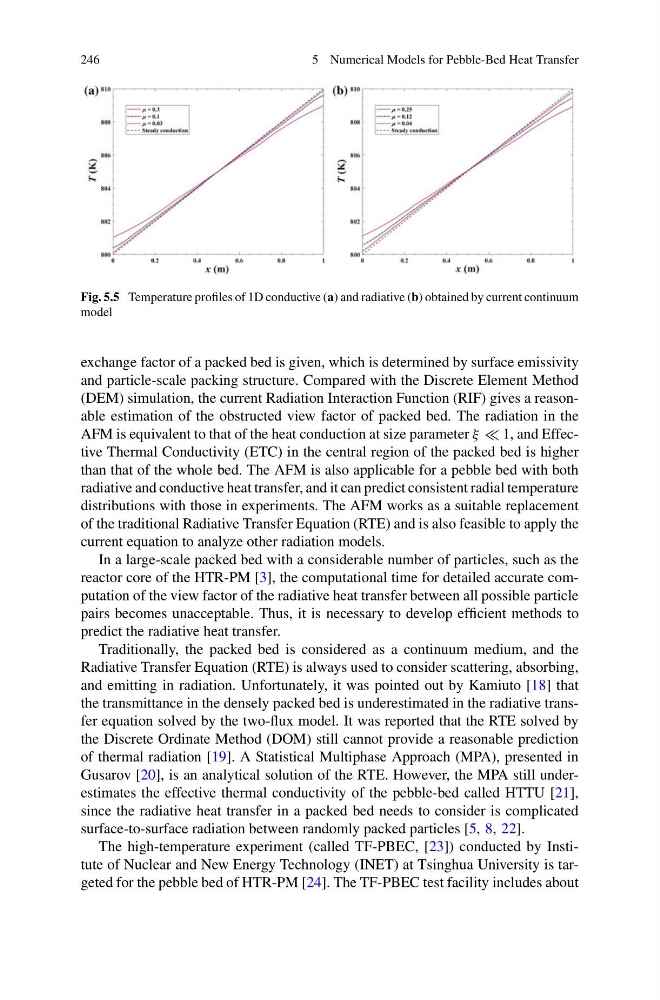
Fig. 5.5 Temperature profiles of 1D conductive (a) and radiative (b) obtained by current continuum
model
exchange factor of a packed bed is given, which is determined by surface emissivity
and particle-scale packing structure. Compared with the Discrete Element Method
(DEM) simulation, the current Radiation Interaction Function (RIF) gives a reasonable estimation of the obstructed view factor of packed bed. The radiation in the
AFM is equivalent to that of the heat conduction at size parameter ξ 1, and Effective Thermal Conductivity (ETC) in the central region of the packed bed is higher
than that of the whole bed. The AFM is also applicable for a pebble bed with both
radiative and conductive heat transfer, and it can predict consistent radial temperature
distributions with those in experiments. The AFM works as a suitable replacement
of the traditional Radiative Transfer Equation (RTE) and is also feasible to apply the
current equation to analyze other radiation models.
In a large-scale packed bed with a considerable number of particles, such as the
reactor core of the HTR-PM [3], the computational time for detailed accurate computation of the view factor of the radiative heat transfer between all possible particle
pairs becomes unacceptable. Thus, it is necessary to develop efficient methods to
predict the radiative heat transfer.
Traditionally, the packed bed is considered as a continuum medium, and the
Radiative Transfer Equation (RTE) is always used to consider scattering, absorbing,
and emitting in radiation. Unfortunately, it was pointed out by Kamiuto [18] that
the transmittance in the densely packed bed is underestimated in the radiative transfer equation solved by the two-flux model. It was reported that the RTE solved by
the Discrete Ordinate Method (DOM) still cannot provide a reasonable prediction
of thermal radiation [19]. A Statistical Multiphase Approach (MPA), presented in
Gusarov [20], is an analytical solution of the RTE. However, the MPA still underestimates the effective thermal conductivity of the pebble-bed called HTTU [21],
since the radiative heat transfer in a packed bed needs to consider is complicated
surface-to-surface radiation between randomly packed particles [5, 8, 22].
The high-temperature experiment (called TF-PBEC, [23]) conducted by Institute of Nuclear and New Energy Technology (INET) at Tsinghua University is targeted for the pebble bed of HTR-PM [24]. The TF-PBEC test facility includes about
5 Numerical Models for Pebble-Bed Heat Transfer
Fig. 5.5 Temperature profiles of 1D conductive (a) and radiative (b) obtained by current continuum
model
exchange factor of a packed bed is given, which is determined by surface emissivity
and particle-scale packing structure. Compared with the Discrete Element Method
(DEM) simulation, the current Radiation Interaction Function (RIF) gives a reasonable estimation of the obstructed view factor of packed bed. The radiation in the
AFM is equivalent to that of the heat conduction at size parameter ξ 1, and Effective Thermal Conductivity (ETC) in the central region of the packed bed is higher
than that of the whole bed. The AFM is also applicable for a pebble bed with both
radiative and conductive heat transfer, and it can predict consistent radial temperature
distributions with those in experiments. The AFM works as a suitable replacement
of the traditional Radiative Transfer Equation (RTE) and is also feasible to apply the
current equation to analyze other radiation models.
In a large-scale packed bed with a considerable number of particles, such as the
reactor core of the HTR-PM [3], the computational time for detailed accurate computation of the view factor of the radiative heat transfer between all possible particle
pairs becomes unacceptable. Thus, it is necessary to develop efficient methods to
predict the radiative heat transfer.
Traditionally, the packed bed is considered as a continuum medium, and the
Radiative Transfer Equation (RTE) is always used to consider scattering, absorbing,
and emitting in radiation. Unfortunately, it was pointed out by Kamiuto [18] that
the transmittance in the densely packed bed is underestimated in the radiative transfer equation solved by the two-flux model. It was reported that the RTE solved by
the Discrete Ordinate Method (DOM) still cannot provide a reasonable prediction
of thermal radiation [19]. A Statistical Multiphase Approach (MPA), presented in
Gusarov [20], is an analytical solution of the RTE. However, the MPA still underestimates the effective thermal conductivity of the pebble-bed called HTTU [21],
since the radiative heat transfer in a packed bed needs to consider is complicated
surface-to-surface radiation between randomly packed particles [5, 8, 22].
The high-temperature experiment (called TF-PBEC, [23]) conducted by Institute of Nuclear and New Energy Technology (INET) at Tsinghua University is targeted for the pebble bed of HTR-PM [24]. The TF-PBEC test facility includes about