

5.2 Continuum Modeling of Pebble Radiation
239
where σ , ε r , A i , and E b,i are the Stefan–Boltzmann constant, emissivity, particle
surface area, and black radiation power, respectively. X i j is the obstructed view
factor and assumed to be a function of the distance, i.e., X i j = X (r i j ) and H (r i j ) =
ε r A i σ X (r i j ).
For a particle positioned at x i , the heat flux in Eq. (5.1) to tiny volume ΔV j at x j
is
ΔQ i j = H (r i j )(T
n
i − T
n
j )Δn(r i j ),
(5.4)
where Δn(r i j ) is the particle number in the control volume. As the fact that Radial
Distribution Function (RDF) is g(r i j ) =
Δn(r i j )
ρ 0 ΔV j
and ρ 0 is the number density in the
packed bed, the total flux of particle i is
Q i =
j
ΔQ i j =
H (r i j )(T
n
i − T
n
j )g(r i j )ρ 0 dx j dy j dz j ,
(5.5)
where is the domain of the bed. The energy balance equation at steady state is
q = Q v − ρ 0 Q i = 0
(5.6)
where Q v is the local volume heat source. In pseudo-porous assumption, the radial
temperature profile is
T (r i j ) = T i −
Q v
6k eff
r
2
i j
(5.7)
where k eff is the Effective Thermal Conductivity (ETC), and Q v is uniform in the
packed bed. When T j is close to T i , k eff is a constant and T
n
i − T
n
j = nT
n−1
(T i − T j ).
From Eqs. (5.5)–(5.7), the ETC in continuum model in a packed bed is
k eff =
1
6
nT
n−1
ρ
2
0
R 3
H (r i j )g(r i j )r
2
i j dx j dy j dz j .
(5.8)
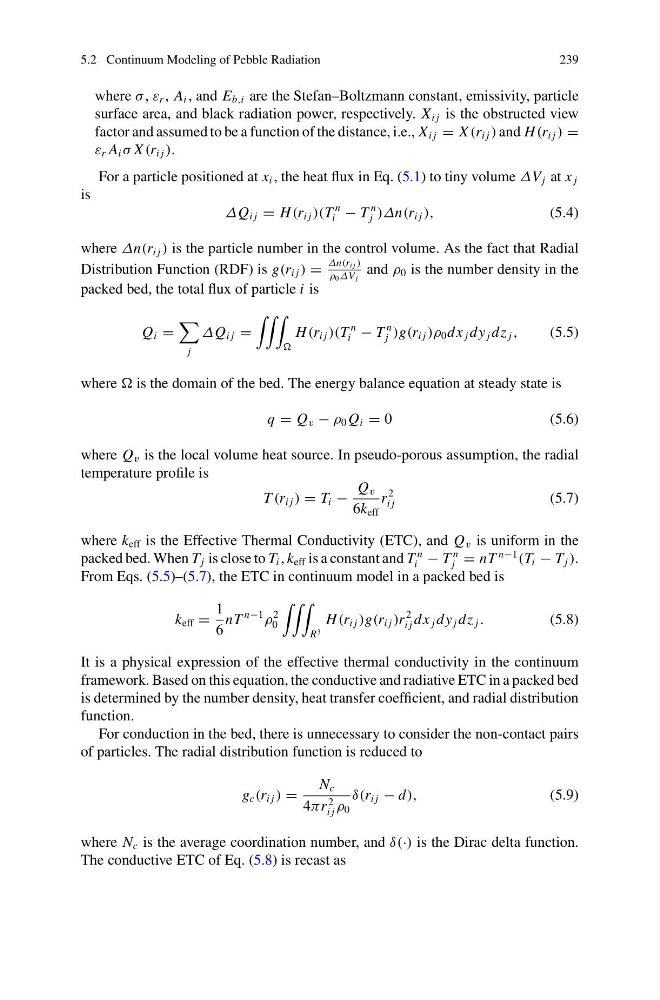
It is a physical expression of the effective thermal conductivity in the continuum
framework. Based on this equation, the conductive and radiative ETC in a packed bed
is determined by the number density, heat transfer coefficient, and radial distribution
function.
For conduction in the bed, there is unnecessary to consider the non-contact pairs
of particles. The radial distribution function is reduced to
g c (r i j ) =
N c
4πr
2
i j ρ 0
δ(r i j − d),
(5.9)
where N c is the average coordination number, and δ(·) is the Dirac delta function.
The conductive ETC of Eq. (5.8) is recast as
239
where σ , ε r , A i , and E b,i are the Stefan–Boltzmann constant, emissivity, particle
surface area, and black radiation power, respectively. X i j is the obstructed view
factor and assumed to be a function of the distance, i.e., X i j = X (r i j ) and H (r i j ) =
ε r A i σ X (r i j ).
For a particle positioned at x i , the heat flux in Eq. (5.1) to tiny volume ΔV j at x j
is
ΔQ i j = H (r i j )(T
n
i − T
n
j )Δn(r i j ),
(5.4)
where Δn(r i j ) is the particle number in the control volume. As the fact that Radial
Distribution Function (RDF) is g(r i j ) =
Δn(r i j )
ρ 0 ΔV j
and ρ 0 is the number density in the
packed bed, the total flux of particle i is
Q i =
j
ΔQ i j =
H (r i j )(T
n
i − T
n
j )g(r i j )ρ 0 dx j dy j dz j ,
(5.5)
where is the domain of the bed. The energy balance equation at steady state is
q = Q v − ρ 0 Q i = 0
(5.6)
where Q v is the local volume heat source. In pseudo-porous assumption, the radial
temperature profile is
T (r i j ) = T i −
Q v
6k eff
r
2
i j
(5.7)
where k eff is the Effective Thermal Conductivity (ETC), and Q v is uniform in the
packed bed. When T j is close to T i , k eff is a constant and T
n
i − T
n
j = nT
n−1
(T i − T j ).
From Eqs. (5.5)–(5.7), the ETC in continuum model in a packed bed is
k eff =
1
6
nT
n−1
ρ
2
0
R 3
H (r i j )g(r i j )r
2
i j dx j dy j dz j .
(5.8)
It is a physical expression of the effective thermal conductivity in the continuum
framework. Based on this equation, the conductive and radiative ETC in a packed bed
is determined by the number density, heat transfer coefficient, and radial distribution
function.
For conduction in the bed, there is unnecessary to consider the non-contact pairs
of particles. The radial distribution function is reduced to
g c (r i j ) =
N c
4πr
2
i j ρ 0
δ(r i j − d),
(5.9)
where N c is the average coordination number, and δ(·) is the Dirac delta function.
The conductive ETC of Eq. (5.8) is recast as