

216
4 Numerical Methods and Simulation for Pebble Flows
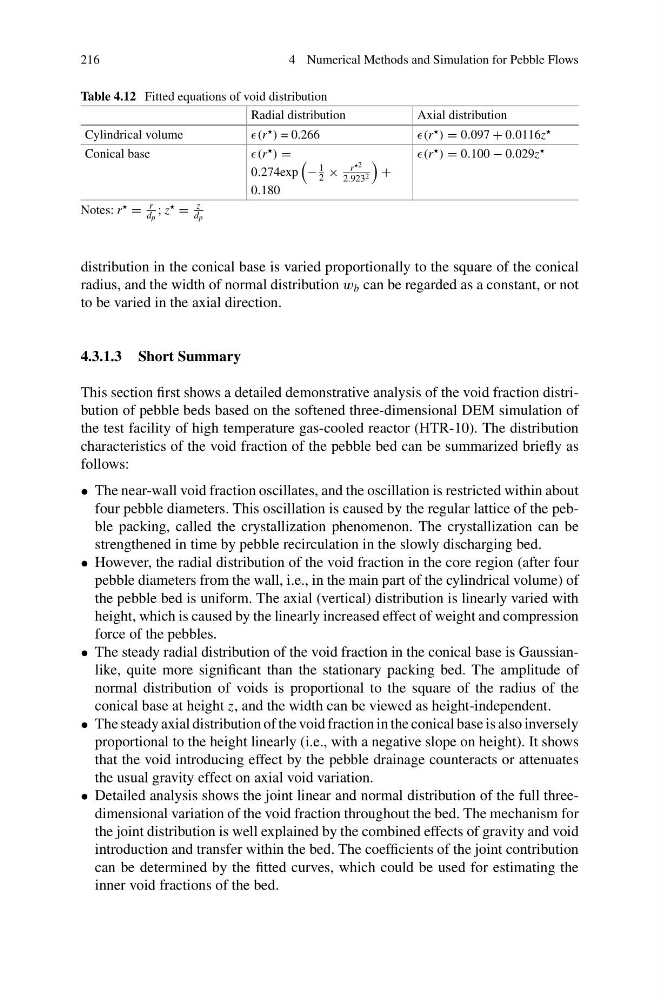
Table 4.12 Fitted equations of void distribution
Radial distribution
Axial distribution
Cylindrical volume
(r ) = 0.266
(r ) = 0.097 + 0.0116z
Conical base
(r ) =
0.274exp
−
1
2 ×
r 2
2.923 2
+
0.180
(r ) = 0.100 − 0.029z
Notes: r =
r
dp ; z =
z
dp
distribution in the conical base is varied proportionally to the square of the conical
radius, and the width of normal distribution w b can be regarded as a constant, or not
to be varied in the axial direction.
4.3.1.3 Short Summary
This section first shows a detailed demonstrative analysis of the void fraction distribution of pebble beds based on the softened three-dimensional DEM simulation of
the test facility of high temperature gas-cooled reactor (HTR-10). The distribution
characteristics of the void fraction of the pebble bed can be summarized briefly as
follows:
• The near-wall void fraction oscillates, and the oscillation is restricted within about
four pebble diameters. This oscillation is caused by the regular lattice of the pebble packing, called the crystallization phenomenon. The crystallization can be
strengthened in time by pebble recirculation in the slowly discharging bed.
• However, the radial distribution of the void fraction in the core region (after four
pebble diameters from the wall, i.e., in the main part of the cylindrical volume) of
the pebble bed is uniform. The axial (vertical) distribution is linearly varied with
height, which is caused by the linearly increased effect of weight and compression
force of the pebbles.
• The steady radial distribution of the void fraction in the conical base is Gaussianlike, quite more significant than the stationary packing bed. The amplitude of
normal distribution of voids is proportional to the square of the radius of the
conical base at height z, and the width can be viewed as height-independent.
• The steady axial distribution of the void fraction in the conical base is also inversely
proportional to the height linearly (i.e., with a negative slope on height). It shows
that the void introducing effect by the pebble drainage counteracts or attenuates
the usual gravity effect on axial void variation.
• Detailed analysis shows the joint linear and normal distribution of the full threedimensional variation of the void fraction throughout the bed. The mechanism for
the joint distribution is well explained by the combined effects of gravity and void
introduction and transfer within the bed. The coefficients of the joint contribution
can be determined by the fitted curves, which could be used for estimating the
inner void fractions of the bed.
4 Numerical Methods and Simulation for Pebble Flows
Table 4.12 Fitted equations of void distribution
Radial distribution
Axial distribution
Cylindrical volume
(r ) = 0.266
(r ) = 0.097 + 0.0116z
Conical base
(r ) =
0.274exp
−
1
2 ×
r 2
2.923 2
+
0.180
(r ) = 0.100 − 0.029z
Notes: r =
r
dp ; z =
z
dp
distribution in the conical base is varied proportionally to the square of the conical
radius, and the width of normal distribution w b can be regarded as a constant, or not
to be varied in the axial direction.
4.3.1.3 Short Summary
This section first shows a detailed demonstrative analysis of the void fraction distribution of pebble beds based on the softened three-dimensional DEM simulation of
the test facility of high temperature gas-cooled reactor (HTR-10). The distribution
characteristics of the void fraction of the pebble bed can be summarized briefly as
follows:
• The near-wall void fraction oscillates, and the oscillation is restricted within about
four pebble diameters. This oscillation is caused by the regular lattice of the pebble packing, called the crystallization phenomenon. The crystallization can be
strengthened in time by pebble recirculation in the slowly discharging bed.
• However, the radial distribution of the void fraction in the core region (after four
pebble diameters from the wall, i.e., in the main part of the cylindrical volume) of
the pebble bed is uniform. The axial (vertical) distribution is linearly varied with
height, which is caused by the linearly increased effect of weight and compression
force of the pebbles.
• The steady radial distribution of the void fraction in the conical base is Gaussianlike, quite more significant than the stationary packing bed. The amplitude of
normal distribution of voids is proportional to the square of the radius of the
conical base at height z, and the width can be viewed as height-independent.
• The steady axial distribution of the void fraction in the conical base is also inversely
proportional to the height linearly (i.e., with a negative slope on height). It shows
that the void introducing effect by the pebble drainage counteracts or attenuates
the usual gravity effect on axial void variation.
• Detailed analysis shows the joint linear and normal distribution of the full threedimensional variation of the void fraction throughout the bed. The mechanism for
the joint distribution is well explained by the combined effects of gravity and void
introduction and transfer within the bed. The coefficients of the joint contribution
can be determined by the fitted curves, which could be used for estimating the
inner void fractions of the bed.