

190
4 Numerical Methods and Simulation for Pebble Flows
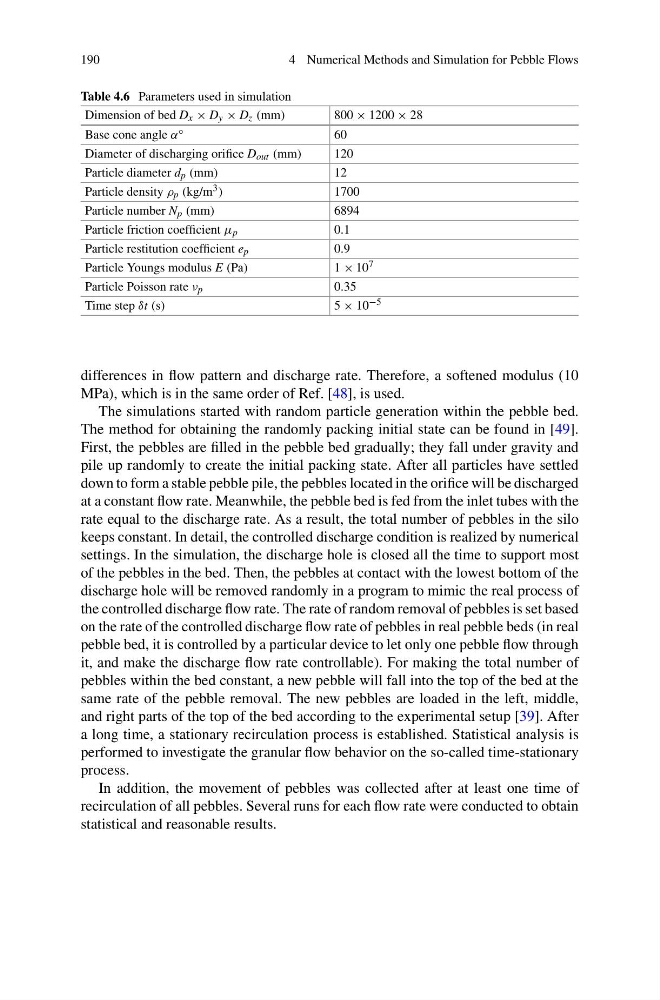
Table 4.6 Parameters used in simulation
Dimension of bed D x × D y × D z (mm)
800 × 1200 × 28
Base cone angle α ◦
60
Diameter of discharging orifice D out (mm)
120
Particle diameter d p (mm)
12
Particle density ρ p (kg/m 3 )
1700
Particle number N p (mm)
6894
Particle friction coefficient μ p
0.1
Particle restitution coefficient e p
0.9
Particle Youngs modulus E (Pa)
1 × 10 7
Particle Poisson rate ν p
0.35
Time step δt (s)
5 × 10 −5
differences in flow pattern and discharge rate. Therefore, a softened modulus (10
MPa), which is in the same order of Ref. [48], is used.
The simulations started with random particle generation within the pebble bed.
The method for obtaining the randomly packing initial state can be found in [49].
First, the pebbles are filled in the pebble bed gradually; they fall under gravity and
pile up randomly to create the initial packing state. After all particles have settled
down to form a stable pebble pile, the pebbles located in the orifice will be discharged
at a constant flow rate. Meanwhile, the pebble bed is fed from the inlet tubes with the
rate equal to the discharge rate. As a result, the total number of pebbles in the silo
keeps constant. In detail, the controlled discharge condition is realized by numerical
settings. In the simulation, the discharge hole is closed all the time to support most
of the pebbles in the bed. Then, the pebbles at contact with the lowest bottom of the
discharge hole will be removed randomly in a program to mimic the real process of
the controlled discharge flow rate. The rate of random removal of pebbles is set based
on the rate of the controlled discharge flow rate of pebbles in real pebble beds (in real
pebble bed, it is controlled by a particular device to let only one pebble flow through
it, and make the discharge flow rate controllable). For making the total number of
pebbles within the bed constant, a new pebble will fall into the top of the bed at the
same rate of the pebble removal. The new pebbles are loaded in the left, middle,
and right parts of the top of the bed according to the experimental setup [39]. After
a long time, a stationary recirculation process is established. Statistical analysis is
performed to investigate the granular flow behavior on the so-called time-stationary
process.
In addition, the movement of pebbles was collected after at least one time of
recirculation of all pebbles. Several runs for each flow rate were conducted to obtain
statistical and reasonable results.
4 Numerical Methods and Simulation for Pebble Flows
Table 4.6 Parameters used in simulation
Dimension of bed D x × D y × D z (mm)
800 × 1200 × 28
Base cone angle α ◦
60
Diameter of discharging orifice D out (mm)
120
Particle diameter d p (mm)
12
Particle density ρ p (kg/m 3 )
1700
Particle number N p (mm)
6894
Particle friction coefficient μ p
0.1
Particle restitution coefficient e p
0.9
Particle Youngs modulus E (Pa)
1 × 10 7
Particle Poisson rate ν p
0.35
Time step δt (s)
5 × 10 −5
differences in flow pattern and discharge rate. Therefore, a softened modulus (10
MPa), which is in the same order of Ref. [48], is used.
The simulations started with random particle generation within the pebble bed.
The method for obtaining the randomly packing initial state can be found in [49].
First, the pebbles are filled in the pebble bed gradually; they fall under gravity and
pile up randomly to create the initial packing state. After all particles have settled
down to form a stable pebble pile, the pebbles located in the orifice will be discharged
at a constant flow rate. Meanwhile, the pebble bed is fed from the inlet tubes with the
rate equal to the discharge rate. As a result, the total number of pebbles in the silo
keeps constant. In detail, the controlled discharge condition is realized by numerical
settings. In the simulation, the discharge hole is closed all the time to support most
of the pebbles in the bed. Then, the pebbles at contact with the lowest bottom of the
discharge hole will be removed randomly in a program to mimic the real process of
the controlled discharge flow rate. The rate of random removal of pebbles is set based
on the rate of the controlled discharge flow rate of pebbles in real pebble beds (in real
pebble bed, it is controlled by a particular device to let only one pebble flow through
it, and make the discharge flow rate controllable). For making the total number of
pebbles within the bed constant, a new pebble will fall into the top of the bed at the
same rate of the pebble removal. The new pebbles are loaded in the left, middle,
and right parts of the top of the bed according to the experimental setup [39]. After
a long time, a stationary recirculation process is established. Statistical analysis is
performed to investigate the granular flow behavior on the so-called time-stationary
process.
In addition, the movement of pebbles was collected after at least one time of
recirculation of all pebbles. Several runs for each flow rate were conducted to obtain
statistical and reasonable results.