

4.2 Gravity-Driven Flow Regime Characterization
187
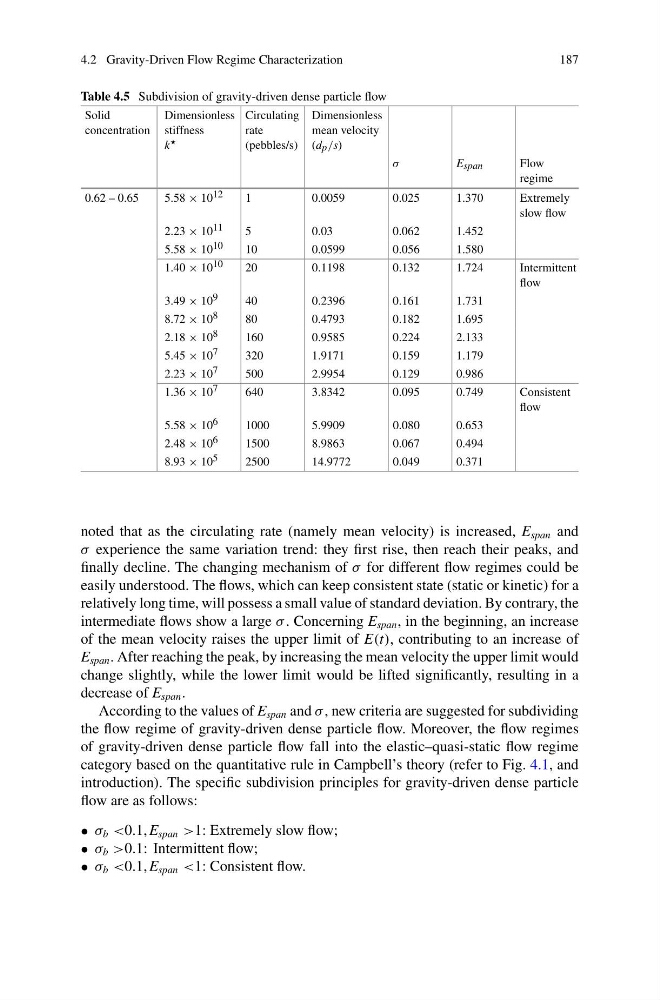
Table 4.5 Subdivision of gravity-driven dense particle flow
Solid
concentration
Dimensionless
stiffness
k
Circulating
rate
(pebbles/s)
Dimensionless
mean velocity
(d p /s)
σ
E span
Flow
regime
0.62 – 0.65
5.58 × 10 12
1
0.0059
0.025
1.370
Extremely
slow flow
2.23 × 10 11
5
0.03
0.062
1.452
5.58 × 10 10
10
0.0599
0.056
1.580
1.40 × 10 10
20
0.1198
0.132
1.724
Intermittent
flow
3.49 × 10 9
40
0.2396
0.161
1.731
8.72 × 10 8
80
0.4793
0.182
1.695
2.18 × 10 8
160
0.9585
0.224
2.133
5.45 × 10 7
320
1.9171
0.159
1.179
2.23 × 10 7
500
2.9954
0.129
0.986
1.36 × 10 7
640
3.8342
0.095
0.749
Consistent
flow
5.58 × 10 6
1000
5.9909
0.080
0.653
2.48 × 10 6
1500
8.9863
0.067
0.494
8.93 × 10 5
2500
14.9772
0.049
0.371
noted that as the circulating rate (namely mean velocity) is increased, E span and
σ experience the same variation trend: they first rise, then reach their peaks, and
finally decline. The changing mechanism of σ for different flow regimes could be
easily understood. The flows, which can keep consistent state (static or kinetic) for a
relatively long time, will possess a small value of standard deviation. By contrary, the
intermediate flows show a large σ . Concerning E span , in the beginning, an increase
of the mean velocity raises the upper limit of E(t), contributing to an increase of
E span . After reaching the peak, by increasing the mean velocity the upper limit would
change slightly, while the lower limit would be lifted significantly, resulting in a
decrease of E span .
According to the values of E span and σ , new criteria are suggested for subdividing
the flow regime of gravity-driven dense particle flow. Moreover, the flow regimes
of gravity-driven dense particle flow fall into the elastic–quasi-static flow regime
category based on the quantitative rule in Campbell’s theory (refer to Fig. 4.1, and
introduction). The specific subdivision principles for gravity-driven dense particle
flow are as follows:
• σ b <0.1, E span >1: Extremely slow flow;
• σ b >0.1: Intermittent flow;
• σ b <0.1, E span <1: Consistent flow.
187
Table 4.5 Subdivision of gravity-driven dense particle flow
Solid
concentration
Dimensionless
stiffness
k
Circulating
rate
(pebbles/s)
Dimensionless
mean velocity
(d p /s)
σ
E span
Flow
regime
0.62 – 0.65
5.58 × 10 12
1
0.0059
0.025
1.370
Extremely
slow flow
2.23 × 10 11
5
0.03
0.062
1.452
5.58 × 10 10
10
0.0599
0.056
1.580
1.40 × 10 10
20
0.1198
0.132
1.724
Intermittent
flow
3.49 × 10 9
40
0.2396
0.161
1.731
8.72 × 10 8
80
0.4793
0.182
1.695
2.18 × 10 8
160
0.9585
0.224
2.133
5.45 × 10 7
320
1.9171
0.159
1.179
2.23 × 10 7
500
2.9954
0.129
0.986
1.36 × 10 7
640
3.8342
0.095
0.749
Consistent
flow
5.58 × 10 6
1000
5.9909
0.080
0.653
2.48 × 10 6
1500
8.9863
0.067
0.494
8.93 × 10 5
2500
14.9772
0.049
0.371
noted that as the circulating rate (namely mean velocity) is increased, E span and
σ experience the same variation trend: they first rise, then reach their peaks, and
finally decline. The changing mechanism of σ for different flow regimes could be
easily understood. The flows, which can keep consistent state (static or kinetic) for a
relatively long time, will possess a small value of standard deviation. By contrary, the
intermediate flows show a large σ . Concerning E span , in the beginning, an increase
of the mean velocity raises the upper limit of E(t), contributing to an increase of
E span . After reaching the peak, by increasing the mean velocity the upper limit would
change slightly, while the lower limit would be lifted significantly, resulting in a
decrease of E span .
According to the values of E span and σ , new criteria are suggested for subdividing
the flow regime of gravity-driven dense particle flow. Moreover, the flow regimes
of gravity-driven dense particle flow fall into the elastic–quasi-static flow regime
category based on the quantitative rule in Campbell’s theory (refer to Fig. 4.1, and
introduction). The specific subdivision principles for gravity-driven dense particle
flow are as follows:
• σ b <0.1, E span >1: Extremely slow flow;
• σ b >0.1: Intermittent flow;
• σ b <0.1, E span <1: Consistent flow.