

4.2 Gravity-Driven Flow Regime Characterization
185
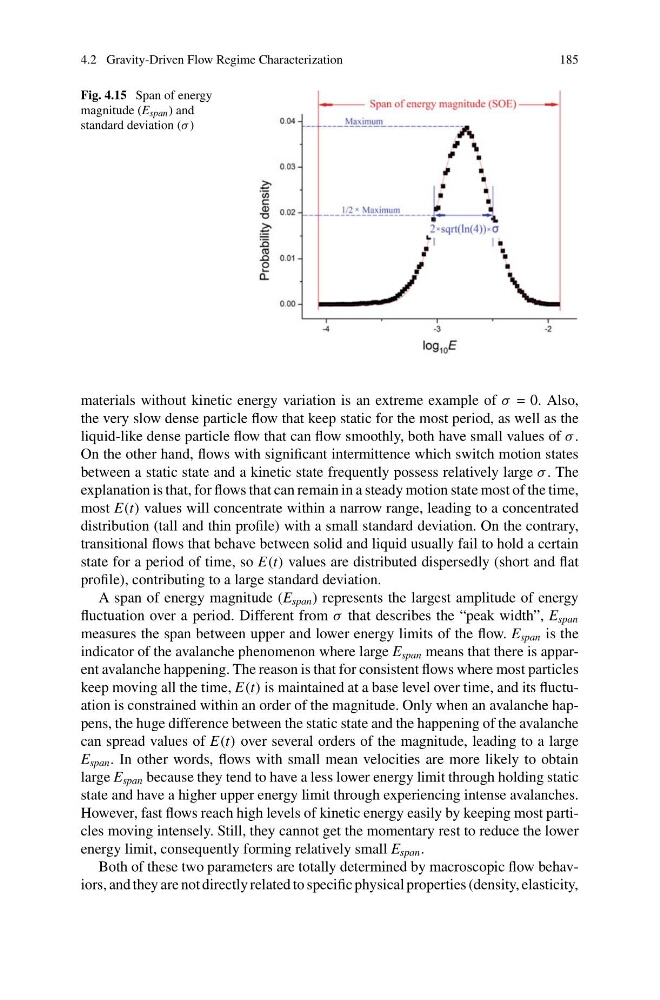
Fig. 4.15 Span of energy
magnitude (E span ) and
standard deviation (σ )
materials without kinetic energy variation is an extreme example of σ = 0. Also,
the very slow dense particle flow that keep static for the most period, as well as the
liquid-like dense particle flow that can flow smoothly, both have small values of σ .
On the other hand, flows with significant intermittence which switch motion states
between a static state and a kinetic state frequently possess relatively large σ . The
explanation is that, for flows that can remain in a steady motion state most of the time,
most E(t) values will concentrate within a narrow range, leading to a concentrated
distribution (tall and thin profile) with a small standard deviation. On the contrary,
transitional flows that behave between solid and liquid usually fail to hold a certain
state for a period of time, so E(t) values are distributed dispersedly (short and flat
profile), contributing to a large standard deviation.
A span of energy magnitude (E span ) represents the largest amplitude of energy
fluctuation over a period. Different from σ that describes the “peak width”, E span
measures the span between upper and lower energy limits of the flow. E span is the
indicator of the avalanche phenomenon where large E span means that there is apparent avalanche happening. The reason is that for consistent flows where most particles
keep moving all the time, E(t) is maintained at a base level over time, and its fluctuation is constrained within an order of the magnitude. Only when an avalanche happens, the huge difference between the static state and the happening of the avalanche
can spread values of E(t) over several orders of the magnitude, leading to a large
E span . In other words, flows with small mean velocities are more likely to obtain
large E span because they tend to have a less lower energy limit through holding static
state and have a higher upper energy limit through experiencing intense avalanches.
However, fast flows reach high levels of kinetic energy easily by keeping most particles moving intensely. Still, they cannot get the momentary rest to reduce the lower
energy limit, consequently forming relatively small E span .
Both of these two parameters are totally determined by macroscopic flow behaviors, and they are not directly related to specific physical properties (density, elasticity,
185
Fig. 4.15 Span of energy
magnitude (E span ) and
standard deviation (σ )
materials without kinetic energy variation is an extreme example of σ = 0. Also,
the very slow dense particle flow that keep static for the most period, as well as the
liquid-like dense particle flow that can flow smoothly, both have small values of σ .
On the other hand, flows with significant intermittence which switch motion states
between a static state and a kinetic state frequently possess relatively large σ . The
explanation is that, for flows that can remain in a steady motion state most of the time,
most E(t) values will concentrate within a narrow range, leading to a concentrated
distribution (tall and thin profile) with a small standard deviation. On the contrary,
transitional flows that behave between solid and liquid usually fail to hold a certain
state for a period of time, so E(t) values are distributed dispersedly (short and flat
profile), contributing to a large standard deviation.
A span of energy magnitude (E span ) represents the largest amplitude of energy
fluctuation over a period. Different from σ that describes the “peak width”, E span
measures the span between upper and lower energy limits of the flow. E span is the
indicator of the avalanche phenomenon where large E span means that there is apparent avalanche happening. The reason is that for consistent flows where most particles
keep moving all the time, E(t) is maintained at a base level over time, and its fluctuation is constrained within an order of the magnitude. Only when an avalanche happens, the huge difference between the static state and the happening of the avalanche
can spread values of E(t) over several orders of the magnitude, leading to a large
E span . In other words, flows with small mean velocities are more likely to obtain
large E span because they tend to have a less lower energy limit through holding static
state and have a higher upper energy limit through experiencing intense avalanches.
However, fast flows reach high levels of kinetic energy easily by keeping most particles moving intensely. Still, they cannot get the momentary rest to reduce the lower
energy limit, consequently forming relatively small E span .
Both of these two parameters are totally determined by macroscopic flow behaviors, and they are not directly related to specific physical properties (density, elasticity,