

164
4 Numerical Methods and Simulation for Pebble Flows
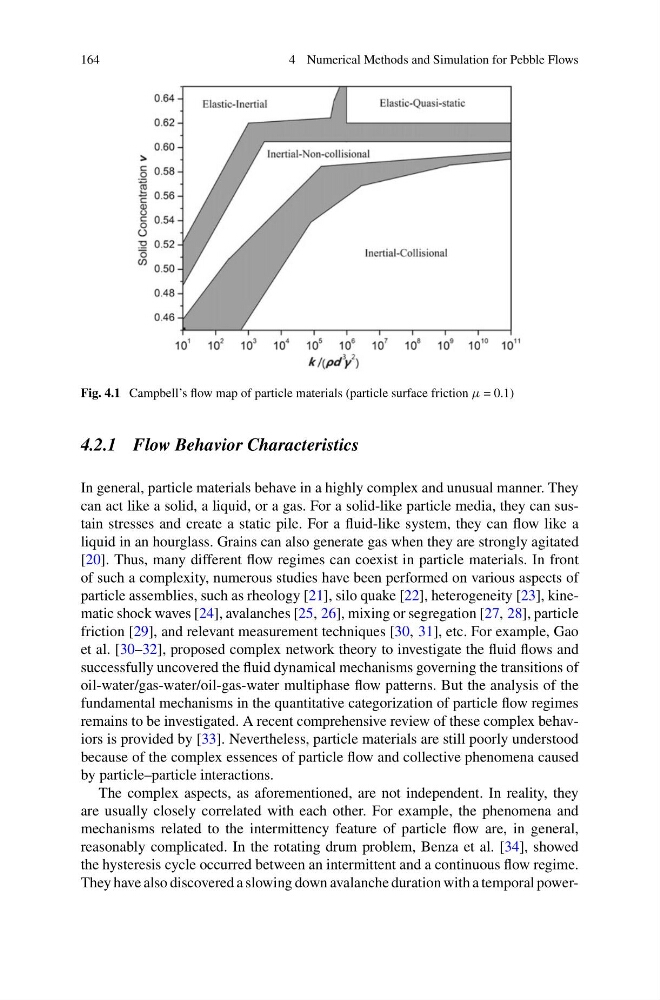
Fig. 4.1 Campbell’s flow map of particle materials (particle surface friction μ = 0.1)
4.2.1 Flow Behavior Characteristics
In general, particle materials behave in a highly complex and unusual manner. They
can act like a solid, a liquid, or a gas. For a solid-like particle media, they can sustain stresses and create a static pile. For a fluid-like system, they can flow like a
liquid in an hourglass. Grains can also generate gas when they are strongly agitated
[20]. Thus, many different flow regimes can coexist in particle materials. In front
of such a complexity, numerous studies have been performed on various aspects of
particle assemblies, such as rheology [21], silo quake [22], heterogeneity [23], kinematic shock waves [24], avalanches [25, 26], mixing or segregation [27, 28], particle
friction [29], and relevant measurement techniques [30, 31], etc. For example, Gao
et al. [30–32], proposed complex network theory to investigate the fluid flows and
successfully uncovered the fluid dynamical mechanisms governing the transitions of
oil-water/gas-water/oil-gas-water multiphase flow patterns. But the analysis of the
fundamental mechanisms in the quantitative categorization of particle flow regimes
remains to be investigated. A recent comprehensive review of these complex behaviors is provided by [33]. Nevertheless, particle materials are still poorly understood
because of the complex essences of particle flow and collective phenomena caused
by particle–particle interactions.
The complex aspects, as aforementioned, are not independent. In reality, they
are usually closely correlated with each other. For example, the phenomena and
mechanisms related to the intermittency feature of particle flow are, in general,
reasonably complicated. In the rotating drum problem, Benza et al. [34], showed
the hysteresis cycle occurred between an intermittent and a continuous flow regime.
They have also discovered a slowing down avalanche duration with a temporal power-
4 Numerical Methods and Simulation for Pebble Flows
Fig. 4.1 Campbell’s flow map of particle materials (particle surface friction μ = 0.1)
4.2.1 Flow Behavior Characteristics
In general, particle materials behave in a highly complex and unusual manner. They
can act like a solid, a liquid, or a gas. For a solid-like particle media, they can sustain stresses and create a static pile. For a fluid-like system, they can flow like a
liquid in an hourglass. Grains can also generate gas when they are strongly agitated
[20]. Thus, many different flow regimes can coexist in particle materials. In front
of such a complexity, numerous studies have been performed on various aspects of
particle assemblies, such as rheology [21], silo quake [22], heterogeneity [23], kinematic shock waves [24], avalanches [25, 26], mixing or segregation [27, 28], particle
friction [29], and relevant measurement techniques [30, 31], etc. For example, Gao
et al. [30–32], proposed complex network theory to investigate the fluid flows and
successfully uncovered the fluid dynamical mechanisms governing the transitions of
oil-water/gas-water/oil-gas-water multiphase flow patterns. But the analysis of the
fundamental mechanisms in the quantitative categorization of particle flow regimes
remains to be investigated. A recent comprehensive review of these complex behaviors is provided by [33]. Nevertheless, particle materials are still poorly understood
because of the complex essences of particle flow and collective phenomena caused
by particle–particle interactions.
The complex aspects, as aforementioned, are not independent. In reality, they
are usually closely correlated with each other. For example, the phenomena and
mechanisms related to the intermittency feature of particle flow are, in general,
reasonably complicated. In the rotating drum problem, Benza et al. [34], showed
the hysteresis cycle occurred between an intermittent and a continuous flow regime.
They have also discovered a slowing down avalanche duration with a temporal power-