

162
4 Numerical Methods and Simulation for Pebble Flows
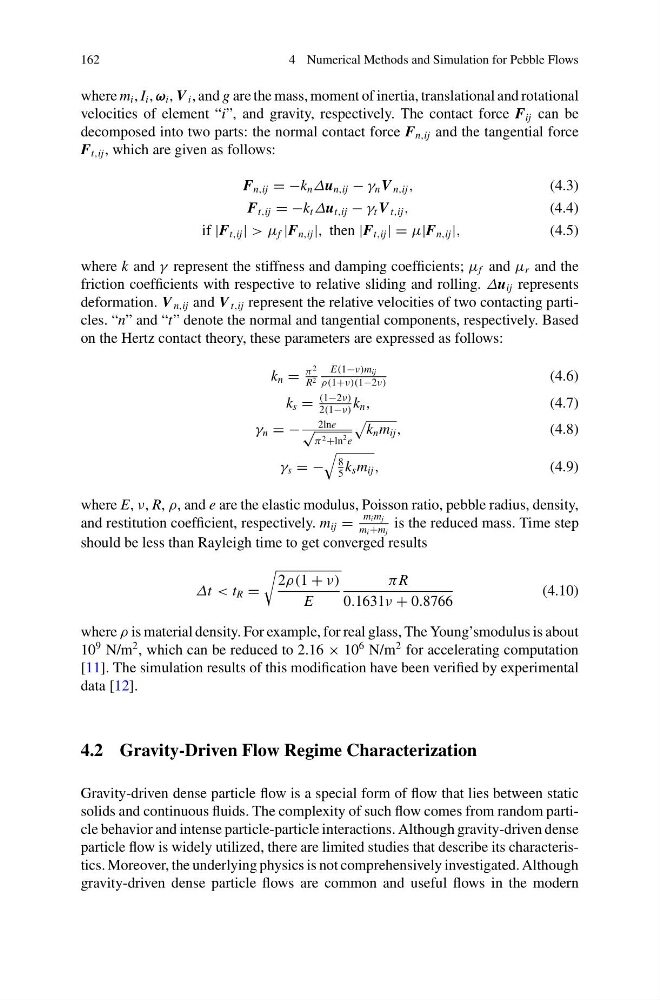
where m i , I i , ω i , V i , and g are the mass, moment of inertia, translational and rotational
velocities of element “i”, and gravity, respectively. The contact force F ij can be
decomposed into two parts: the normal contact force F n,ij and the tangential force
F t,ij , which are given as follows:
F n,ij = −k n Δu n,ij − γ n V n,ij ,
(4.3)
F t,ij = −k t Δu t,ij − γ t V t,ij ,
(4.4)
if |F t,ij | > μ f |F n,ij |, then |F t,ij | = μ|F n,ij |,
(4.5)
where k and γ represent the stiffness and damping coefficients; μ f and μ r and the
friction coefficients with respective to relative sliding and rolling. Δu ij represents
deformation. V n,ij and V t,ij represent the relative velocities of two contacting particles. “n” and “t” denote the normal and tangential components, respectively. Based
on the Hertz contact theory, these parameters are expressed as follows:
k n =
π
2
R 2
E(1−ν)m ij
ρ(1+ν)(1−2ν)
(4.6)
k s =
(1−2ν)
2(1−ν)
k n ,
(4.7)
γ n = −
2lne
√
π 2 +ln
2 e
k n m ij ,
(4.8)
γ s = −
8
5
k s m ij ,
(4.9)
where E, ν, R, ρ, and e are the elastic modulus, Poisson ratio, pebble radius, density,
and restitution coefficient, respectively. m ij =
m i m j
m i +m j
is the reduced mass. Time step
should be less than Rayleigh time to get converged results
Δt < t R =
2ρ(1 + ν)
E
π R
0.1631ν + 0.8766
(4.10)
where ρ is material density. For example, for real glass, The Young’smodulus is about
10
9 N/m
2 , which can be reduced to 2.16 × 10
6 N/m
2 for accelerating computation
[11]. The simulation results of this modification have been verified by experimental
data [12].
4.2 Gravity-Driven Flow Regime Characterization
Gravity-driven dense particle flow is a special form of flow that lies between static
solids and continuous fluids. The complexity of such flow comes from random particle behavior and intense particle-particle interactions. Although gravity-driven dense
particle flow is widely utilized, there are limited studies that describe its characteristics. Moreover, the underlying physics is not comprehensively investigated. Although
gravity-driven dense particle flows are common and useful flows in the modern
4 Numerical Methods and Simulation for Pebble Flows
where m i , I i , ω i , V i , and g are the mass, moment of inertia, translational and rotational
velocities of element “i”, and gravity, respectively. The contact force F ij can be
decomposed into two parts: the normal contact force F n,ij and the tangential force
F t,ij , which are given as follows:
F n,ij = −k n Δu n,ij − γ n V n,ij ,
(4.3)
F t,ij = −k t Δu t,ij − γ t V t,ij ,
(4.4)
if |F t,ij | > μ f |F n,ij |, then |F t,ij | = μ|F n,ij |,
(4.5)
where k and γ represent the stiffness and damping coefficients; μ f and μ r and the
friction coefficients with respective to relative sliding and rolling. Δu ij represents
deformation. V n,ij and V t,ij represent the relative velocities of two contacting particles. “n” and “t” denote the normal and tangential components, respectively. Based
on the Hertz contact theory, these parameters are expressed as follows:
k n =
π
2
R 2
E(1−ν)m ij
ρ(1+ν)(1−2ν)
(4.6)
k s =
(1−2ν)
2(1−ν)
k n ,
(4.7)
γ n = −
2lne
√
π 2 +ln
2 e
k n m ij ,
(4.8)
γ s = −
8
5
k s m ij ,
(4.9)
where E, ν, R, ρ, and e are the elastic modulus, Poisson ratio, pebble radius, density,
and restitution coefficient, respectively. m ij =
m i m j
m i +m j
is the reduced mass. Time step
should be less than Rayleigh time to get converged results
Δt < t R =
2ρ(1 + ν)
E
π R
0.1631ν + 0.8766
(4.10)
where ρ is material density. For example, for real glass, The Young’smodulus is about
10
9 N/m
2 , which can be reduced to 2.16 × 10
6 N/m
2 for accelerating computation
[11]. The simulation results of this modification have been verified by experimental
data [12].
4.2 Gravity-Driven Flow Regime Characterization
Gravity-driven dense particle flow is a special form of flow that lies between static
solids and continuous fluids. The complexity of such flow comes from random particle behavior and intense particle-particle interactions. Although gravity-driven dense
particle flow is widely utilized, there are limited studies that describe its characteristics. Moreover, the underlying physics is not comprehensively investigated. Although
gravity-driven dense particle flows are common and useful flows in the modern